
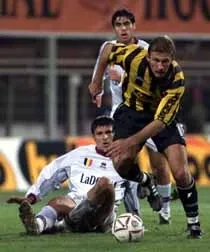
Shevchenko left Italy, and interest in that championship in general and Milan in particular instantly dropped in Ukraine. But the shares of the English Premier League and London's Chelsea immediately rose. True, if in Italy the captain of the Ukrainian national team delighted with goals and excellent play, then in England his adaptation process dragged on. Andriy regularly appears on the field, but scores much less often than his partner Didier Drogba. And much less than his own self at Milan.
Because of this, British journalists, who love all kinds of exposés, immediately began to calculate Roman Abramovich's losses and compile rankings of the most unjustified purchases with Shevchenko at the top. It got to the point that talk surfaced about a possible loan of the Ukrainian striker to… Milan, and in the Italian club itself this even caused a split, since one part of the players does not want Shevchenko's return, the other is not against his arrival.
Andriy Voronin is also not making us very happy, whose club — Bayer Leverkusen — performs very inconsistently both in the German Bundesliga and in the UEFA Cup. Although, of course, "Voronin is not making us happy" is a purely superficial opinion. In fact, Andriy is among the top ten footballers in the Bundesliga in such an important performance indicator as "goal plus assist", and at Bayer Voronin is the best of all. And the German press ratings are quite good.
But, by and large, both Andriys — Shevchenko and Voronin — have accustomed us to higher statistics, more effective and bright play. And while both are going through a kind of transitional phase in their careers (Voronin may soon swap Germany for Spain or Italy), the midfielder of Dutch Groningen, Yevhen Levchenko, has unexpectedly come to the fore among Ukrainian legionaries.
In Ukraine, they got to know this guy more closely relatively recently, although in January 2007 he will turn 29, and he played for the youth and national teams of Ukraine. However, even this "closer acquaintance" still resembles a nodding acquaintance. Many know that Levchenko has scored several goals in the current Dutch championship, but few will say what position he plays, which clubs he played for before, where he was born, what his interests are. The thing is, Zhenya suddenly started scoring a lot, and if in the ordinary world you are judged by your clothes, then in the world of football — by the number of goals. So it is not surprising that as soon as Levchenko for some time entered the list of top scorers of the Dutch championship, interest in him sharply increased.
But at the same time, the Ukrainian midfielder reacts quite calmly to everything that is happening: "Yes, this is a personal scoring record in all my years playing in the top division of the Dutch championship. But I scored most of the goals from penalties, which I started to be entrusted with taking after our regular penalty taker Cornelisse let Groningen down in the UEFA Cup and we were eliminated. Moreover, it is wrong when a midfielder is the team's top scorer. Our coach Ron Jans also says that. Like, if Levchenko remains first in scoring, then we are playing and training incorrectly. Because everyone must perform their functions. Midfielders — to tackle and intercept balls, give passes and only then threaten the goal. And being on the front line is the lot of forwards."
Now at Groningen, things seem to be gradually improving. The team remains among the leaders, although they still play extremely inconsistently, alternating bright victories with equally bright defeats, and Levchenko, who has scored seven goals in all tournaments this season, has been overtaken in the club's scoring list by the 32-year-old Norwegian Erik Nevland. That same striker who at one time wore the Manchester United jersey. The Scandinavian has eight accurate strikes, two less than the 19-year-old Uruguayan Luis Suárez, who is considered a very promising forward.
And yet, had the situation not turned out this way, it is unlikely that Levchenko's stable play in midfield would have been noted by specialists in Ukraine. After all, currently in Italian Ascoli, playing in Serie A, another native of our country, 23-year-old Viktor Budyanskyi, plays 90 minutes on the field. But he does not score goals, so domestic coaches are skeptical about the guy. And in vain.
However, let us return to Levchenko. The increased scoring (Zhenya has scored more this season than Shevchenko or Voronin in their teams) of the midfielder forced the head coach of the Ukrainian national team, Oleh Blokhin, to state that his assistants will be watching the "Dutchman". Oleh Volodymyrovych often claims that the pool of candidates for the national team is rather narrow, so ignoring a guy who regularly and decently plays in one of the most developed championships is somehow illogical.
Although there is one nuance that does not allow us to say with 100% certainty that the Ukrainian national team can count on Levchenko. He, having lived 11 years in the Netherlands, has two passports — of that country and Ukrainian. That would be fine, but our legislation does not allow a citizen of Ukraine to hold a passport of another country. And it is better not to joke with FIFA or UEFA. Those organizations would not hesitate to apply serious punishment to Ukraine if it is discovered that a player who was not allowed to do so played for our team. Several years ago, when Oleh Blokhin invited Oleh Yashchuk from Brussels' Anderlecht to the Ukrainian national team, the Belgians immediately filed a protest, saying he had a Belgian passport. And our side had to back down.
But Levchenko turned out to be more far-sighted than Yashchuk. He addressed his problem to the Dutch football players' union, the officials of that organization sent a request to UEFA, from which the answer came: 'Levchenko is not prohibited from playing for the Ukrainian national team.' And in fact, the European football federation does not care whether the footballer violated Ukrainian legislation or not. If by a decree of the President of Ukraine, Levchenko were deprived of our citizenship, then perhaps he would not be allowed to play for the national team of his homeland. But as long as he has his passport, what's the problem?
Is it worth giving up such a footballer, who for the sake of a chance to get into the national team of his country, conducted his own investigation? Do we have many such literate and patriotic guys? Another in his place, having a house in Groningen and a Dutch passport in hand, would be idle and enjoying life. Levchenko is not like that. He is ready to arrive at the national team at the first call – whether on foot or on a bicycle popular in the Netherlands.
And in general, Zhenya does not lose touch with his homeland and even plans to open a shelter for orphans in Ukraine, involving acquaintances and the management of Groningen. His parents live in Donetsk.
The footballer Levchenko left the Donetsk club 'Garant' at a young age for Moscow, to CSKA. At 18, he first made it into the main squad of the army team, but in the same 1996 he moved to Holland, to Vitesse from Arnhem. Things did not go well at first. The adaptation dragged on, and the attitude towards the guy 'from somewhere in Russia' was not the friendliest. 'It got to the point that the answer to your greeting was silence,' recalls Zhenya. 'I saw a lot at Vitesse. Sometimes even the coaches would pass by without greeting. At Groningen, the group is excellent, and the coach is wonderful.'
Perhaps because of this, the Ukrainian midfielder failed to immediately succeed at Vitesse. In the very first season after playing for the second team, he had to go on loan to a lower-ranked club – Helmond Sport. There he managed to play and score four goals in 15 matches, but Vitesse again did not accept him, sending him on loan to another club – Cambuur from Leeuwarden. A so-so little team, but they played in the elite division. And Levchenko played 41 matches and scored two goals over two seasons, and from there he was invited to the Ukrainian youth national team, for which he played three matches.
Unfortunately, Cambuur were relegated to the lower division and could not find the funds to buy out Levchenko's contract, so in 2000 Zhenya again returned to Arnhem. There, only by the summer of 2002, when the team was headed by the coach under whom the Ukrainian had played for the reserves, he earned a place in the main squad. In 2003, the Ukrainian left Vitesse and went to Sparta from Rotterdam, which played in the first division, not the elite division, where he finally found stability. Over two championships – 70 matches and 11 goals, and with these statistics in 2005 he received an offer from Groningen. And he does not intend to leave this city or this team.
'Why?', the footballer answers a question with a question. 'One doesn't look for good from good. I am happy here, we have a good team, great fans. I could go somewhere to earn money, but that's closer to the end of a football career. With Groningen, we can achieve high positions, compete for a spot in European competitions. This season we are playing stronger than last. We now have better balance, more mature football. It's certainly difficult to compete with PSV, Ajax, and AZ, but with Twente, Roda, Feyenoord, and Heerenveen, it's quite within our power.'
In Holland, Levchenko has long settled in, as he is fluent in both English and Dutch. He lives with a girl who was also born in Ukraine, and in Holland she studies and simultaneously acts in films (a link to her internet page can be found on Zhenya's personal website – www.levchenko.nl).
Levchenko also does not ignore Ukrainian football. He worries that a lot of frankly weak foreign players come to our country: 'To be honest, it's a pity for our championship. In any country, foreigners are treated with caution and jealousy; I felt this myself. But here we have total hospitality. When I finish my career, I'll take up solving this issue (laughs). It's time to move from quantity to quality.'
At Donetsk's Shakhtar, the club academy for reserve training is headed by the Dutchman Henk van Stee – a very respected specialist who worked a lot at Feyenoord. But there are only a few like that. In Alchevsk, another Dutchman – Ton Kaanen – manages Stal. To be honest, I haven't heard anything about him here, although I have lived in Holland for 11 years. Or take another Dutchman – the striker Bito, who also plays in Alchevsk. In our Rotterdam Sparta, he mostly sat on the bench because he ran fast but played so-so at football. And how about Jordi Cruyff, who seemingly had already ended his career, but then suddenly accepted an offer from Donetsk's Metalurh? In Holland, many could not understand what influenced him so much, but when I named the approximate salary of the son of the famous Johan Cruyff, the guys' eyes popped out. They wouldn't mind earning that much either...'
Stories from Levchenko
'There are many dark-skinned people in Holland. For the most part, they are Dutch. It is clear that they or their ancestors came to the Netherlands from numerous colonies (mostly from Suriname). The attitude towards them in the country is, in principle, normal, but racism flourishes at stadiums.'
At some stadiums, even their own footballers get it full force. There was, for example, a very good striker in Utrecht, Rodney Cairo, a Surinamese. As soon as he made a mistake, the entire stadium would start chanting: 'U! U! U! U! U!' In the end, he couldn't take it and left the club.
And in Rotterdam, Feyenoord fans have a special way of greeting Amsterdam's Ajax. They are irreconcilable enemies, a Dutch derby. As soon as Ajax players run out of the tunnel, the stands at De Kuip start hissing: "S-sss-s-sss-s! S-sss-sss-sss! S-sss-sss-sss!"
At first I didn’t understand anything, but after the game I asked my friend from Feyenoord, Paul Bosvelt, what it meant. It turns out, since Ajax is considered a Jewish club, this hissing is meant to remind them of the gas being released in the gas chambers of concentration camps. Absolutely horrifying, but year after year Ajax encounters this hissing in Rotterdam.