
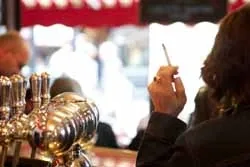
The new law prohibits smoking in all public places. If it can be applied in practice, then the smoke-filled bars will become zones of clean air. But omens suggest otherwise: since 1561, when King Charles IX's ambassador Jean Nicot brought tobacco to France, all attempts to force the French to give up this potion have failed.
Warnings from doctors and tax increases have not yielded results. Cafe and restaurant owners often ignored the law passed in 1991, which required setting aside separate areas for non-smoking customers. Although 65,000 French people die annually from tobacco addiction and related diseases, many residents of the country continue to consider this habit a sign of refinement, chic, and romance. They point out that most iconic figures of French civilization - from Jean-Paul Sartre to Brigitte Bardot - were smokers. Politicians who demand giving up the harmful habit are considered hypocrites by the French. The law was being prepared under President Jacques Chirac, who, as is well known, did not go to sleep without making sure there was a pack of cigarettes on his nightstand.
Nicotine addiction remains widespread among young people. For French teenagers, especially those raised in bourgeois environments, smoking is as much a test of adulthood as declaring oneself a Trotskyist or buying a moped. According to estimates, more than half of those aged 15 to 25 today smoke - the highest rate in the European Union.
All efforts to wean them off the harmful habit have so far had no effect. Several years ago, an expensive public campaign with football fans' idol Zinedine Zidane ignominiously failed after Zizou was photographed behind the stadium while taking a drag on a cigarette.
“In fact, the government has simply shifted this problem onto us,” says René Le Pap, president of the Paris-based Union of Cafe Owners, which has 19,000 members. “They want to look socially responsible, but they don’t understand how a cafe works and why people come here. Smoking is part of French life. We have already lost thousands of traditional cafes. Now we want to finish off the rest?”
Such appeals have a strong public resonance. Although public opinion polls initially showed that the majority of French people were loyal to the ban, today support for the law is waning. Intellectuals quote the words of Jean Claude Blondel, manager of the venerable Cafe de Flore on the Left Bank of the Seine, where philosophers gathered: “Smoking and thoughts share a common history.”
“This world is collapsing,” worries novelist Philippe Delerm on the pages of Le Monde. “Once it seemed that intellectual life, denunciations, and seductions could only exist in clouds of tobacco smoke. There was such a time. Smoking kills, but life also kills in the same inscrutable way.”
“Look at old photographs,” adds Blondel. “Sartre, de Beauvoir, Colette, Camus - they all smoked.” And it is true, although at a recent exhibition dedicated to Sartre's work, the name of his favorite brand of cigarettes was painted over - that was a condition of state funding for the exhibition.
From the perspective of heavy smokers, such tactics are typical of a government in despair. They say that both the size and strength of the most popular cigarettes in France have been quietly but steadily decreasing over the years, and the cigarettes sold today are just pale copies of the old ones. In the 1950s, the state monopoly Seita made Gauloises cigarettes from Paraguayan, Syrian, and Turkish tobacco with a tar content of 35 mg. Today, only a few are alive who can testify to their taste, although looking at the black ceilings of old Parisian bars, one can imagine what they did to the lungs. The tar content in modern cigarettes does not exceed 1 mg.
So, the bets are placed. The government promises to monitor compliance with the law, and it has a whole army of inspectors who will conduct random checks and issue fines. Health Minister Roselyne Bachelot-Narquin stated: “It is time to enforce this ban. It has already been introduced in Britain and Italy. This process is spreading in the USA. We must keep up.”
However, there are signs that the government of Nicolas Sarkozy - a big fan of Cuban cigars - is already backtracking. Ms. Bachelot-Narquin recently softened the proposed measures, allowing smoking in isolated areas of cafes, as well as on terraces and under awnings of restaurants. At the same time, the uncertainty of the concept of an “isolated area” may lead to legal conflicts. It is expected that owners of large bars and cafes will be able to set up isolated rooms inside the establishment. “We are developing a new concept - it will be a luxury room for VIPs, something like a club,” says Thierry Chevrin, press secretary of Eichenglaud, one of the companies that decided to take advantage of the loophole left. “We will make these rooms very popular. For us, this is a fantastic chance.”
Serge Gainsbourg, a well-known figure of the Parisian bohemia, shortly before taking his last drag in life, said that God was a smoker. This point of view, of course, needs verification. But for now, supporters of the smoking ban would consider themselves lucky if the smoke clears even a little, and they can make out who is a smoker and who is not.
William LANGLEY.
Translation by Gzt.ru