
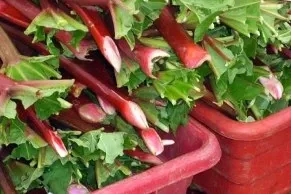
Britons refuse to buy German 'Rabarbar', passed off as the beloved English rhubarb
The product's popularity peaked in recent years, when it was proven that rhubarb contains a huge amount of antioxidants capable of preventing the appearance of cancerous tumors. Moreover, British scientists claim that the concentration of antioxidants significantly increases when rhubarb is heat-treated.
At the end of last year, Yorkshire farmers announced an unprecedented harvest of rhubarb, and one of Britain's largest supermarket chains, Waitrose, prepared a series of promotional clips in which famous chefs and show business stars shared their rhubarb pie recipes. All this took place against the backdrop of a noisy campaign to promote English cuisine, and housewives eagerly awaited the start of the new culinary season.
When the first batches of rhubarb arrived on supermarket shelves at the end of March, a scandal erupted that shook the entire kingdom. It turned out that the unprecedented harvest that farmers had talked about was almost destroyed by record frosts that unexpectedly hit early spring.
Despite this, the management of Waitrose decided to continue the aggressive advertising campaign, and rhubarb was imported from Germany. British farmers accused the supermarket of undermining the product's reputation, as the German 'Rabarbar' turned out to be grown in greenhouses using gibberellic acid.
"Rhubarb containing additional acids has a completely different taste than ours," lashed out at the supermarket English cuisine icon Delia Smith, whose family has been growing rhubarb for several generations. "Why continue this advertising campaign when it became clear that there would be no real rhubarb this year?"
Carmen Kirsing.
Russkaya Germaniya