
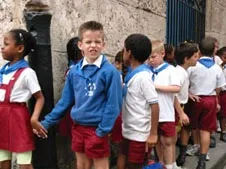
For the best education in all of Latin America, Cuba received a UNESCO award
Bodily Food
Cuba has huge citrus plantations, from which harvest is taken twice a year. The plantations are state-owned. When asked what would happen if one stopped on the road and picked an orange, Cubans reply: "Execution." (A joke.) On the other hand, for a country where, apart from oranges, pineapples, tomatoes, sweet potatoes, cucumbers, mangoes, bananas and much else ripen twice a year, there are extremely few vegetable shops, and its residents consume very little fresh fruit.
Cuba has a ration card system, which involves giving out a certain amount of several food items, such as flour, rice and sugar, for free. Children, the elderly, the sick and pregnant women are guaranteed meat at subsidized prices. The regular price of meat varies depending on type and cut from half a dollar to one and a half dollars per pound. In addition, the state provides every child under six with a liter of milk a day.
A standard Cuban breakfast consists of a cup of cocoa or coffee with a piece of bread. For lunch one gets a plate of black beans or rice; for dinner, rice and beans can be mixed, and that already makes the favorite national dish. Between meals, if desired, one can have coffee with cookies. All food is washed down with water, which can be drunk straight from the tap, and not at all rum, as one might think. There is, of course, plenty of rum here. But as for national drinks, these are by no means the famous cocktails "Cuba Libre", "Mojito" or "Daiquiri" offered to tourists, but "Guarapo" – a mixture of cane syrup squeezed right there from sugar cane, and rum. There are two kinds of "Guarapo". The popular one – without rum, and Guarapo criollo – with rum. By the way, the "Margarita", which is not a national drink, is prepared correctly only in Cuba, by adding freshly purified water straight from the ocean to the drink, rather than a diluted concentrate, since sea water spoils within a day.
Spiritual Food
Cuba has the best education in all of Latin America, for which the country has a UNESCO award. Every two years, teacher congresses are held here, at which those working in the system can exchange experience and developments. All education, from kindergartens right up to higher education, is free. Children join the pioneers in the first grade. The rules are roughly the same as those once held by their Soviet "colleagues" – help adults, study well, do not be late. Ties are given out at school. If you lose your tie, a fairly serious scolding awaits. However, they won't execute you – they will give you a new one. From grades 1 to 4, children wear blue ties, from grades 6 to 11 – red ties. Children are accepted into the preparatory class from the age of five, but they are not accepted into the pioneers.
Secondary schools are located in the countryside, where teenagers – boys and girls – live in one building, and study in a neighboring building. This is done so that children can help adults on the plantations (two to three hours a day) in their free time from studying. Supervision over them is minimal, and Cubans often joke that kindergartens should be built next to school buildings.
After school, all boys go straight into the army, where they serve for two to three years depending on the branch of service. Recently, girls have also been taken into the army, but exclusively on a voluntary basis. In 1994, the budget funds allocated to the army were cut by 50%, but the exact figures are strictly classified.
After the revolution, one of Cubans' favorite expressions became "struggle of ideas". A vivid confirmation of this was a museum created in 2001 and dedicated to the story of seven-year-old Elián González, and the central theme of the exhibition was the long struggle for his return to Cuba from Miami. Elián's mother and several other Cubans died trying to reach the "capital" of Cuban emigrants in America, and the boy was saved and taken in by relatives in Miami. But his father remained on the island, which zealously set about reuniting this incomplete family. As a result, Elián's return to his father was regarded by Havana as a moral victory over the United States, and the idea of saving the child turned into a political act.
Besides the "Museum of Struggle of Ideas", in Cuba one can find a school of the same name, a model school that was built several years ago. It has a computer class without the Internet, television and video equipment, an intercom (no one understands why, since the whole school can be walked at a slow pace in four minutes), a sports class. The school is more like a kind of half-boarding school; about 90% of children spend the whole day here, going home only to sleep. They also have lunch here (mostly the same black beans, rice and water). English is taught from the fifth grade. The school is designed for 180 people, but for less gifted children there is another, simpler one in the countryside, since education in Cuba is part of the compulsory program.
The main idea of the "Struggle of Ideas" is best explained by the school director. He says that from the US side, via online radio there is constant propaganda directed against Cuban socialism, and citizens need to understand that the struggle for Cuba's independence continues, that unity is necessary, and that Cubans are on the right path. In this regard, every day there are political information sessions for adults on television, and in the morning parents and teachers retell what they heard to the children. Due to the absence of advertising and entertainment shows, educational programs, which occupy more than 60% of airtime, cost two to three times more than in other countries. The favorite cartoon of Cuban children is about a short, stocky, clever boy El Pirio Valdes – a fighter for freedom and independence.
Treatment by Kisses
在古巴约有80万名医生。所有医疗服务,直到最复杂的手术,都是免费的。任何疾病都可以去综合诊所就医。诊所设备齐全,化验室每天工作八小时,而且一个必备的室内陈设是一台锁在柜子里的电视机。只有在转播总司令讲话时才打开它。综合诊所数量不算多,但城市里通常还有几个医疗站,而且几乎每个区域都有一名家庭医生,通常就住在这里。据统计,95%的古巴居民由家庭医生照看。
要成为医生,需要读完大学——六年,之后还要用三年时间进行专科训练。古巴医生不断完善自己。总的来说,当地医疗体系被认为非常成功。古巴每年向发展中国家派遣数千名医生。难怪正是在这座岛上,约18万名切尔诺贝利儿童得到了康复治疗,他们至今仍免费来到这里。只有在古巴,他们才能获得治疗,有时包括肝脏和骨髓移植等复杂手术。
有句谚语:“古巴医生用亲吻治病”——这意味着对病人健康非常关心、非常体贴的态度。其结果是,古巴是世界上预期寿命最高的国家之一——76岁。
腹腔镜手术让古巴外科医生闻名世界。此外,这里还开发了溶解血栓和预防心肌梗死的独特方法。每年大约进行3万例白内障摘除手术(相比之下,邻国委内瑞拉只有143例)。
女子拳击
在古巴,为全体居民创造了从事体育和健身的一切条件。拉丁美洲任何国家,包括巴西,都没有类似的条件。最受欢迎的运动是拳击和棒球,卡斯特罗还是美国学生时就非常热衷于此。在棒球方面,古巴人24次成为世界冠军。至于拳击,有许多专门学校,那里的教师挑选最有天赋的孩子。不久前甚至出现了女子拳击训练班。
几乎任何一场体育赛事都可以免费入场。国家比赛除外。这里实行优先权和门票制度。换句话说,只有工作最出色的人才能去看最有趣的体育比赛,这由工作单位或社区的共产主义会议决定。此外,劳动模范还可以指望获得疗养院和度假屋的名额。
平均来说,劳动英雄每月大约能看一场比赛。有时菲德尔本人也会出现在体育场。
革命首都和殖民主义残迹
很明显,大多数关于海滩度假的广告和海报都是在古巴拍摄的。不是因为便宜。只是没有哪个国家有这种不真实的蔚蓝或碧绿的海水,以及如此纯净的白沙。只是古巴人自己看到当地美景的机会远少于外来游客。社会主义制度要求所有人辛勤劳动,而首都居民却千方百计地避免这一点。
由于古巴的平均工资是15美元,养老金是2美元,首都居民只能设法生存。在闷热潮湿的暑气中逐渐衰败的哈瓦那,既带有殖民地风格又带有美国风貌,令所有人无法无动于衷。贫困和更加贫困的街区、警察对地下雪茄贩子的突袭、男女妓女……皮条客们全天候以10到50美元的优惠价格提供她们。克里奥尔服装和舞会礼服与几件破旧衣衫并肩而立,异口同声地用各种语言说着背熟的话:“老爷,给点吃的吧。我的孩子快饿死了。”与此同时,富有同情心的游客会被偷偷地搜刮走所有值钱的东西——从相机到钱包和项链。这一切都发生在无处不在的卡斯特罗的严密监视之下。
顺便说一句,古巴人谈到他们的领袖时,往往就像伊拉克人在与美国人开战前谈论萨达姆·侯赛因一样:“我们不能告诉您菲德尔现在住在哪里。不是因为不想说。只是出于安全考虑,他从不在同一个地方过夜。针对他的暗杀超过600次。我们甚至有一座‘暗杀博物馆’。所以没人知道他在哪里过夜。”
事实上,菲德尔·卡斯特罗一直住在哈瓦那的同一所房子里。
永恒的菲德尔
菲德尔·卡斯特罗是一位伟大的表演家和政治家。他开一辆不起眼的汽车,住在一间乍看之下非常普通的公寓里,几乎没有警卫。其实警卫是有的,只是只有在紧急情况下才看得见——只要有一点点危险,总司令就会置身于职业保镖的包围圈中。
菲德尔真诚地信任大部分民众。他甚至允许马坦萨斯-巴拉德罗度假区的渔民携带步枪出海捕鱼。而正是这些城镇距离迈阿密最近——只有180到200公里。
菲德尔睡得少,吃得少,似乎休息对他来说就是当地电视不停直播(或录播)的两三个小时的演讲。这时,悬挂着“革命”横幅的代表大会宫的讲台变成了一座独角戏剧场,卡斯特罗在那里讽刺美国敌人,谈论国家的新成就,并嘲笑敌对媒体关于他的报道。
The people mostly reciprocate the leader's feelings. "If Fidel himself has no desire to flee from the socialist paradise, then others should think twice," such words can be heard quite often. 95% of the population votes for the head of Cuba in every election, and the opposition, if it exists at all, is completely invisible. At the same time, Fidel himself does not hide that there are political prisoners in Cuban prisons - around 377 people, and people say that he skillfully solved the AIDS problem by sending all infected women to the Guantanamo area.
No one can give the exact number of Fidel Castro's children. Officially, he was married four times and acknowledged the same number of children. But none of them went into politics. Nor did the children of his fallen comrade-in-arms Che.
Hero for sale
Ernesto Guevara de la Serna (Che) Guevara is a great romantic and a great Cuban hero. Every government institution has his (or Fidel Castro's) portrait with the mandatory slogan Hasta la victoria siempre - "For victory until the end." At every crossroads there are T-shirts, berets, CDs - all the paraphernalia with the mandatory star and Che. Tourists buy them readily. However, in residential buildings and on Cubans themselves (unless they are in a tourist area), images of Che are rarely seen. Even Fidel, in his multi-hour speeches, does not mention him unless asked separately.
Nevertheless, the family of the "legend" still lives in Cuba today - his widow and four children. None of them take part in political struggle; they all have civilian professions. If you really want to, you can even meet them, but it's unclear what to talk about. After all, his offspring simply have no memories of their father. Even the eldest daughter almost never saw the legendary revolutionary, and the younger ones live only on official historical memory.
By the way, they almost never agree to take people to Santa Clara, the place where the idol of millions rests in a mausoleum. They say the road is bad, there's not much to see there except the six-meter statue of Che, and it's a long drive - better to visit Playa Girón.
"Pre-revolutionary" Museum
Why tourists are sent to Playa Girón is not entirely clear, since you can see about as much there as in a provincial local history museum: propaganda material about how badly people lived before the revolution, a couple of military posters, several worn-out boots and battered pilotka caps, one sock, and bullet-riddled tunics.
Along the narrow road leading to the place of the "mercenaries" seizure of Cuba, which was burning in revolutionary fire, there are concrete slabs - gravestones for every Cuban who died in those battles. So it is impossible to miss the way, despite the complete absence of road signs. And there are no more roads here. The low, one-story, dusty and stuffy building is tastefully furnished inside and out with 1960s military equipment - tanks, airplanes, machine guns. On April 17-19, 1961, the revolutionary people of Cuba crushed the aggressor in 72 hours, thwarting the plans of the Kennedy administration. True, the fair-minded people remember that the counter-revolutionaries were deceived by the American government, which failed to provide proper air support.
Cubans like to meaningfully end the story of Playa Girón with the words that Kennedy was killed in 1963 not without reason.