
Offers from cheap discount airlines have become increasingly relevant for many people lately. Indeed, why not quickly fly somewhere for €30 or €50? Sometimes you have to pay that much, or even more, for a taxi when traveling from one end of the city to the other in the evening. On the other hand, how convenient are "discounted" flights? Sometimes you have to get to some remote airport longer and more difficult than flying to the other end of Europe. Let's weigh all the pros and cons using the example of one of the leading low-cost airlines in Europe – the German Germanwings.
If you fly (a passenger's view)
Given my habit of arriving at the airport at the last possible moment allowed by the rules, the check-in procedure for a flight looks extremely convenient because it goes quickly. At any rate, there are no nervous queues with fussy latecomers. Nor are there any tickets themselves. That is, this does not mean they are sold out due to lack of seats, but that they do not exist as a physical object. Seats are booked and paid for in advance via the Internet using credit cards, so upon arriving at the check-in point you simply state your surname and show a document confirming the appearance of the bearer of that surname. In return you receive a slip with a number. The later you come, the higher the number you get. This means you board the plane last, searching for free seats. Of course, no one flies standing, but the right to choose a seat "to your liking" belongs to the first comers. As a result, most time is spent not on check-in queues, but on running around the endless (especially in Germany) airport labyrinths.
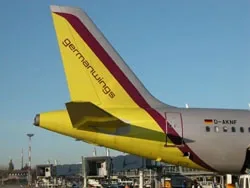
Food on the plane is only for cash. True, seasoned travelers can no longer be surprised by this - even many reputable airlines (for example, SAS, Iberia, and some others) have stopped serving free meals on many not-too-long routes. In all other respects, there is no particular difference. The plane is large and solid – an Airbus A319 with leather seats. The only thing is advertising in the most unexpected places - not only on fold-down trays in the cabin, but also on the fuselage itself. That is, a huge mobile advertising stand with passengers flies along.
During the journalist's test flight, no delays were noted. The plane arrives at normal airports, not somewhere in the middle of nowhere, so there were no difficulties getting to and from the city center either. Overall, I dare to conclude, based on my own experience: you can fly.
We'll keep an eye on the price
The main selling point of discount airlines, of course, is price. At Germanwings it starts, as they say now, "from €19". But you won't get a ticket for €19 just like that. You have to hunt for it, track it, catch it. It's a whole game, a real art, like many other discount hunts on the Internet.
First, you need to book your seat on the plane as early as possible. The earlier, the better your chances of getting it cheaper. As the flight fills up, the price for remaining seats rises. It is best to attend to your trip at the "launch" of the summer or winter timetable. That is when the notorious €19 are in use, which are charged for travel in any direction. You won't find out about the day sales open just like that; you need to constantly hang around the airline's website or receive a customer newsletter. It contains confidential hints "for insiders".
In addition to the start of the seasonal sale, spontaneous promotions are also held under the banner of "crazy night" or "crazy week", when tickets with very large discounts are also available. Usually they happen once or twice a month, and in winter sometimes even three times. Finally, there are fascinating campaigns when you are offered to go on a trip to certain destinations for free, with only tax payable. But again, you have to catch the moment. The calculation is simple - the customer must always be in touch. And then his loyalty is rewarded. If he, of course, is lucky.
For those who plan to travel spontaneously, the ticket will still be inexpensive, but not €19, rather €100 or even more, depending on how full the flight is. This, of course, is incomparable to last-minute tickets from many regular airlines, which are ready to charge sometimes €1.000 or even more ("only business class left", "priced according to expensive fare", etc.).
However, when totaling all travel expenses, it is necessary to keep in mind that Germanwings means a flight only one way and only along one route. In practice this means the following. If you need to get, for example, from Helsinki to Moscow, you must first fly to Cologne and pay. Then from Cologne to Moscow. And pay again. Theoretically, such a trip could cost a lucky person €38. And the return trip will cost him the same. In total, therefore, €76. On average, however, the normal price when booking not at the last minute is about €160. Plus, of course, the same cost for the return trip. Total - €320. Thus, the benefit is obvious, but mainly in those cases when you have to fly to only one final destination without a transfer, or when you "find" a ticket at a reduced price. In other cases, the benefit is no longer so obvious. But there is still savings.
Fly where they take you
Why must you absolutely fly from Helsinki to Cologne? Because this discounter does not fly directly between "foreign" cities. It flies exclusively through its base airports. There are several of these, all in Germany – in Cologne, Stuttgart, and Berlin. Therefore, flights from cities where Germanwings is represented go only there. If you need to get specifically to Berlin or Cologne, then you can be sure – no one will sell a ticket cheaper than Germanwings. And it's convenient because it's fast.
It is a different matter when one plans to go somewhere farther. The concept of "flight connections" does not exist in a discounter's vocabulary. Please, buy separate tickets for each destination, and then it is your business. It is possible that you will be able to continue your journey on the airline's hospitable planes only the next day. Budget hotels at reasonable prices (in some cases, if you have a flight booking, prices look simply stunning - for example, a four-star hotel in Germany for twenty euros!) can be found, of course, in various Germanwings brand catalogs, but the passenger must arrange lodging himself. Of course, if it is a pleasure to admire the celebrated beauties of the famous Cologne Cathedral, then it is even beneficial... But again, based on my own experience, I must note that a long-distance flight on Germanwings, taking into account an overnight stay in a hotel, still remains quite competitive in price compared to classic airlines.
The Difficult Cheapness
What does a discounter save on by offering flights that are several times cheaper than usual? The main source of financial inspiration is the optimization of everything and anything. The most economical aircraft (in terms of fuel, of course) are chosen and must fly as many hours as possible. It was already mentioned above that preference is given to Airbus. The cabin has 20 more seats than, for example, on similar Lufthansa models, due to slightly narrower rows and reduced working areas. No excesses. One of the most practical approaches is selling tickets via the Internet. It accounts for 95% of sales. This saves about €20 per passenger, since a classic sales system costs €22-23 per buyer, while an electronic one costs no more than €1-3. Since all roads lead to Cologne (or Berlin, Stuttgart), the crew always returns home for the night rather than staying in expensive hotels. Finally, advertising. In short, everything that can be sold is sold.
By the way, Cologne as the main base of Germanwings was also chosen not by chance. Located between Frankfurt and Düsseldorf - two of the largest civil aviation hubs in Germany - it found itself out of work after the country's capital was moved from nearby Bonn to Berlin. It urgently needed a basic concept, otherwise the threat of turning into a beautiful but ordinary provincial airport terminal with a small number of visitors would become all too real. One might think that the appearance of a major airline proposing a completely new strategy became manna from heaven for the airport administration. And of course, the partners did not fail to agree on mutual love and indulgences.
As a result, the company manages to turn a profit even with its relatively low rates. Over three years of existence, Germanwings (founded in 2002) has carried more than 10 million passengers and expects more. Recently, an intention was announced to acquire 18 new aircraft. This means that passengers have accepted the company's strategy.