
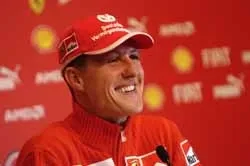
It is simply impossible to be indifferent to this driver. By and large, all of modern Formula 1 is divided into admirers of Schumacher and those who cannot live peacefully with his success. There are roughly equal numbers of the former and the latter. Some constantly remind us that Schumacher has won so many races and so many championship titles that no one can even be placed next to him; others note that throughout his career, the "Red Baron" committed small dirty tricks on the track that he believed would help him leave his rivals behind.
In fact, Schumacher is the last of the Mohicans. He fought with Ayrton Senna and Alain Prost, he overtook and chased Mika Hakkinen and Jean Alesi, and now his competitors are Fernando Alonso and Kimi Raikkonen. The history of Formula 1 over the last fifteen years is inextricably linked with Schumacher. Let us recall how the German sportsman came into the royal races and what he managed to achieve.
London Taxi Driver
It is worth noting that Michael Schumacher, like almost all racing drivers, started his career with karting. The first kart was made for him by his father's neighbor (Rolf Schumacher), assembled from a lawnmower, and then his father himself gave Michael an old but real kart. However, the world of motorsport would hardly have known its future hero if not for three people who had a serious influence on Schumacher's development as a racing driver.
The first was the Schumacher family friend Jürgen Dilk, who gave the young talent a real new kart. This happened literally a couple of days before Michael Schumacher intended to apply to a football school, the classes of which were affordable for his family. But Dilk saved Schumacher for motorsport. He took ten-year-old Michael to all the karting races, and also helped Rolf Schumacher build his own kart track in Kerpen, where the future record-holder could hone his skills.
Michael Schumacher won almost all the karting competitions in his age group that he took part in, but financial problems forced him in 1986 to find time not only for racing but also for working as a mechanic in a car repair shop. That's where Schumacher was helped by a second person, who later took an important place in his life. He turned out to be Willi Weber, co-owner of one of the Formula 3 teams. The shrewd manager instantly saw a future super-driver in Schumacher and signed a long-term contract with him.
It was Weber who pushed Michael Schumacher as a participant in the Mercedes Junior program, under which the German auto giant financed the training of young drivers. And it was Weber, who had serious connections in the world of Formula 1, who reacted faster than anyone to the incident that opened the door to the royal races for Michael. The fact is that in the middle of the 1991 season, Belgian Jordan driver Bertrand Gachot was involved in a car accident in London while in a taxi. The taxi driver was at fault for the accident. 28-year-old Gachot, enraged by the driver's behavior, argued with him, and during the quarrel threatened him with a gas pistol. The Belgian violated English laws by using a gas weapon, and the jury decided that the Formula 1 driver would spend some time in Brixton Prison (at that time a run-down and dilapidated institution). Thus, an unknown English taxi driver left a vacant seat in the Jordan stable. Team owner Eddie Jordan urgently began looking for a replacement and succumbed to Weber's persuasions.
The Irishman decided that the 22-year-old Schumacher would look good as a rent-a-driver, and his sponsors would add to the team's budget. But Michael simply exploded in Formula 1. In qualifying for the Belgian Grand Prix at Spa, he took seventh place, only behind the powerful Williams, McLaren and Ferrari. In the race, the German did not make it to the finish, but with his aggressive driving style he impressed the bosses of all teams without exception.
Seven Championship Titles
No one could have imagined then that this young German would soon become a threat to all authorities. Literally two weeks after his debut in Spa, Benetton, then led by Flavio Briatore with technical staff Ross Brawn and Rory Byrne, signed a contract with Michael Schumacher. The cunning Briatore, like Weber, instantly saw a future champion in the German.
Of course, the Italian manager violated all the canons of Formula 1 in terms of transfer policy, but legally everything was lawful. The fact is that the lawyers hired by Briatore found several loopholes in Schumacher's contract with Jordan, which eventually allowed the contract to be terminated. Literally everyone opposed Schumacher's move from Jordan to Benetton, even the legendary Brazilian Ayrton Senna. But gradually the talk about Michael's place in a Formula 1 cockpit subsided, and his career truly began.
Talent, skill, hard work and luck predetermined Schumacher's success. Benetton managers began building the team around the newcomer. The German progressed at a gigantic pace, and the team grew stronger with him. In 1992 he finished third, and in 1993 fourth in the drivers' championship. By 1994, ideal conditions for victory had been created for the future star of world motorsport. Giants like Nigel Mansell, Nelson Piquet and Alain Prost left the royal races. Ayrton Senna remained, who moved from McLaren to Williams, but the Brazilian "magician" died in May 1994, losing control of a car with technical damage at the Tamburello corner at Imola.
It seemed that Michael Schumacher had no more rivals, but Senna's teammate, Briton Damon Hill, upheld the honor of Williams, keeping his chances for the championship title until the last race. Then the German made people talk about him as a dirty driver for the first time. At the last Grand Prix of the season in Australia, he flew off the track, but also managed to knock out Hill, who was following behind, preserving a minimal points advantage. In the following season, Schumacher's superiority over Hill was already indisputable.
And before the start of the 1996 season, the German moved to Ferrari – a team that had won nothing since 1979. Neither a huge budget, nor the invitation of the best drivers and managers – nothing helped. The bosses of FIAT decided that to restore their former reputation they needed a driver around whom everyone could unite. That driver turned out to be Schumacher. The German signed a long-term contract with Ferrari, under which he received more money than anyone had ever received in the world of motor racing.
Together with him came French manager Jean Todt, who became sporting director, and Formula 1 guru Ross Brawn, who became technical director. The team was rebuilt from scratch and in a short time turned into a formidable force. Even with a not-so-good car, Schumacher managed to fight for the championship. In 1996 he lost to Hill, and in 1997, having a one-point lead over Canadian Jacques Villeneuve (Williams), in the last race of the season at Jerez he knocked him off the track.
Apparently, Schumacher expected a repeat of the 1994 story, but this time the officials of the International Automobile Federation acted very harshly, disqualifying the two-time world champion and stripping him of all the points he had earned in the season. In 1998 and 1999, Schumacher lost the championship battle to Finn Mika Hakkinen of McLaren, but in 2000 he brought the long-awaited championship title to the "stallions from Maranello".
The concentration of Ferrari's efforts around Schumacher bore fruit. A powerful technical staff, serious financial support from FIAT, major sponsorship contracts that advertisers entered into for the sake of Schumacher – all of this could not help but have an effect. The Italian team turned into a winning machine that sometimes had minor glitches but regularly delivered results. The years 2001-2004 changed nothing in the balance of power on the Formula 1 horizon – there was Schumacher and there were all the others, with the German winning regularly.
Having become a seven-time world champion, breaking all conceivable and inconceivable statistical records, the "Red Baron" (a nickname that stuck with Schumacher after moving to Ferrari) almost killed Formula 1. He deprived it of intrigue, crossing the finish line first time after time. He remained one of the representatives of that era when they still drove cars not packed with complex electronics, when the driver's skill decided everything. He managed to adapt the new realities to himself and continued to win.
Some driver from past years called Schumacher the most pragmatic person in the history of Formula 1, who knows how to achieve results by any means. At the same time, all the "dirty" episodes that his career actually abounds in are held against Schumacher. But these episodes pale in comparison to one circumstance that his detractors forget. He practically single-handedly raised a legendary team from its knees, instilling in it German precision and responsibility.
1992 world champion Nigel Mansell called the driver the arrowhead. If the bow is poorly drawn, the arrow will not reach the target, no matter how sharp the arrowhead is. Michael Schumacher refuted Mansell's assertion, forcing the archer to tense all muscles, the bow to bend, and the bowstring to hum. This is his fundamental difference from all the other drivers who share the track with him.
Last race at Monza
Michael Schumacher's last race in Formula 1 will be the Brazilian Grand Prix, which will take place at Interlagos on October 22 of this year. By then, Michael Schumacher could become an eight-time world champion. The fact is that after the Italian Grand Prix, at which the legendary German announced that the current season is his last, he is only two points behind the reigning world champion and season leader, Spaniard Fernando Alonso of Renault.
Michael Schumacher failed to win the qualifying session before the Italian Grand Prix – Kimi Raikkonen did it, and the seven-time world champion started from second place. After the start, Michael tried to break ahead, but he could not immediately overtake Raikkonen, but firmly stuck to the McLaren driver's tail. Raikkonen was the first to pit for refueling, and Michael needed only a few laps to close the gap and overtake Kimi. After Schumacher himself pitted and returned to the track, Raikkonen was already behind. Schumacher had used this trick many times before – he always managed to pull himself together and post a few phenomenally fast laps that allowed him to overtake his rivals. Characteristically, it seemed to make no difference to Schumacher who pitted first – when left alone on the track, he was so fast that his opponent, exiting the pit lane, almost always ended up behind.
The battle between Schumacher and Alonso did not happen this time. The Renault driver started from tenth position after being penalized for blocking Felipe Massa during qualifying. Fernando almost immediately managed to break into sixth place, where he got stuck behind Jenson Button's car. Alonso overtook the Briton during a pit stop, after which he ran fifth for a long time. During the last, second refueling stop, Alonso seemed to be lucky: he overtook both Massa and Kubica at once. However, the happiness of Renault fans was short-lived – white smoke billowed from Alonso's car, and the Spaniard ended the race.
In Monza, the success of new BMW Sauber driver Robert Kubica is also worth noting. The young Polish driver, who was competing in his third Grand Prix in Formula 1, managed to jump from seventh to third position at the start and hold it until the end of the race. The result – his first and well-deserved podium in his career.
A victory in the race, when the main rival in the championship failed to finish – the best thing Schumacher could have wished for from the home Ferrari Grand Prix. As he approached his 153rd podium, the fans did not yet know that in a few minutes the retirement of the best (you can't argue with statistics) driver in the history of the championship would be announced. And Michael himself, it seemed, was saying goodbye both to the public and to the team: on the podium, as it seemed to us, he could hardly hold back his tears.
No matter how the current season ends, Michael Schumacher achieved outstanding results in his Formula One career. He started 245 Grand Prix races, won 90 victories, finished on the podium 153 times, started from pole position 68 times, from the front row 114 times, scored 1,354 points, and drove 65,344 kilometers in races. It is unlikely that any current driver will be able to even approach these achievements in the near future – these are likely records of the eternal kind.
Schumacher's place at Ferrari will now be taken by Finn Kimi Räikkönen, the best driver of 2005, who still dreams of becoming world champion one day. Perhaps he will make the Italian tifosi less painfully accept the departure of their idol from racing. As for Formula One itself, it will now be completely different. An entire era, personified by the brilliant German racing driver, has left it. Next season, everyone, including his ill-wishers, will miss him. The "Red Baron" has handed over his rights...