
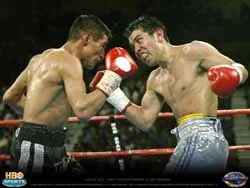
Last week, American heavyweight Shannon Briggs challenged Belarusian Sergei Lyakhovich, the holder of the WBO world heavyweight title, for the championship. On November 11, Ukrainian Vladimir Klitschko, the IBF champion, will test his strength against Kelvin Brock at the legendary arena in Madison Square Garden in New York. And on December 10, Russian boxer and reigning WBC world champion Oleg Maskaev will defend his title in a fight against Peter Okhello.
The question arises: why are there so many champions? Itogi tried to understand the roots of such a variety of versions and where this might lead professional boxing.
Competing Firms
Imagine for a second that the same situation as in boxing occurred in football. Brazil, Germany, France, and Italy - each national team received a title. It seems no one is offended. About once a year, champions, on the advice of their managers, defend the title by playing against someone who occupies a high position in a ranking compiled according to very vague criteria. Which of these teams is the strongest in the world? None. All at once and none in particular. But the point is that in football, the title itself is valuable, which takes four years to achieve (be it the World Cup or European Championship), while in boxing, it's more about the confrontation of personalities, the fact of the fight, the clash. A fight needs a loud title (we're not fighting for the district champion title!) and a catchy poster - then this product is easier to sell. If the world champion were the only one, the public would be able to see only one title fight a year, maybe two at most, because even these stone jaws and iron organisms cannot withstand a greater load. After all, in the heavyweight category, there are virtually no weight restrictions; here, guys two meters tall and above, weighing well over a hundred kilograms, pound each other with massive fists with incredible force. During a bout, judging by the judges' notes, a boxer takes more than a hundred blows with a force of a ton: imagine a car falling on you a hundred times in an hour and a half. I think even once would be enough. After almost every fight, participants have to go to the hospital. Many great boxers, such as Muhammad Ali, begin to suffer from ailments like Alzheimer's and Parkinson's as they age... In short, stepping into the ring more often is absolutely impossible. Of course, there are a great many contenders for a place in the elite, but fights involving them, called ranking fights, attract a much smaller audience. Meanwhile, the demand to watch boxing exists, and if TV ratings are to be believed, it is growing. In short, in order to have more title fights, you need more titles. Therefore, versions of various organizations arise, which coexist quite peacefully in professional boxing.
Made in USA
Although all these organizations call themselves world or, at worst, international, they are focused primarily on the American market and receive money from American sources. Mainly from television, which broadcasts fights on paid channels. The largest of these - Showtime and HBO - have a huge audience. For example, the number of subscribers to the cable network HBO, part of the Time Warner empire, is 35 million people (domestic audiences know this network thanks to the series "Sex and the City" and "The Sopranos"). Pay channel subscribers are joined by boxing fans who watch fights selectively via pay-per-view system, that is, "pay and watch." As a result, huge sums are raised. True, they are now significantly smaller than in the days when Mike Tyson or Evander Holyfield stepped into the ring. These monsters of boxing received fees in the tens of millions of dollars. For comparison: Nikolai Valuev was paid only one million for his last fight with Monti Barrett. Moreover, to popularize the huge "Russian Bear" in the States, promoters showed the show on a public channel, that is, for free, which is quite rare for fights of this level. And the promoters themselves, by the way, earned nothing at all, believing: first you need to invest money, and then reap the harvest.
Why does this happen? The fact is that interest in boxing in America has waned somewhat. And there is a logical explanation. For many years, the world heavyweight champions were African Americans. And the local promoters had long been looking for, as they themselves said, a 'big white fist' to mix up the company of black guys. But when as many as four such guys appeared at once, and they are being chased by at least two more - Russian Alexander Povetkin, Olympic champion of Athens, and Uzbek boxer Timur Ibragimov - the local show business pondered a bit. America currently has practically no one to respond with. This clearly threatens the well-being of fight promoters and, in particular, the four organizations that control the entire process. The American public is much more interested in 'product' made in USA than in everything else. Of course, a sequel to the movie story about the Russian boxer Ivan Drago would greatly boost ratings, and therefore revenues, but only if Rocky is there. If there is no Rocky, then the story becomes uninteresting for Americans.
In general, boxing, oddly enough, is very reminiscent of chess in its inner workings and atmosphere, although it is hard to find more dissimilar activities. In one case, athletes work with their heads, and in the other, mostly on the head. Just like in chess, in boxing it is customary to tell a lot of interesting things about the upcoming opponent, to fence with newspaper interviews and to choose an easier opponent. After winning a title, the tactic of 'avoiding' the strongest opponent under any pretext comes into play. In short, the role of personality is extremely high. However, as history shows, without these very personalities, even with a disgusting character, the spectacle loses its edge and turns into uninteresting chewing gum. For example, after Kasparov left chess, the world champion title depreciated considerably. When Mike Tyson stopped performing, it became less exciting to watch what was happening. And it's not even that no one bites off half an opponent's ear. After all, besides his bloodthirstiness, Tyson boxed superbly.
So what are the near-term prospects for the heavyweight division in professional boxing? It is clear that promoters will not leave it at that. They are unlikely to accept a situation where fights are more profitable to hold in Europe than in the USA. To overcome this trend, an American champion is needed. For now, none is on the horizon, so a 'resuscitation' of former champions is possible. Even the Englishman Lennox Lewis, who could be persuaded to return to the ring, would do for this. In his time, he defeated the elder Klitschko. However, perhaps the hegemony of our fighters will continue until a new Ali, Frazier or Tyson appears, and that this will happen is beyond doubt. Another question is when? Sometimes, the search for a new 'boxing symbol' dragged on for a long time...