
Photo epa
War on Liquids
Since November 6 of this year, security rules at European airports have been unified. In addition to the 25 EU countries, the new instructions apply in Albania, Kosovo, Iceland, Norway, and Switzerland. They were already implemented earlier in the US and Canada. From now on, when boarding a plane at European airports, a very limited amount of liquid can be carried as hand luggage. Let us immediately clarify that airlines have nothing to do with checking the contents of hand luggage; the responsibility lies entirely with the airport administration.
What is meant by liquid? Its definition is interpreted quite broadly by the new rules because too many different types can be used as ingredients for explosives. And since modern scanning machines at airports cannot quickly distinguish one type of liquid from another, the new instructions exclude them all. In addition to obvious liquids (such as water, alcoholic and non-alcoholic drinks, and perfumes), the “dangerous list” includes: gels, pastes, lotions, creams, and aerosols. That means now items such as hair gel, toothpaste, face cream, lotion, liquid soap, deodorants, shaving foam, and even mascara and eyeliner are best checked in. And if for some reason it is difficult for you to part with cosmetics (for example, doctors recommend women use moisturizer in dry air-conditioned conditions) - you can take a limited amount of women’s items into the cabin. The limit for transport in the aircraft cabin is 100 ml per “container”, and it is specifically a 100 ml container, not, say, a 250 or 500 ml jar that is “almost empty”. The number of containers is also strictly limited - no more than 500 ml total. Powder, lipstick, and solid deodorants can be carried without restriction.
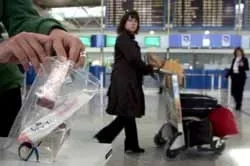
However, the requirements do not end there. Thanks to the intervention and advice of American specialists, all these obviously small containers must be packed in ONE transparent resealable bag with a volume not exceeding 1 liter, i.e., no larger than 20x20 cm. Moreover, it is important that the bag can be opened and closed (a plastic zipper, zip-top will do), since a security officer may want to take a closer look at the contents. In general, a regular plastic bag will not work, but a plastic folder with a clip is suitable. Note that later the EU authorities want these required bags to be sold directly at the airport. But for now, it is the passenger’s responsibility. And the passenger must take the transparent bag out of their carry-on bag during screening and present it separately from other items for scanning. All items that do not comply with the new instructions or are improperly packed will be confiscated.
By the way. From food, you can take solid products with you on the flight: sandwiches, chips, etc. Sauces, soups, pastes, yogurts, syrups, and other liquids are prohibited.
The new security instructions apply to all flights departing from EU airports, regardless of the flight’s destination and the airline’s country of origin. This means that our citizens may encounter the new EU requirements only while already in Europe, including on transit flights and on the return journey. The innovations do not apply to air passengers flying to Europe, airlines confirmed to us. However, there are some concessions at transit points for people who started their journey from an airport in the EU territory.
Changes have also been made regarding medications, dietary products, and baby food. Liquid or gel medicines with a prescription (e.g., insulin for diabetics and baby food) can be carried on board in quantities larger than 100 ml. The guideline is a reasonable amount necessary for the flight. But in the case of a medication, you must be ready to show a prescription (the name on it must match the name on the ticket, and apparently this document will be required in English). Without a prescription, you can carry saline solutions and other contact lens care products. And in the case of baby food, a parent may be asked to taste each bottle of baby formula in front of the officers. However, this is only possible if the person’s identity or the “medication” itself raises certain concerns for security.
As for water and drinks - passengers still have the opportunity to buy water and other drinks in areas after screening and on board the aircraft. No one intends to attack the trade at airports - destroying an entire industry that generates revenue would be foolish. But – attention! – there are also restrictions here. In European airport shops, you can still buy liquids in volumes exceeding 100 ml and take them on board. But with three conditions.
First: all liquids (perfumes, creams, alcohol from Duty Free) must be packed in the store’s branded bag, which will be sealed at the checkout with special tape, making it obvious that it has not been opened during the entire flight. In general, no admiring your purchase on the plane - security needs evidence that the item has not been tampered with; you also need to keep the receipt.
Second: all of the above applies to all flights except those to North America (passengers flying across the ocean are not allowed to carry liquid and gel cosmetic products purchased at Duty Free in the cabin). In general, if you are flying to the US or Canada, drinks purchased in the so-called “sterile” area must be consumed before boarding the aircraft, and “prohibited” duty-free goods from Duty Free stores or from on board aircraft must be placed in checked luggage. And, by the way, in the US and Canada, the volume of liquid containers is limited to 90 ml.
And third: passengers who are connecting to European flights in transit, coming from countries that do not comply with the new rules, are advised not to buy liquids even in 'sterile' zones until they have reached the airport of an EU country or boarded the flight. In general, if you are traveling in transit through Europe, it is better to stock up on alcohol and perfumes on the way back.
Take off your coat, take out your laptop!
Now all European airports require passengers to remove their outer garments. For example, coats and jackets must be removed before passing through the 'frame' at the checkpoint and placed on the belt, rather than carried through the metal detectors. Carrying items in pockets is prohibited. Large electronic devices that a passenger wants to bring into the cabin, whether a laptop, digital or video camera, hair dryer or other gadgets, must be taken out of bags and cases and placed on a special tray during scanning. This will make the security check not only more effective but also faster. Only small devices such as cell phones, MP3 players, and game consoles are allowed to remain in the bag.
By the way, you need to be alert with electronics. So, mobile phones and personal electronic devices with wireless telephone capabilities, despite all the hassle, it turns out, may only be carried in hand luggage; they should not be checked in - this would raise suspicion. Passengers are strictly forbidden from bringing into the cabin even souvenir imitations and children's toys that resemble any kind of weapon. And as before, sharp, cutting objects and lighters are prohibited as carry-on luggage. (For flights to the USA, lighters cannot be brought on board, even those purchased at the airport after the security checkpoint; in Europe, 'airport' lighters are allowed on board).
Furthermore, in some EU countries the transport department has also changed the dimensions of bags and suitcases that can be brought on board as carry-on luggage. For example, in the UK, all travelers departing from the country may only take one piece of luggage on board with dimensions not exceeding 56x45x25 cm (the same applies to France, Belgium, and Germany). However, travelers and business people arriving in the UK may, in addition to luggage of size 56x45x16 cm, also take a small briefcase (case, bag) with a laptop. If your bag or suitcase exceeds the new standards, you may be asked to repack your belongings and check prohibited items. By the way, it won't stop at the UK. IATA - the International Air Transport Association, threatens to reduce the size of carry-on luggage allowed on board throughout the EU in about six months.
And finally. To avoid delays, passengers are now asked to arrive at the airport at least 1.5 hours before domestic flights within Europe, 2.5 hours before short international flights, and for long-haul flights, they recommend arriving three hours before departure. Also for this purpose, at check-in counters, all passengers are asked whether they know the new carry-on luggage rules.
And one last fly in the ointment: any measures in any country may be tightened if its authorities deem it necessary.