
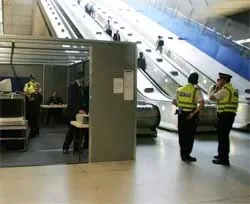
If the tests scheduled for mid-2008 are successful, within a couple of years the new 'anti-terrorist' equipment will appear in all major airports and on the airliners of the world's leading airlines.
According to the concept adopted by the developers, passenger surveillance will be carried out from the moment he enters the airport building until he exits the doors of the arrival airport. Already at the entrance, the traveler's luggage will be thoroughly inspected, after which the owner and his luggage will be marked with identical chips that allow monitoring the movement of the person and his bags through the airport territory and seeing whether the passenger has boarded the airliner where his bags and suitcases have already been placed. Moreover, the innovation will forever solve the problem of 'anonymous' luggage, which terrorists love to use to plant explosives.
The second innovation will be cameras capable of capturing the traveler's biometric parameters – they are planned to be installed at the check-in counter and at the aircraft entrance, so that there is no doubt that the person boarding the airliner is exactly the one who previously checked in luggage and went through check-in. At the same time, the passenger and his hand luggage will be analyzed by an 'electronic nose' capable of detecting the slightest traces of explosives and poisons that may be in the luggage or pockets of the departing person.
However, a truly revolutionary modernization awaits the safety system of the airliners themselves. Thus, it is planned that above each passenger seat, audio and video sensors will be installed, analyzing the behavior of their 'charge' throughout the flight. It is foreseen that all this information will be analyzed by a central computer installed in the cockpit. If the behavior of any of the people on the plane becomes inappropriate, the machine will inform the pilots of what steps they should take in the situation.
The scientists also took care to deprive terrorists of the opportunity to act according to the scenario carried out on September 11, 2001. The TARMS system will not only monitor compliance of the flight direction with the given route, but will also be able to take control of the airliner if it begins to approach potentially dangerous objects such as buildings or mountains too closely. Moreover, entry to the cockpit will only be possible if the fingerprints of the person wanting to take the controls are entered into the onboard computer's database. Otherwise, manual control of the aircraft will be blocked.
Anatoly POMORTSEV.
Novye Izvestia