
First of all, Catalonia has decided to uphold its reputation as a beacon of culture and has resolved to prevent possible excesses that keep occurring in places where so-called "cheap tourists" gather, with the help of the police.
Loud advertising on the Internet sounds completely unambiguous: "Lloret de Mar: fun girls and cool parties!" Indeed, this small resort town north of Barcelona has long and firmly earned a reputation as a "German-Dutch cesspool." Vacationers flock here in droves, primarily from those two countries, and mostly they represent the so-called middle-low contingent: not particularly high earners, and sometimes simply unemployed Germans and Dutch, who fill cheap hotels and are interested mainly in "simple amusements." In addition, Lloret de Mar is considered the "number one destination" for German school graduates wanting to celebrate receiving their certificates. Also not the quietest crowd.
From the reviews of these tourists posted on the Internet, one can glean roughly the following: "Cool place, great chicks, had some good laughs, only cops are a dime a dozen!" The latter "feature," by the way, appeared recently. Moreover, the friendly and hospitable Catalan municipal police have of late begun acting against drunks and hooligans with unprecedented decisiveness: batons are used, troublemakers are arrested, and some are even deported back to where they came from.
All this is happening because local authorities have finally become convinced: the influx of this sort of tourist brings no income to either the country or local residents, but only multiplies losses and scares off other, calmer and often far more solvent guests.
Moreover, in nightclubs all along the Costa Brava and Costa Dorada coasts (northern regions of Catalonia adjacent to the Mediterranean Sea), one can find not only a girl, a couple of decaliters of sangria, and a good brawl, but also hashish, cocaine, ecstasy - just pay. Often drugs cost even less than alcohol, and their possession is not considered a crime if there is a small amount and only for personal consumption. After 72 hours of such parties, young English, Germans, and Dutch simply fall into comas and have to be nursed back to health by doctors at local hospitals. Medics complain that dealing with these patients takes up the lion's share of their time and resources, so that when something happens, there is no one to help local residents.
Catalans are fed up with all this. The Spanish tourist region on the Mediterranean is tired of such clientele. Before the start of the new season, the Catalan government decided to "dry out" the considerably tarnished reputation of its coastal towns and try to restore Catalonia's honor as a beacon of culture. Instead of rioting youths, from whom there is almost no profit, the emphasis henceforth will be on a respectable public with steady income and a calmer disposition. "We cannot allow our cities to turn into garbage dumps for human refuse, for those whom other European countries do not want to see," said in an interview Javier Guitart, head of the Catalan Ministry of Tourism. "We are not ready to turn our region into a prostitute for four euros!"
The Catalan government is currently examining the possibility of legal measures against the owners of thirty internet pages that carry advertising for Catalan hotels and nightclubs with dubious reputations. However, Catalonia's Minister of the Interior, Montserrat Tura, believes that waging a legal battle against foreign sites will be difficult: many of them belong to private individuals organizing group trips. How are the police supposed to prevent riots, say, of British hooligans who fly to Girona for eight pounds on a Ryan Air flight (an airline that practices dumping prices)? How can one prevent mass binge drinking among tourists from the Rhineland regions of Germany, from where buses deliver crowds of young men eager for adventure with their stiff crew cuts straight to Barcelona? Catalan police even have to ask for help from Europol.
Spanish politicians and hotel owners for too long have bet on the quantity of tourists rather than their quality. Despite mutual accusations being made at the moment on this matter, there is still no particularly decisive change in course. Last summer Spain set a new attendance record - 55.6 million foreign guests. The country ranks second in the world in the number of tourists after France. Moreover, the most vacationers - 14 million - were received by Catalonia.
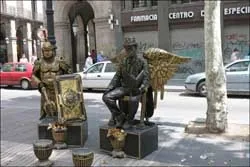
However, dumping prices have led to a decline in tourism revenue, and Barcelona - the wonderful city of Gaudí and Montserrat Caballé, the European capital of avant-gardism and painting - is gradually descending into chaos. Hundreds of blue-faced "tourists" from drinking hangovers wander along La Rambla, whose nationality even the most brilliant linguists could not determine, because these specimens simply cannot string two words together. The ancient Plasa Reial has turned into a campsite for "backpackers" - hundreds of them live here under the open sky, nightly getting sloshed on cheap booze that helpful street vendors scurry around delivering. At the same time, half of the "guests" do not part day or night with the season's novelty - bongo drums. So local residents are able to fall asleep only behind double shutters, tightly closed curtains, and with air conditioners running at full power.
Protests from local shop owners and city residents forced mayor Joan Clos to draw up a list of measures against "uncivilized behavior" by guests of the Catalan capital. Those wishing to "relieve themselves" under a bush or publicly get drunk to the point of insensibility risk fines of up to one and a half thousand euros. Anyone who plans to buy a "refill" from an unregistered street vendor discovers that they will have to pay an extra €500 for cheap drinks. "Cashiers" in uniform from the local Guardia Urbana prefer to settle on the spot and in cash - if the "client" disagrees, serious trouble awaits.
No tolerance, no leniency for violators - such is the slogan of the new summer season. However, not all residents of Barcelona agree with the authorities' position. Local youth express concerns that their city, known worldwide for its principle of 'live and let live,' could turn into a second Singapore, where, as is well known, the rules are quite strict. As a sign of protest against the 'arbitrariness of the authorities,' young people have planned a whole series of mass drinking parties in several clubs in Barcelona. According to young people, against the background of thousands of drunk Catalans, the 'guiris' (foreigners) would simply not be noticeable.