
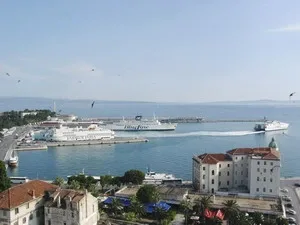
A trip to the Croatian resorts of the Adriatic Sea is becoming a common and popular holiday. Not that it's a really fashionable place, but still close to it. The Croats themselves are making considerable efforts to promote their trademark on the difficult tourist market, writes the magazine New Horizons.
Tourism - nationwide policy
Croatia's resorts are needed, first of all, by the Croats themselves. The war-shattered economy of the country has no other way to recover except tourism business. Impressive is the unanimity with which the entire Croatian people, in a single impulse, restores its tourist reputation. "Restores" - that's even not the word: creates it almost from scratch. And, it must be admitted, not without success. Why "from scratch"? After all, the resorts on the eastern coast of the Adriatic have long enjoyed a well-deserved reputation, and people from neighboring countries deprived of a warm sea (in the post-war years - primarily from Germany) flocked here by thousands.
That is true, but all this was known under the brand "Yugoslavia". Such a brand as "Croatia" did not exist on the tourist market! In the late 1990s, the country that gained independence had to start from scratch. And that would have been half the trouble, if not for the war. The country was involved in hostilities from 1991 to 1995 after the collapse of Yugoslavia, of which it had been a part for many years. One can realistically speak of the end of the war years by the beginning of 1997. What really happened then continues to be argued by politicians, gradually passing this thankless occupation to historians. Although memorial plaques hung in former hot spots speak of the "aggression of Serbia and Montenegro against independent Croatia", it is still mostly about destruction caused, in essence, by civil war. Croats burned the houses of Serbs who lived next door, and those, feeling the support of the regular Yugoslav army, in turn smashed Croats. Real battles were fought only in some, and by no means the most tourist areas. Without going into complex questions like "Who started first?" or "Who is right, who is guilty?" (in September last year, the presidents of Serbia, Montenegro and Croatia officially offered mutual apologies), we only state this fact; it will still be useful when choosing a tourist route in the current situation.
Having emerged from the war, the country found itself in an extremely difficult situation: the economy was ruined, old ties were broken, and there were no outstanding mineral wealth. There was only the Adriatic coast - money could be made only on it. In Croatia this is very well understood, so no matter what you started talking about with Croats, the conversation would inevitably turn to the topic of the beautiful resorts on the Adriatic: "What? You haven't been there yet? Be sure to look!" There is indeed something to see. Although some things are better to close your eyes to, and in other cases, on the contrary, you need to keep them wide open.
Behind the scenes
In the more than five years that have passed since the end of the war, the Croats have managed to do surprisingly much. Now their Adriatic routes are offered in most catalogs of the largest tour operators in Europe, and, for example, in our country trips to Croatia have become almost a generally accepted ritual, mainly for people with "lower middle" income (somehow the hand does not rise to write "middle class"). Moreover, for some reason everyone is convinced that this is a cheap country. Not at all. Prices on the coast (Split, Dubrovnik) in restaurants and shops are already by no means lower than European ones. Zagreb, the capital of Croatia, is a little cheaper.
The price increase is understandable - the number of foreign tourists is steadily growing every day. In 2002, it approached seven million, half a million more than the year before. In the hotel business there is such an important indicator as overnight stays, i.e. when a tourist stays in a hotel for a day or more. In 2002, almost 40 million such overnight stays were recorded. And that is money! And considerable money - with the population of Croatia itself being 4.5 million.
In first place in supplying clients for the Croatian tourism industry is Germany, then Italy, followed by neighboring Slovenia, the Czech Republic, Austria, and Poland. The number of our compatriots is growing rapidly. Cautious Swedes and Danes have begun to appear much more often.
The impressive victory was not easy for the Croatian tourism industry. Again because of the consequences of the war. From the Minister of Tourism, Mrs. Pava Župan Rusković, we managed to learn about the enormous difficulties encountered in restoring the destroyed tourist economy. According to her, Croatia, the only one of the countries involved in the Yugoslav conflict, provided five-star hotels for refugees to live in. In neighboring Bosnia, it must be said, there was nothing to provide - there they were simply destroyed. But on Croatian territory military operations were, as already mentioned, fragmented in nature, and the main hotel complexes, with a few exceptions, survived. But after refugees lived in them, one can imagine what they became.
But that is not all. The necessity not just for major repairs, but for a complete restructuring of high-class hotels ran up against an insurmountable lack of funds. As is customary in a socialist country - and Yugoslavia was one, albeit in a more liberal version following the model of Josip Broz Tito - hotels belonged to the state. Therefore they were forced to act in the state's interests. The state undertook to provide for refugees at its own expense, but in practice at the expense of the very same self-financing hotels where they were housed. The government, for its part, allocated about five euros per day for food, which was clearly insufficient, and even that money arrived irregularly. Costs were compensated from the hotels' budgets, which were obliged to take loans from state-owned banks - those, in turn, raised interest rates to thirty percent or more. Thus, one state structure was fleecing another.
As a result, all the major hotels were left with enormous debts, and they had nowhere to get money for reconstruction. The subsequent attempt at privatization encountered clearly unscrupulous offers, and fraud involving hotel property reduced to a deplorable state assumed a threateningly massive scale. After long disputes, the government decided to annul all previous debts when a hotel was resold to some reputable international chain with a well-known brand. The "pie" gained some attractiveness, and Sheraton, Intercontinental, Hilton, as well as the slightly less known but no less authoritative Millennium, Wren's Hotels, Sagrada Hotels, flocked to Croatia.
But, as Mrs. Ruskovich noted, three years were lost on debates over old debts and sale conditions. Nevertheless, the work accomplished has been titanic. On the coast, war wounds are not noticeable at all; hotels and historical centers shine with newness, and the service system operates flawlessly. Whether the minister will retain her post after the recent parliamentary elections can be said by experts on Croatian politics, but that she knows her job and runs it competently, perhaps, leaves no doubt. One of my acquaintances, a German journalist specializing in tourism, was unstinting in his compliment: "I would wish such a minister for any country!" But for Croatia this is not just one of the economic sectors; it is a matter of the country's survival and prosperity. Therefore, the person in such a post must be responsible.
Be Vigilant
It is worth going to Croatia. From a week's acquaintance with the country, there remained some concrete impressions that formed a kind of memo for a future trip.
First, it is better to head straight to the coast, bypassing the capital Zagreb, despite its historical merits. In Zagreb, of course, there is also much worthy of attention, but this city, which by its external appearance is quite European, is too spoiled by socialism. It is not even a matter of service; service here is generally up to standard, but rather a certain general tension that is felt in the urban atmosphere. The socialist shabbiness and worried expressions on faces are easily explained by recent events, but they do not serve as the best backdrop for a vacation, contrary to the hosts' well-intentioned efforts. According to guides, crime in the city does not threaten tourism (advertising brochures call Croatia one of the safest countries in Europe), and from personal observations this can perhaps be agreed with when it comes to hooliganism and other serious troubles. However, it is still necessary to remain vigilant: a careless Swiss journalist, who hung his jacket on the back of a chair during a gala dinner - not somewhere, but in a solid five-star Zagreb "Sheraton" - immediately lost his wallet. The abundance of sights does not compensate for the psychological costs, so it is better to go straight to the sea; it is cozier there.
The country abounds in all sorts of interesting places: castles, small towns with preserved historical centers, unique nature reserves. One of them - the Plitvice Lakes - has been on the UNESCO treasure list since 1979 and is a highly interesting natural phenomenon. Bursting from mountain depths, streams and rivulets carry out a large amount of dissolved calcium carbonate, which precipitates at the first opportunity and forms limestone barriers. As a result, pools and waterfalls appear. The fragile barriers grow quickly but break easily, so the process is continuously creative: new lakes emerge, old ones disappear or merge, the height of the waterfall increases or decreases, and the directions of flows change. The entire system constantly lives amid wonderful landscapes - quite naturally, such a place has long been favored by tourists. The Plitvice Lakes are only one example of the amazing scenes that unfold when traveling through Croatia.
And yet, it makes sense to go on such a trip only with caveats. First, the roads are very "slow". There are few motorways (their total length is 1,400 km), they are toll roads and concentrated mainly in the northern part of the country. The coast and the notable regions adjacent to it are only just beginning to be truly developed by road builders. Thus, the idea of traversing Croatia by one's own or a rented car is hardly justified: it would require too much effort and time. "Crawling" along a narrow road behind some bulky slow-moving vehicle is not the most pleasant experience.
Secondly, the dilapidated houses and settlements all along the route southwest of Zagreb almost to the coast, if you travel from the capital to the sea, have a depressing effect. These areas were always considered the poorest even in socialist times. It was precisely here that neighbor turned against neighbor. Some houses have been restored, but many are abandoned, sometimes entire villages are empty. Or on a large old foundation there is a small building, a kind of symbol of lost well-being. Pierced roofs and broken walls of beautiful mansions, stone fragments scattered around - a common sight. And one cannot say that it pleases the eye.
Nothing of the kind remains on the coast anymore. The people are richer, and the efforts and resources invested here have made it possible, first of all, to restore Croatia's "showcase". This is exactly where a car can be very useful: towns, each more picturesque than the last, lie in a chain along the Adriatic Sea. Split and Dubrovnik are the most famous of them. But there is also the amazing Trogir, and if you add the islands of Hvar, Korčula, and many others, believe me, you won't be bored.
Even Dubrovnik alone, in its architecture, is incomparable to anything previously seen. The uniqueness of Croatian cities may appeal to some and not to others, but they are distinctive, colorful, and rich in a glorious historical past. It is tempting to live in them, immersing oneself in that past, switching off from the annoying daily hustle and bustle.
The conclusion I drew for myself made it possible to determine the optimal Croatian route: by plane to Split or Dubrovnik (both cities have airports, although their facilities still leave much to be desired); hotels here are fine, there are many of them - at different prices and for different needs; a rental car - and a leisurely exploration of the coast with all its enticing nooks and numerous entertainment options (diving, golf, and other gentlemanly pursuits). At the moment, as it seems, this is the best that Croatia can offer. Given past events, that is quite a lot, especially when everything around is changing very quickly. The main thing is that the Croats have so far managed to strengthen their tourist brand quite successfully.