
Britain and Ireland
In Britain and Ireland, so-called further and vocational education colleges are common. Strictly speaking, they are not universities. The concept of "further education" includes all types of post-school education, except higher education, aimed at obtaining or improving qualifications.
Colleges can be private or public, multidisciplinary, operating in only a few academic areas, or highly specialized. The duration of the course varies greatly - from a few weeks to two years. It all depends on the specialization and what qualification you are aiming for. Ideally, the "ceiling" for a college is the highest diploma in vocational education.
The greatest variety of programs is in public colleges. "Private" ones, as a rule, have fewer technical capabilities than public ones, and the choice of programs is significantly narrower. The most common are those that allow you to continue studying your chosen specialty at a university. Usually these are business, computer science, design, journalism, hospitality, and some other specialties.
Across the Ocean
In Australia, most public educational institutions of this level are united in the TAFE system (Technical and Further Education), which allows better coordination of their work. Educational institutions in this system are well-equipped and provide students with all conditions for study and life. They may be called either colleges or institutes, but the essence is the same - all provide specialized education leading to one of the qualification documents accepted in Australia: a certificate (four levels) or a diploma (two levels).
The link we are interested in is also present in the US education system. These are the so-called community colleges - public educational institutions that provide education at the level of the first two years of university. After which you can easily transfer to a university for the third year and obtain a higher education.
For those who think that secondary specialized education is enough for them, one- or two-year courses are offered, upon completion of which a corresponding certificate is issued.
A type of educational institution close to a college is the so-called polytechnic, or simply polytech. They exist in many countries, and are especially popular in New Zealand. The specialization of polytechnics is usually narrower than that of colleges: they offer diploma programs mainly in technical and business specialties.
Almost a University
Some colleges bear the proud designation "university". What does that mean? It means that in addition to diploma programs, they also offer bachelor's programs. But it is not for the colleges themselves to award academic degrees - that is the prerogative of universities. Therefore, in order to take their graduates beyond secondary specialized education, university colleges enter into partnerships with universities. The degrees awarded here must be accredited by one or another university, otherwise they are invalid. Occasionally, university colleges also aim for master's programs, typically MBAs.
Studying at a university college is usually significantly cheaper than at a university. And having obtained a bachelor's degree, you can continue your higher education at any university without hindrance.
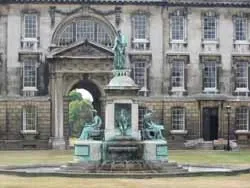
Just in case, we remind you: university colleges of this type should not be confused with full-fledged universities that, for historical reasons, bear the name University College. For example, University College Dublin, one of the largest and most famous universities in Ireland. In addition, a college can be an independent unit within a large university, such as Christ Church College in Oxford or King's College in Cambridge.
A Leap into University
Thus, a college is not a vocational school: it can be an alternative to a university. Moreover, it is a very convenient, inexpensive, and "pleasant in all respects" loophole into a university. And it's not just that almost all colleges have preparatory pre-university programs: Foundation, A-level, etc. Simply put, the education obtained at a college is not a dead end. After completing a two-year professional course, you can transfer to a university - and not start from scratch, but enter immediately into the second or even third year. Considering that the cost of tuition at some colleges and polytechnics is almost half that of universities, such a tactic clearly makes sense. And for foreigners, initial study at a college can provide additional advantages: the fact is that there are far fewer students here than at universities, so the atmosphere is often more congenial. This facilitates adaptation and acclimatization to life and study in a foreign country.
Many colleges have partnership agreements with specific universities, so when transferring you will have no trouble at all - it will happen automatically. Of course, the English language requirements will be high, but most colleges have language courses that will allow you to bring your language proficiency to the level required for university study. As for the diploma in vocational education obtained at a college, it can also be useful for a master's degree holder - after all, who knows how life will turn out.