
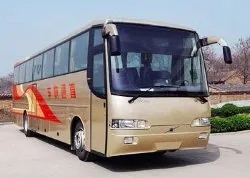
“Golden Dragon” of the Chinese auto industry
Chinese cars have, without a doubt, become a kind of calling card for another incredibly rapid Asian success. Until recently, Chinese cars were not taken seriously and were viewed with a certain degree of skepticism. But today, the media is prophesying the decline of the domestic auto industry under the pressure of fierce competition from China’s automotive sector.
Moreover, according to experts, Chinese cars are capable of rapidly conquering the Russian car market, as much more attention is now being paid to their manufacture, which has positively affected assembly. Furthermore, Chinese cars are comfortable and convenient compared to domestic technology; as for the latter, it is now also inferior in quality.
There is also an opinion that Chinese cars of many brands simply copy Japanese cars, not only their appearance but also their ‘inner workings’. One vivid example where Japanese cars served as a prototype is the Chinese-made minibus Golden Dragon CityLine, which at first glance bears a complete resemblance to the Toyota HiAce. In this case, even the engine of the ‘Golden Dragon’ replicates the powertrain from Toyota. It is the same displacement of 2.2 liters. However, there is a difference: the Chinese engine has its own designation.
Even if the external similarity of these cars is striking, Chinese cars of this brand can be distinguished by the coarser trim material. The plastic on Chinese cars has visible burrs. Moreover, the doors on Japanese cars close much more easily than on Chinese-made minibuses. However, all these drawbacks become less noticeable when it comes to price. Japanese HiAce cars cost about 900,000 rubles, while the price of Chinese CityLine cars is only about 550,000 rubles.
Moreover, an interesting situation is developing in the Far East, where, despite the great popularity of right-hand drive Japanese cars, more and more dealerships offering Chinese cars are beginning to appear. Thus, it can be confidently stated that competition in this region will be the fiercest.
Recently, Japanese Toyota cars have not been officially supplied to China. This is because the Japanese auto giant responded this way to Beijing’s recent imposition of trade sanctions against Toyota due to Japan restricting the supply of agricultural machinery to China. The cancellation of car exports from Japan was also influenced by the PRC’s actions, which introduced huge customs duties, including 100% on Japanese cars.
In all this, one can see a fierce struggle in the automotive market, which is just beginning to gain momentum, as Chinese cars, like everything in the Celestial Empire, are rapidly improving their quality.
_