
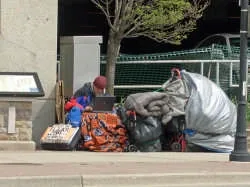
"Land of unlimited opportunities" has become a bad joke for many Americans today
Even drug dealers are doing poorly
The social system in the US has always operated on the principle "Every man for himself!" The state made efforts to provide minimal protection for those on the lower rungs of the social ladder – nothing more.
Private insurance companies handle health insurance and unemployment insurance. Numerous charitable organizations ensure that the poor have a piece of bread and a bowl of soup. Church institutions offer the homeless a place to sleep and free (albeit superficial) medical care. The state takes minimal part in all this. It only allows wealthy philanthropists to deduct amounts spent on the poor from taxes and distributes free vouchers for food and essential goods.
Social welfare has never provided even minimally acceptable living conditions in America. By and large, it wasn't necessary: in the land of unlimited opportunities, the absolute majority of citizens could take care of themselves. If so, why impose state social security on them, which, among other things, requires significant tax contributions?
Today, Americans are feeling the weakness of this concept firsthand. Along with stock market indices, millions of jobs have gone to hell, and with them, the ability to support oneself. Many of those who cared about the future by paying premiums for private health insurance, unemployment insurance, and pension plans suddenly discovered that their substantial, large insurance funds had lost everything on the stock markets and collapsed.
There are no more insurance policies. Charitable church and private organizations are forced to cope with an influx of hungry and homeless people unprecedented since the early 1930s. Even with their previous capabilities, this would have been an impossible task, but now even more so – because their budgets have also "thinned" as a result of the crisis. It is rumored that ruin has even touched the criminal world: small-time drug dealers can no longer sell their deadly "product" – drug addicts have run out of money.
Poverty, as a mass phenomenon, has returned to America. Approximately 50 million US residents are without health insurance. Every day this army is joined by new "recruits." 32 million people receive state food vouchers, 13 million are unemployed. The number of homeless is growing as the number of forced evictions increases: from 233,000 losing their homes at the end of March 2008 to 341,000 at the end of March 2009 – an increase of 45%. The middle class is shifting into the category of the poor. The poor are becoming destitute.
The rich also cry
Social upheavals have not spared even the wealthy neighborhoods of American cities. The streets in the prestigious Los Angeles district of Venice Beach, located near the coast, have always been wide. Now they seem narrower because of camper vans and trailers parked on both sides. They are not going anywhere; they just stand there – people who have lost their homes live in them. Many cover the windows of their "homes on wheels" with cardboard, trying to maintain a private atmosphere. For car thieves and other petty hooligans, handwritten signs are posted: "Nothing to steal here" or even "Try it if you value your life!"
The beginning of the end of normal life for the average American, as a rule, is the loss of a job. As if in a feverish delirium, US companies and corporations are throwing even permanent employees, who for many years belonged to the so-called "core contingent," out onto the street at a conveyor-belt pace. In March, approximately 690,000 new unemployed registered at the labor exchange. In February, there were 810,000, in January 510,000. Since the beginning of the financial crisis, i.e., since the summer of 2008, the number of "official" US unemployed has increased by 6 million people. Their state social guarantees are too small to provide them with a "transition period."
The consumer boom of past years led to the bank accounts of "little people" being literally torn apart, and even the stock portfolios of middle-class representatives "thinned" by an average of 40%. Thus, the status of unemployed is now often followed by the status of beggar. Need in the bottom third of the social ladder has become a permanent phenomenon. Many soup kitchens are often forced to turn away those who come for a bowl of soup – there simply isn't enough for everyone. According to New York City administration data, the city's soup kitchens provided lunches to 1.3 million people in 2007. In just the period between October and November 2008, the number of needy jumped to 3 million. More and more people are leaving charity canteens literally "without having had a bite," with stomachs rumbling from hunger. And hunger rarely comes alone – homelessness, lack of a roof over one's head, follows closely on its heels.
Demand for homeless shelter beds far exceeds supply. Thousands of families can no longer afford apartment rent and move, if lucky, into cheap motels. All of them recently belonged to the middle class. Tent cities are springing up like mushrooms – from Florida on the east coast to Seattle on the west.
Across the country, private firms are stopping funding for social projects – and their generosity has exhausted itself precisely at the moment when mass impoverishment has returned to America. Even the state, instead of caring for the disadvantaged, often only contributes to the development of poverty as a phenomenon. Washington is ready to allocate additional funds at the federal level, but many states, on the contrary, are cutting their social budgets. The reason is that their constitutions force them to be frugal. The law prohibits the governments of most states from going into debt.
Compassion and Death
Compassion for those who have been thrown to the sidelines of life is now in fashion among those who are called the 'cream of society.' Politicians visit homeless shelters more often than before. Quite recently, America's first lady Michelle Obama honored with her lightning visit a long line waiting for soup at the Washington soup kitchen 'St. Mary's Kitchen.' Her husband, even before the inauguration, took part in painting the walls of a new homeless shelter. 'My vision of the future is an America where sustained economic growth provides ever new jobs,' he declares, but against the backdrop of the crisis, these words do not sound very plausible. At the moment, this vision is from a happy past, not from a vague future. Now the president has to observe the opposite picture: jobs are disappearing, incomes are dwindling, and the future looks threatening.
Nevertheless, compassion ensures public interest. Hollywood celebrities almost line up to visit one shelter or another and smile at its inhabitants. American television superstar Oprah Winfrey a couple of weeks ago went as part of a show to a tent camp on the outskirts of Sacramento. The footage shot there vividly resembles pictures from history textbooks – as if the past has returned.
Adults with empty eyes and ragged children form a nerve-wracking frame for a picture that is a bitter caricature of the American Dream. 'The land of unlimited opportunities' has become a bad joke for many today,' says Professor James Alan Fox, a criminologist who has long warned about a sharp rise in crime. The latest official reports confirm his fears: America is on the verge of returning to the group of so-called 'criminal states' – countries where crime has spiraled out of control. Just this April, before it even properly ended, was dubbed the 'bloody month.'
'This is the American way,' writes New York Times columnist Bob Herbert with bitter irony. In his article, he reminds that since the terrorist attacks of September 11, 2001, about 120,000 Americans have died at the hands of Americans. That is about 25 times more than the number of soldiers killed in Iraq and Afghanistan combined. Experts explain the jump in criminal activity primarily by the catastrophic economic situation. 'I have never encountered so many killings in such a short time,' admits Jack Levin, a criminologist from Northeastern University in Boston.
In America, a generation is growing up again whose daily lives consist of violence and hopelessness. Worse, the new poor are increasingly too poor to get even a decent education. For the American school system, the consequences of the crisis are comparable to the consequences of Hurricane Katrina for New Orleans – it leaves only ruins behind. Ruined parents are increasingly taking children out of school – they need to find food, there is no time to study.
Save yourself if you can!
However, the worst off are those whose affairs were already in a bad way before the crisis – primarily illegal immigrants. Even before, they were forced to earn a living by hiring themselves out as day laborers, and now that work has also disappeared. Every morning, a huge crowd of Mexicans and Puerto Ricans gathers in the parking lot of one of the Home Depot hardware stores – just a stone's throw from the famous Hollywood Sunset Boulevard. They no longer have any illusions about a 'breakthrough' into a prosperous life. At eleven in the morning, the crowd still consists of hundreds of men and women frantically rushing to every car whose owner looks like someone who might need workers. They hastily squeeze out a couple of learned English words: 'painting,' 'cleaning,' 'do everything,' 'cheap'.
Only a few get day work. There is no one to help them – however, this applies to some extent to everyone who has been swallowed up by the greedy vortex of the economic crisis. The depression can shake any hopes and any ideas – including faith in the blessed salvation by the new government. The White House has already 'injected' hundreds of billions of dollars into the banking system. Tens of billions have been allocated for the construction of new roads and bridges, for infrastructure development, which will help provide jobs for at least a small part of those who are able to perform them. At the same time, at best, millions are spent on maintaining the social system – for a huge country, that is simply nothing.
The euphoria from the election of the first black president, who won the election rally with the words 'hope' and 'change,' is fading. Barack Obama's beautiful words still sound enchanting, but the public is increasingly watching his actions, not his words. When the president speaks about the economic situation, the enthusiasm of listeners increasingly gives way to a sober view of things – and this view is far from optimistic.
Speaking recently at Georgetown University in Washington, Obama warned listeners: 'Don't expect poetry from me today – I have only prose for you.' Now the president appeals, above all, to the patience and endurance of Americans. The first glimmers of hope, in his words, have already appeared, but one must survive until the moment when the situation begins to improve. 'We cannot build our economy on sand again,' emphasizes Barack Obama. 'Our new house must stand on a rock-solid foundation.' But such a foundation cannot be built in a short time.
The only thing that has not changed in the new US president's speeches is the accusations against his predecessor, George W. Bush. 'We inherited from the previous administration a ruined budget, a truly bottomless abyss,' Obama tirelessly reminds. But these reminders are becoming increasingly ineffective. George Bush is already the past. Now he appears at meetings of charitable committees as honorary chairman and opens baseball games in his native Texas. To questions from journalists about how he feels about Obama's accusations against him, and what he thinks about the anti-crisis policy of his successor, the former president only smiles amiably at TV cameras and states: 'He deserves that I remain silent.'
Khaim GRETS.
IA «Rosbalt»