
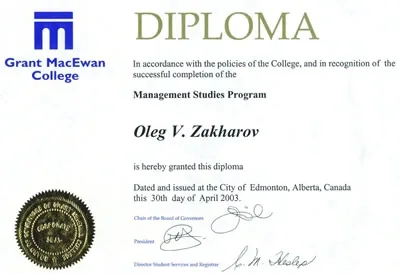
Today's business cannot be imagined without specialists who ensure effective company management. The increased demand for highly qualified financiers and accountants has given impetus to the development of economic education. International educational programs are designed to bring well-trained personnel to enterprises, specialists who understand issues such as personnel management, 1C trade, electronic banking, and so on.
- Oleg, why did you decide to get a foreign diploma?
- The fact is that I worked for several years at the representative office of Kodak in Ukraine, and I know firsthand how business is conducted in the West. There were business trips to Germany, the Czech Republic, Austria, and Canada. And although I have two higher education degrees - a diploma as a radio engineer (Kyiv Higher Military Aviation Engineering School) and a diploma in marketing (Academy of Foreign Trade) - I constantly felt that the knowledge I possessed was insufficient to effectively conduct business with foreign partners. Of course, I also read literature and attended various trainings and seminars, but knowledge was still lacking, especially in finance. At one time I even had the idea of trying to go abroad to get the necessary education. And then I learned about the Canadian program at the International Institute of Management.
- What is this program?
- This educational project started in 1999 as part of intergovernmental cooperation between Ukraine and Canada. On the Canadian side, the program is implemented by Grant MacEwan College (Edmonton), and on the Ukrainian side, by the International Institute of Business (IIB, Kyiv). Of course, I asked what kind of college this was. It was founded in 1971 in the capital of Alberta province and today is among the top five colleges in Canada. Every year it educates more than 80 thousand students from different countries of the world. The college offers 60 diploma and certified programs in humanities, natural and social sciences, as well as in management and accounting. Currently, two programs operate in Ukraine: the Canadian Business Management Program and the Canadian HR Management Program. Graduates of both programs receive professional business education and an original Canadian diploma, Management Studies Diploma or HR-Management Diploma, respectively. The latter, by the way, is a significant fact - there is no difference between diplomas issued in Edmonton and in Kyiv. And the diploma itself is highly valued by Canadian employers. Everyone who, having moved to Canada for permanent residence, gets a job pays attention to this.
- Tell us more about the training program itself.
- I studied under the Canadian Business Management program. It is a two-year program. Classes were held daily (except Saturday and Sunday) from 18:30 to 21:30. Each day we studied one subject. We worked with one instructor, but the method of presenting the material differed: a lecture, then a discussion, then an analysis of a so-called "case" - a practical training task, then a debate. Moreover, all educational material is a constant connection between theory and practice. The learning process is organized in such a way that we not only gained knowledge and skills in this field, but also actively engaged in various research and developed practical experience ourselves.
Of course, a lot depends on the instructors. We were lucky: first, we were taught not just academic teachers, but practicing teachers who are actively involved in business, being, so to speak, in its very thick. And, second, they all underwent special training and internships in Canada and adopted a completely different manner and style of teaching. Each teacher goes to Canada once a year for retraining - time does not stand still. In addition, we studied many subjects that were completely new to us, or gained an absolutely new perspective on familiar ones. I would like to highlight such key subjects as Financial Math, Accounting, Management Accounting, Business Computing, Organizational Behavior, Topics in Finance, International Business, Business Finance.
The Canadian module takes one and a half years, then, after obtaining the Canadian diploma, a Ukrainian module is added, after which students receive a Ukrainian diploma of second higher education. The Ukrainian module provides in-depth information on financial and tax accounting in Ukraine.
- And what language was the instruction conducted in?
- Mostly in Ukrainian. True, when guests - visitors from the Canadian business world - spoke to us, of course, the conversation was in English. By the way, the curriculum includes a good block of business English training.
- What requirements are imposed on those who want to enroll in this program?
- Getting into the program is quite easy - you need to pass a fairly simple test on knowledge of the basics of mathematics and economics, and an English test. In addition, applicants must have a higher education or obtain it by the time they complete the program. In our cohort there were senior students. I would like to note that I studied at my own expense and consider this correct: with this approach you feel real motivation, and the level of responsibility increases. The cost of the program at that time was $2.800, and the payment could be made per semester or even monthly.
- Of course, the workload is very heavy; for two years you simply 'drop out' of normal life. But as the philosopher Nietzsche said: 'What does not kill us makes us stronger.' I, for example, wanted to join the second intake back in 2000, but could not - there were too many business trips at work. There can be no question of not doing assignments or skipping classes - you immediately lose pace, fall behind, and 'drop out'. Our group initially had 32 students, and 25 received diplomas. You know, in addition to gaining new knowledge, studying there helps you build very productive business connections. Most of the students, of course, are business people. Among our students were employees of very large well-known companies: for example, Nikolai Fabro, executive director of Yug-Kontrakt company (Foxtrot group), Sergei Badridinov, director of department at MTI, Alexander Boroda, commercial director of Infokom, Sergei Kornienko, head of the supervisory board of the Kamenets-Podolsky instrument-making plant, Elena Kornienko, owner of the Volkswagen and Audi dealership. I still maintain friendly relations with many of them.
But what also interested me very much in the Canadian program was the opportunity to do an internship in Canada. Just after starting the course, I firmly decided: I will definitely go!