
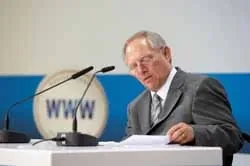
He is consistently pushing the German government and legislators to expand the powers of the police and intelligence services, as well as to amend the Constitution, which would at least allow a freer interpretation of the rights of many categories of defendants. The innovations of the head of the Interior Ministry are drawing criticism not only from experts but also from ordinary citizens – after all, some of them can be called outrageous. In addition to the relatively harmless (at first glance) proposal to use photos from the passports of German citizens and foreigners permanently residing in Germany in police databases, Schäuble has come up with the idea that all telephone conversations and SMS messages in the country should be stored by telecom companies for six months and made available to the police at the first request. This idea, which tramples all the foundations of democracy, was put into practice on Wednesday, April 18, at another meeting of the German Cabinet of Ministers.
Germany had barely grasped what this meant when Minister Schäuble came out with a new initiative: he now demanded that the fundamental legal principle of the presumption of innocence be abolished for those suspected of terrorist activities. He justified his demand by saying that in the fight against terrorism, the main thing is not to find those guilty of a terrorist attack, but to prevent the attack itself, so as a preventive measure, the competent authorities should be allowed to arrest potential terrorists at the first suspicion. 'I insist that the investigative bodies be given this opportunity,' he said. 'We cannot allow terrorists to calmly blow up whatever they want, and we can only start an investigation afterwards, when the worst has already happened.'
The head of the German Interior Ministry, according to him, relies on the experience of the United States, where many new rules and instructions have been introduced in recent years that in one way or another 'free the hands' of intelligence agencies and law enforcement bodies. Nevertheless, Schäuble's zeal has begun to simply frighten Germans, who seriously fear the transformation of their country into a kind of 'glass house' where everyone will spy on everyone else, and people can be grabbed on the street without much fuss – prove, they say, that you are not a terrorist and do not intend to blow up a bomb somewhere in the Reichstag.
Until now, the leaders of the Christian Democratic Union (CDU) have been quite tolerant of the demands of the unbridled anti-terrorism fighter Schäuble, while his main opponents have been the leaders of the Social Democratic Party of Germany (SPD) and the Greens. As for the Christian Democrats' coalition partners, they simply staged a real revolt in the Cabinet, so that it was necessary to announce an emergency, extraordinary meeting of the government just to try to reconcile opponents and supporters of the reckless minister.
But now, apparently, the patience of the conservatives has run out. Several CDU politicians have made sharp statements about Schäuble's 'authoritarian methods,' and one of his predecessors, liberal Gerhard Baum, said that 'if such a decision is adopted, the first to be arrested should be Wolfgang Schäuble himself – for attempting to dismantle the German democratic system.' In some parts of the country, voices are even heard comparing the projects of the head of the German Interior Ministry to Hitler's preparation for the Nazi coup, but such comparisons still seem exaggerated to most Germans.
Paradoxically, Schäuble's defender turned out to be a representative of the Social Democrats, German Justice Minister Brigitte Zypries. In one interview, she said that such debates should stick strictly to the factual side of the matter, rather than falling into political rhetoric. In her opinion, an effective mechanism for preventing terrorist activities should be developed as soon as possible, and on this she fully agrees with her colleague.
Wolfgang Schäuble himself calls himself a 'defender of democracy' and believes that his opponents are unfairly insulting him with their suspicions. But today many Germans ask whether, after the reforms he has proposed, the 'defender of democracy' will simply have nothing left to defend?
Boris ALTNER.
IA Rosbalt