
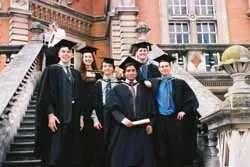
In Germany, as in many other countries, the Bologna process is gaining momentum. So far, classes under the rigid Anglo-American scheme are only an addition to the traditional German system and, let's face it, are aimed not so much at Germans themselves as at foreigners: classes are conducted in English. Germans, for now, prefer to study "the old-fashioned way." Despite the fact that the familiar German higher education system draws considerable criticism from politicians and ordinary citizens: some sincerely believe that higher education in Germany has fallen into decay. This would seem to be evidenced by the fact that over the past decade the number of foreign students arriving to study in Germany has declined: the fashion for Anglo-American education has made Germany's classical universities less attractive to students from abroad.
Why are they "eternal"?
The average duration of study at a German university is seven years. But do not think that students are "marinated" at universities, being taught some unheard-of subjects or with German meticulousness drilling academic disciplines "from cover to cover." No, the curricula for many specialties provide no more than four and a half years to obtain a degree or diploma. The students themselves drag out the educational process. Fortunately, the education system allows them to do so.
Upon entering a university, a German student receives a list of courses he must complete and exams he must pass. At this point, the academic office's participation in the educational process ends. The student creates his own class schedule and exam timetable. Moreover, he has the right to take an exam only when he feels ready for it. Have you ever felt ready for an exam? That's the thing.
About 400 German universities have long lost track of how many serious students they have and how many slackers who show up in classrooms once a year, as if by promise. Attendance records for seminars and lectures are not kept, especially in the humanities and social sciences. Let's face it, even in technical and natural science departments, lecturers often only notice after four semesters whether their charges have done their homework. That is usually when the first exams are held, comparable to a bachelor's degree in America, but in Germany having only intermediate significance. So is it any wonder that German universities are overcrowded? And perhaps if all students in a course suddenly showed up for a lecture at the same time, they would have to crowd in the aisles and hang from the chandeliers...
It must be said that German students have some reason to treat their studies so negligently. First, recall that it is not exactly "green" youths who take their places at university desks in Germany. Schooling at a gymnasium, after which one can become a student, lasts 13 years, so the German Abitur is a certificate of maturity in the fullest sense of the word. After that, young men must also serve in the army, or – if they refuse service in combat units – perform alternative service in social institutions. This takes from seven to ten months, so practically one more year is lost. Twenty-year-old "lads" starting their studies at university are already quite independent people, and of course the vast majority immediately start working part-time. In the early years they do unskilled labor, later they seek practical experience in their future specialty. Such practical work may bring less income than a part-time job at a restaurant or gas station, but afterwards it will be easier to find a job – nothing is valued as much by German employers as practical skills.
There are also extreme cases. For example, one German acquaintance of mine is a classic "eternal student"; he has been enrolled at the Faculty of Philosophy of Düsseldorf University for, it seems, about ten years now. He has no incentive to get a diploma – for several years he has been working at a publishing house in a position as editor that suits him quite well, and he does not intend to leave his job. A diploma would practically give him nothing, because career advancement for a humanities scholar is a dubious matter, and he does not intend to pursue science. So the man lives a full life, occasionally remembering that he is a student... To the horror of his Russian wife, who, like many of our compatriots, is convinced that without a diploma you are a nobody.
Girls enter university somewhat earlier than boys. But not everyone manages to finish it earlier. Unlike pragmatic American women, who believe that you first need to build a career and then start a family, romantic Gretchens fall in love with delight, get married, and have children regardless of whether they have a diploma or not. When else, if not in youth? And the university will not run away, no one will kick a young mother out. And the good state will even add a social benefit.
So not all German students are loafers. They simply have a lot to do...
The housing question
Almost half of German students (40%) rent an apartment – alone or jointly. Only a fifth of students prefer to burden their parents. In recent years, student 'communes' popular in the 1970s have become fashionable again – a whole crowd lives in one multi-room apartment, and the tenants share the rent. They do this not for political reasons, as in the 'red seventies', but simply because it is cheaper and more fun: you can save money and make friends at the same time. This type of accommodation is not forbidden for foreigners either, although many students from abroad would prefer not to complicate matters and live in a dormitory. Rooms in dormitories are often small, and the amenities are not the best, but it is the cheapest type of housing for students. Information about the allocation of places in dormitories and their addresses can be obtained from the Student Welfare Society. True, there are not enough places in dormitories for everyone. So one has to study the 'black board' hanging in the university lobby – that's what students call the bulletin board. These boards are always full of information about available housing. You can take the initiative and post your own notice about looking for a room. In any case, universities always circulate information about free student housing, so you won't be left without a roof. It should be noted that the most expensive housing is in traditionally student cities such as Marburg, Heidelberg, or Tübingen. Not surprising – demand here exceeds supply.
Don't get lost!
From the above, one might get the impression that German students never set foot in the walls of their alma mater and that German universities are filled with echoing silence. Far from it! There are plenty of people eager to attend classes, and it is they, by the way, who complain about overcrowded universities, that communicating with a professor is truly a luxury, because poor teachers simply do not have enough time for all those thirsting for knowledge. A newly arrived foreigner has every reason to be confused when caught in the bustling crowds in lobbies and lecture halls...
But there is no need to get lost. To quickly integrate into university life, one should quickly find the Student Welfare Society (available at every university) and an organization called the United Student Committee (AstA). These organizations are financed by student fees paid by all students per semester. A student who has paid the fee can contact these organizations on all issues, be it legal problems, finding housing, work, etc. In a crisis situation, one can go there for advice and support from a psychologist. Some welfare societies offer special assistance to foreign students – the so-called service package (Servicepaket). It includes a room in a dormitory, care by a 'tutor' (the name for a senior student assigned to newcomers), membership in sports sections and foreign language courses, cultural events, and, if desired, even lunch at the student cafeteria. The cost of such a package ranges from €150 to €320 per month.
Student committees have special departments for working with foreigners. Often, students with common interests unite in special faculty organizations – Fachschaften. Their functions include, in particular, organizing Freshman Week: senior students mentor newcomers for a week to introduce them to university life, libraries, the student cafeteria, etc., and also to the city, its sights, and leisure opportunities. These events are an excellent opportunity to immediately make new friends, as are the numerous sports sections where contacts are made by themselves. These weeks are usually held at the very beginning of the semester, and information about them can be found on the same 'black board'.
Many universities give students the opportunity to participate in sports sections for free (for example, at the University of Düsseldorf there are more than 50), distribute tickets to theaters and concerts, and organize cheap excursions around the country and around Europe. It must be said that German students willingly attend cultural events, and when it comes to trips, they are extremely keen on traveling.
At leisure
The front entrances of German universities look prim and proper. Neat paths, green lawns, herds of bicycles – these beloved 'horses' of European students – are parked nearby. In the warm season, hundreds of students sit and lie on the lawns, with and without books. Idyllic! But the real student life is in full swing in the backyards, away from superiors' eyes. That's where student cafés and pubs are located. The 'student quarter' may not adjoin the campus – for example, in Düsseldorf, half of the university usually hangs out on one of the streets of the old town. In Bonn, on the other hand, once you leave the main university building, you enter a beer garden almost the size of a campus. There is also a 'decent' establishment behind the main building of Munich University – students have been drinking beer there since 1903. Regardless of location, 'student' pubs exist at almost every university. These are unique clubs where they discuss problems, prepare for seminars, work on group reports and projects, flirt, gossip... All this, of course, over a good German beer.
Expenses for visiting such establishments are as important an item in a student's budget as textbooks. Willy-nilly, you will have to look for side jobs – mom and dad won't give you money for beer... Some, by the way, work right there as waiters or dishwashers.
And what about the famous parties with making punch and singing "Gaudeamus"? - You might also ask about the famous duels of the "Bursch", celebrated by Heinrich Heine and God knows who else. Duels are long gone, and brawls are not considered valor, so they are rare. As for parties, they have no special flavor either - German students have fun exactly like their peers throughout Europe. They will sing "Gaudeamus" for you only in the classical philology department. Germany is a country where people get up and go to bed early, so even students do not like to stay up past midnight. Although there are exceptions.
One of our students came to the University of Göttingen for an internship through DAAD. Due to some mix-ups, no one met her, and she had to get there on her own, reaching campus only at night. She was amazed: the dormitory was fast asleep. This was after midnight, when real life is just beginning! With difficulty, she found a doorman or security guard who was awake on the dark grounds and began asking where the Slavists lived. He waved his hand: "Go over to that building. You'll see - the windows are lit, that's where your Slavists are. They are the only ones who don't sleep at night, just as crazy as those Russians of theirs." And indeed, behind the only lit windows in the huge dormitory, Anya discovered a painfully familiar scene: a thick cloud of smoke and a company solving world problems over a drink. So you are known by the company you keep.