
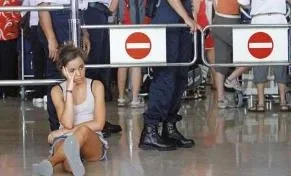
For several days, European train stations and airports became places of unprecedented passenger congestion
Everyone had the same problems. This included the lack of a visa or its expiration, as well as a shortage of money, return tickets, and timely information about what was happening. Add to this the need for accommodation, food, means of communication, and the language barrier – and you get the full picture of a pan-European apocalypse. How, finding yourself in such a situation, do you survive abroad?
Visa blow
It would seem that the one thing that shouldn't have caused problems was visas. Force majeure circumstances were obvious. Moreover, according to the EU Visa Code, adopted in 2009, in case of force majeure, the visa application procedure can be simplified. For example, border guards are given the right to issue visas directly at the border. Those who in London made it to the French border control, which is located at the Eurostar railway terminal, and showed persistence there, received a short-term visa to get home.
During the volcanic force majeure, in most major European airports, consular points worked overtime not only during working hours but also in the evenings and on weekends. For example, at Prague airport, visas were extended in 10-15 minutes.
However, life is richer than any schemes, which is why representatives of travel agencies recommend the most optimal course of action in force majeure conditions. "If a tourist is in the airport not in the transit zone, then he can safely go to the embassy of his country and write an application for visa extension," advises Margarita Gogoleva, director of the travel agency Travel Time. "But if he is in the transit zone, then problems may arise. It's good if border service officers call consular staff to the airport."
That's in theory, but in practice it turned out differently. Dmitry, the guide of a St. Petersburg group of fifteen people, who along with an "Itogi" correspondent found himself trapped in London, took his own path: "I simply took a risk and went to the Polish embassy for a short-term Schengen visa, explained the situation to the staff, they understood us and even let us skip the line. At the embassy, they accommodated us, requiring only photographs, insurance, and a visa fee of 33 pounds sterling each. As a result, the 'Schengen' for the group was obtained in an hour and a half."
Living without worry
Obtaining a visa, as well as its extension, is only half the battle. An equally pressing question: where to find shelter until the departure issue is resolved, given that money is tight? "If under force majeure you are evicted from a hotel, relatives can go to the travel agency where the tour was purchased and extend the stay at the previously booked hotel for a few more days," explains Margarita Gogoleva. "The tourist stays for the number of days paid for by his relatives. Booking will take one hour or about a day if it is decided at the end of the working day."
When a problem with accommodation arises, you need to immediately contact the receiving party (representative of the travel company) by phone. The necessary phone numbers, including guides' mobiles, should be indicated in the memo attached to the tour voucher. Any travel company values its reputation, so in the situation that arose, many firms incurred losses by extending hotel bookings at their own expense. "We accommodated people at our expense hoping to later negotiate with hotels for a 50 percent compensation," Igor Kozlov, general director of the company "Asent Travel," told "Itogi". "Hotels were accommodating."
The problem of accommodation can also be solved by the airline. In case of a daytime flight delay of more than 8 hours, the airline is obliged to accommodate passengers in a hotel. But that's in ordinary life. But when a volcano erupts, the notorious force majeure comes into play again. And then everything depends on the goodwill of the airlines.
While many European airlines left their passengers to sleep in the airports, Russian ones incurred losses and tried to arrange accommodation for citizens in hotels. It is said that in Paris, representatives of Aeroflot initially refused accommodation, citing force majeure, dealing only with complex transit passengers. However, after a day, Aeroflot was already fully accommodating passengers in inexpensive hotels in the area adjacent to the airport. The same thing happened with Aeroflot passengers in Venice. They were not only accommodated but also decently fed.
"Usually it is enough to go to the check-in counter and get a voucher for meals and hotel accommodation," says Margarita Gogoleva. "In the event that the airline, citing force majeure, refuses to pay for food and hotel, the person has to arrange life on his own."
For example, in London, accommodation expenses last week on the most economical option were as follows. About 60 pounds for two per day for a simple room in a "two and a half star" hotel. Those who moved to hostels paid less than 20 pounds per night. By the way, some simply refused to leave their hotel room. "Local laws are such that a hotelier cannot throw you out even with the police," explains Sergey, an employee of a local travel firm. "Of course, there will be a scandal, but they can only evict you by court order, which still needs to be obtained." True, in this case, it must be taken into account that next time you will not be given a British visa under any circumstances.
Always wanting to eat
In London, the airline Transaero provided meals at the airport for its passengers at its own expense. For this, however, they had to stay there all the time. The rest solved the question of daily bread according to their financial capabilities and ingenuity. However, necessity is the mother of invention.
As it turned out, eating on 5-6 pounds a day in London is quite possible. Even in two-star British hotels, you have the opportunity to drink tea and coffee in your rooms. Plus, local supermarkets offer a selection of ready-made cheap meals.
One could head to the Camden area, famous for its "gourmet rows." There, for just 4 pounds, they serve a huge plate of rice with curry, or Chinese noodles with chicken in sweet and sour sauce, or a portion of spicy Mexican chili. And the portions are so large that it is enough for two.
Money-money
The wallets of most tourists ran out by the third day of the forced captivity. Queues appeared at offices dealing with money transfers from abroad. Money from relatives, friends, acquaintances can be received via transfer through one of the companies, whose branches are now available even in the most remote villages.
To do this, you need to deposit a certain amount at the cash desk, fill out a payment form indicating the recipient's last name, first name, phone number, address if available, and a code word. By informing the recipient of the code word, the sender can be sure that the recipient, by saying the password, will instantly receive the money in Paris or Oslo. The operation will cost an average of 5 percent of the transfer amount.
By the way, at the embassy they can help you with cash only in the most extreme case – if it is a matter of life and death. And even then not always and not everywhere...
Escape routes
In principle, the main escape routes were immediately mastered by compatriots. You can catch a train in Europe by reserving a ticket by phone or via the Internet in the desired direction. True, for this you need to have your bank card details, which the operator will require, or you will have to enter them when filling out the electronic form.
You can search for travel companions online to get to your destination by car for a modest sum.
The next option is a taxi. In almost all European cities, you can order one to any corner of the Old World. It is best to call by phone because such an order will be thirty percent cheaper than if it were done at taxi stands.
Some tourists, desperate to get out by train or bus, rented cars. In particular, one of the largest car rental companies in the world – Hertz – provided clients with cars that they could drive, for example, from Germany to France, return the car at a parking lot of the same company and transfer to a train.
By the way, our compatriots came up with perhaps the most exotic method of evacuation, which made Europe once again talk about "crazy Russians." Four wealthy Russian tourists, evacuating from Austria, bought an old Mercedes at a gas station for 5 thousand euros to drive it to Brest. When asked what they would do with it later, the answer was: "We'll just abandon it at the border to avoid paying customs duties..."
For those who decide to steadfastly wait for their flight to depart, it is recommended to constantly stay at the airport or call the airport's duty services every hour. In emergency situations, a departure is prepared in a matter of hours. "Theoretically, a return ticket should be purchased when leaving your country; you can depart on it even if the plane is delayed or if the airline transfers you to another carrier's flight," comments a representative of Travel Time. "Then the ticket must be reissued at the airport at the counter of the airline the passenger will fly with."
If you decide to change your route, cancel your plane ticket and leave by train, then everything depends on the type of flight for which you bought the ticket. If it is a charter, the tourist will most likely not get the money for the plane ticket. As a rule, charter tickets are non-refundable. The tourist is entitled to compensation if the charter did not depart due to the operator's fault, but such a development is practically excluded. In a force majeure situation, all obligations are removed from the operator. Therefore, if the flight did not take place due to a volcano or other cataclysm, the tourist has nothing to count on. The situation is different with regular flights. These tickets can be returned, thus getting the money back, while losing part of the amount spent.
And finally: experienced people recommend, when traveling, to take out insurance against flight delay and cancellation. "In case of unforeseen circumstances, the insurer pays the insured's expenses incurred as a result of the specified risks," says Tatyana Merkulova, Deputy General Director for Sales Development at AlfaStrakhovanie-Life. "As a rule, the company compensates for expenses on food, accommodation, telephony. Some insurers set a fixed amount, for example, for each hour of flight delay, but not more than an agreed amount, say, not more than 400 euros."
Undoubtedly, the taste of volcanic ash will remain with tourists who found themselves at the mercy of circumstances for a long time. Many have learned from personal experience that even developed countries are sometimes unable to solve the problems of their citizens when it comes to force majeure. Now, on a trip, an experienced tourist will definitely take an extra couple of hundred euros rather than the phones and addresses of their country's diplomatic missions.