
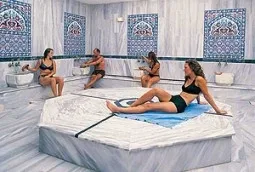
Hamam – a Turkish bathhouse built from stone according to a special architectural design
Speaking of design, bathhouses can be roughly divided into three main types based on the temperature and humidity in the steam room. The first are dry-air baths, where the optimal air temperature is between 60 and 120 degrees and humidity is 10–20 percent. These include stone-heated baths, the Russian banya, and the Finnish sauna. The second type are the so-called ‘wet’ baths, where the air temperature can reach up to 70 degrees and humidity is 90–95%. And the third type are water baths, or Japanese bathhouses.
Each type of bathhouse has its own advantages and disadvantages, its supporters and opponents. Each national bathhouse is built in a style and according to folk traditions.
The oldest steam rooms on earth were the Roman baths. In their construction, precious marble was used for pools, and washbasins were decorated with silver and gold. The bathing ritual had not only hygienic significance; in the baths people socialized and relaxed. In a hot climate, visiting a bathhouse protected against various diseases.
The bathhouse fashion gradually moved to Constantinople, where the famous Turkish bathhouses appeared. They were built according to special original architectural designs from stone, most often marble. Heated floors were doused with water, filling the room with hot steam. Visiting the hamam became a special ritual for the Eastern person. And today, in many bathhouses, you can find stone: stone heaters, stone floors, unique stone countertops and much more.
In Ireland, the bathing process in bathhouses adapted to local mores and customs. Irish bathhouses are similar to the Roman ones, but with lower temperatures.
In Japan, two completely different types of steam rooms are popular. The first is a water bath, where the bathtub is arranged like an ordinary barrel filled with hot water. However, the Japanese also invented an original therapeutic dry sawdust bath, where cedar sawdust is mixed with herbs and heated.
There is also a unique Russian dry bath, where you can steam simply in a bag filled with birch leaves or flower hay. The combination of aromatherapy with gentle heat is beneficial for health. Sand baths are used to treat rheumatism and arthritis, and it is very pleasant to plunge into sea water after such a procedure.
However, despite the variety of exotic types of steam rooms, for a Russian person the closest is the Russian banya, or, at worst, the Finnish sauna. If only because both types of bathhouses are organized in the same way – in a solid log cabin. And although the Finns have improved their saunas, the construction process still follows the same age-old principle.
The bathhouse room is assembled from timber, which is cut using a modern circular sawmill. Various types of wood are used for the interior decoration of the bathhouse. For lovers of a strong pine aroma – cedar or pine, and for those who prefer a healthful effect, interior decoration made of linden is perfect.
The main thing is to remember that nothing invigorates and lifts the mood like a good Russian banya!