
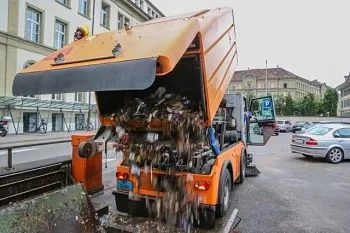
Waste disposal in Bern at the city collection point: no garbage dumps in sight of citizens, all infrastructure hidden underground (Photo Swissinfo.ch)
However, in reality, cleanliness is not where people do not litter, but where they clean. Switzerland is the European champion in the volume of garbage produced, but other countries are suffocating in waste, not Switzerland. Swissinfo.ch invites you to get acquainted with how the waste disposal and street cleaning industry is organized in Bern.
Tuesday, early morning - the clock shows 3:50 a.m. Traffic lights are still off, a lone police car patrols the city center. The streets of Bern are deserted, only an elderly man sitting on a bench, deep asleep, is noticeable. But Roberto Citro has been on his feet for a long time.
Dressed in the summer uniform of Bern's municipal services - orange trousers, blue T-shirt - this 35-year-old guy is about to start his shift. This week it's his turn to take the wheel of the vacuum sweeping machine, the largest in the entire fleet of city cleaning vehicles. In terms of its dimensions, it could indeed rival a small airplane. 'I've always liked being a driver,' Roberto admits.
Early morning enthusiasm
We meet in the 'bunker' - as he calls the head office of Bern's street cleaning service, located on the first floor of a large underground parking lot. With enthusiasm and zeal that few can boast at such an early hour, he first shows me the utility room where brooms, brushes, vacuum cleaners and leaf blowers are stored, then the locker room, staff parking, and a place to rest during a break.
His colleagues are mostly foreigners, primarily Italians, Spaniards and Turks. Roberto himself is also from the Italian administrative region of Campania in the south of the country. Before going on the road, he carefully checks the engine oil level and the condition of the replaceable disc brushes of the cleaning machine. The sound of the turbine sucking in garbage instantly drowns out the music from the radio.
The seats in the cabin are comfortable, but they provide almost no protection from vibration caused by uneven road surfaces. 'It's not very good for the spine,' Roberto says. Along the way, we overtake street sweepers with ordinary brooms. 'Such a broom lasts at best three to four days,' says one of the sweepers. Their task is to take care of cleanliness on sidewalks and in narrow places where the automatic brushes controlled by Roberto, who is responsible today for open city spaces, cannot reach.
Another group of garbage collectors is engaged in emptying street bins and waste containers. In each shift, day or, as now, morning, a total of 15 such specialists work on the streets of central Bern. 'In general, I like working in the mornings because then the whole city belongs to you alone. It's a wonderful feeling,' says Roberto, a black-bearded man with a slight Neapolitan accent.
'Cultural layer of garbage'
One hand on the steering wheel, the other controlling the brushes: Roberto slowly moves along the street leading from the Central Station to the city pedestrian zone. The main rule mandatory for any driver, namely, not to be lazy to turn his head in all directions, he follows especially carefully.
In a minimal period of time, he manages to check the traffic situation in front of him, behind him, to the right, left, and glance at each of the four rearview mirrors. And this is understandable, because his entire path is full of many different obstacles, ranging from tables and chairs of street cafes and road signs to fountains, parked cars and bicycles.
On the street asphalt, you can see garbage of all types and sizes: glass bottles, cans, plastic cups, packaging fragments, paper, and, of course, countless cigarette butts. Roberto says that sometimes under the brushes of his machine even ladies' handbags, wallets, and characteristic packets in which 'grass' or other 'mind-altering' substances are usually sold, end up. 'I am always very glad when the 'dose' ends up in the trash bin,' says Roberto.
In summer, people stay outside longer, which means that garbage collectors have more work. 'I understand that after summer gatherings there is always some garbage. But I am outraged when people throw it on the ground, even though there is a bin or waste container nearby,' he complains.
In Bern, as well as in other cities and towns in Switzerland, strict norms and rules regarding household waste disposal are in force. Anyone caught violating these rules can face a fine of up to 40 francs. So it's better not to throw chewing gum or ice cream wrappers on the pavement in the center of Bern.
'And still, over the years, the volume of garbage is increasing,' notes Andreas Niklaus, official representative of the city's 'Department of Construction and Urban Infrastructure' ('Tiefbauamt Bern'). 'After all, the city's population is also growing year by year, and besides, takeaway food is now in increasing demand,' he says in an interview with the Swissinfo.ch portal.
In Bern, without the agglomeration, about 140,000 people live. 'We can say that this morning, after the night, it turned out to be quite clean,' notes Roberto. However, this is because today is Tuesday, and yesterday was Monday, a day, as we know, hard. But after weekends and holidays, and especially where the nightlife is bustling, a completely different picture often appears before the eyes of street cleaning specialists.
«Maybe in archaeology, trash forms a cultural layer, but in everyday life it's an indicator of complete lack of culture. And it often happens that you haven't even finished your shift yet, but the city already needs cleaning again. And that's very annoying,» says Roberto. A particular problem is idle revelers who, having misjudged their strength, sometimes just fall asleep in the middle of the road or, in a drunken frenzy, try to climb onto a car.
«And this is a real nightmare,» Roberto shakes his head. «Sometimes I have no choice but to call the police. And often many start vomiting right on the street. But we still have to clean up after them too, armed with a rag and a bucket of water.»
Tips for the Street Cleaner
The city hasn't woken up yet, and we are approaching one of the most famous places in all of Switzerland, the square in front of the Federal Palace, where the parliament works and where every Wednesday the government, the Federal Council, holds its meetings. Right opposite is the building of the National (central) Bank of Switzerland. The right side of the square has been turned into an original fountain with 26 jets, one for each canton, shooting straight from the pavement, but for now the fountain is also asleep.
This square, which, believe it or not, is called «Federal Square,» is one of the most strictly guarded places in the country and the city. So it's not surprising that there isn't much trash here. Roberto finishes his work on this square in a matter of minutes. He doesn't want to linger because today is Tuesday, market day, and soon traders will start arriving, and he doesn't want to interfere with them setting up stalls and preparing their fresh produce for sale.
Actually, by his first profession, Roberto is a technical specialist in paint and varnish materials, but since 2008 he has been working for the city's street cleaning department. Over the years, he has thoroughly studied the rhythms of life in Bern, which, unlike other cities, does sometimes fall asleep. He knows that commercial streets with shops and supermarkets should be cleaned first. «Otherwise, they will later be blocked by delivery trucks, and it will be impossible to get through,» he shares the secrets of his craft.
Meanwhile, we leave the area of asphalt streets and find ourselves in the old town of Bern, paved with cobblestones. Due to its unique architecture, preserved almost untouched since the Middle Ages, this part of the city has been a UNESCO World Heritage site since 1983, attracting thousands of tourists from around the world every year. But Roberto makes no exceptions, working just as meticulously as in other areas of the city.
«Sometimes people mistake me for a tour guide and start asking questions,» Roberto notes with a sly smile. Contact with people is exactly what he likes most about his profession. Some passersby sometimes complain about the noise his cleaning machine makes. However, most people understand how important his work is. «I've even gotten tips, a little, five to ten francs, but still - it's a small amount, but nice,» says Roberto.
Trash, Leaves, and Snow
The morning shift has been going on for several hours. We drive around the streets and watch as the city slowly begins to wake up with the first rays of sun. The first trams and buses appear; in the center, cyclists and pedestrians hurrying to work or on errands have already appeared. They are followed by retirees with string bags, then came the hour of dog walkers with their four-legged pets.
For Roberto, this is a sign that it's time to concentrate. «My work requires attention and care. It doesn't take much to have an accident, just a second of inattention.» To those who think that being a street cleaner is, as they say, «a piece of cake,» Roberto recommends personally trying to work in this position. «Try walking around with a broom or mop for a couple of hours and then tell me how you liked it.»
And indeed, waking up early every morning, five to six days a week, is very tiring. But at least no shift is like another; this work cannot be called monotonous in any case, Roberto recounts.
Not to mention that each season places special demands on the garbage specialists. In summer, you have to collect solid waste; in autumn, leaves; and in general, the autumn months are the «hottest time of year.» In winter, you have to clear snow from sidewalks. «But I like that at the end I clearly see the result of my work,» Roberto emphasizes.
8.5 Tons of Trash per Day
The clock reads 7:10 AM. All work in the city center is completely done. Today there is relatively little trash accumulated in the container of the sweeping machine. «Better this much than nothing at all,» Roberto jokes. On average, he and his colleagues collect about 8.5 tons of trash per day on the streets of Bern. The morning break begins. Time to drink coffee, eat a sandwich, play cards... Then he will return to the cab of his orange machine and go clean the next area of the city. And tomorrow everything will start over.
Just the Numbers
* According to Eurostat data published in March 2015, in 2013 the Confederation generated an average of 702 kg of waste per capita. In the EU, this figure is 481 kg. Michael Hügi from the Federal Office for the Environment (Bundesamt für Umwelt) explains this fact by the high level of individual consumption and the prosperous economic situation in Switzerland. «The waste problem, however, is not an environmental problem in the Confederation, since the share of recycled and disposed waste in the country reaches 50%, which is much higher than the average in Western Europe.»
* Street cleaning in Bern is handled by 150 employees of the 'Department of Capital Construction and Urban Infrastructure' ('Tiefbauamt Bern'). For a year's work, they need about 5,000 brooms and brushes.
* The total area of public space in Bern reaches 4.1 million square meters, which corresponds to 850 football fields. Every day, employees of 'Tiefbauamt Bern' monitor 1,300 city trash cans – where necessary, up to 10 times a day.
* For 2013, the city of Bern processed 3,113 tons of solid household waste at a specially built Waste Sorting and Processing Plant (Kehrichtverwertungsanlage – KVA).In a year, the city spends about 20 million francs on cleaning and maintaining squares, sidewalks and streets.
Luigi IORIO.
Translation by Nadezhda Kapone.