
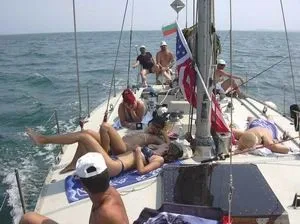
A little over a century ago, English maritime law stated: everyone has an inalienable right to go to sea. But times change. With the development of the coast guard and rescue services, which are funded by the state budget, and on the other hand, under pressure from insurance companies, almost all states with access to the sea have legislated the requirement for a license for a person who operates a yacht.
Coast guard services were tired of rescuing "beginners" who went to sea, taking responsibility for the yacht and the lives of the crew without fully understanding the seriousness of the matter and lacking the necessary skills and knowledge. Insurance companies, for which it was too ruinous to cover damages from the inept actions of yacht owners, also vigorously lobbied for laws on licensing yacht operation. Today it can be said with confidence: without a license, you cannot operate a yacht.
Where and how do people usually obtain licenses to operate a sailing or motor yacht? Currently, there are three most authoritative systems of yacht schools in the world: the British - Royal Yachting Ass (RYA), the American - American Sailing Ass (ASA), and the recently created in the USA system - International Yacht Master Training (IYT).
Since the British RYA is already over a century old, its authority is unconditionally recognized throughout the world, and it has the largest number of partner yacht schools that teach to the highest standards. ASA traces its lineage back to the post-war years and is perhaps too confined to its own continent, although it is recognized almost everywhere.
The IYT system appeared in America several years ago and is currently engaged in opening its schools in as many countries as possible.
It is also worth mentioning a very strong French national yacht school, which, strictly speaking, is not international, but in terms of quality of instruction and traditions is very close to RYA.
All of the above schools, of course, have their own teaching features, but in general they teach the same thing, because the sea and yachts do not change much from country to country. Being familiar firsthand with the three main systems of yacht education - RYA, ASA, and IYT - I can perhaps say that the highest standards of instruction and the oldest maritime traditions are the prerogative of RYA. Therefore, we will consider the path of a person who wanted to learn to operate a yacht and obtain an international license using RYA as an example. The choice is made. What next?
The first requirement is that you must have at least an intermediate level of English. Because you are going to sail in international waters and you will need to communicate with port authorities, coast guard services, and other yachts and vessels. The international language of radio communication is English.
The first step that must be taken if you have no yachting experience at all is Competent Crew ("useful crew member"). Initially, any experience is absolutely unnecessary. The main thing is desire and a basic knowledge of English. This course - half practical, half theoretical - is taken in the form of a five-day yacht voyage. The number of students on the yacht is no more than five people plus an instructor. There are no age restrictions.
During these five days on the yacht, you will be taught the basic skills of working with ropes and sails, the basic techniques of yacht handling, proper maritime terminology, and the fundamentals of navigation safety. Upon completion of this introductory course, you will have 100 nautical miles behind you and will be able to be a fully competent crew member (deckhand) on a sailing or motor yacht. But you are not yet a skipper and cannot operate a yacht.
Next on your path is the first license giving the right to operate a sailing or motor yacht: Day Skipper. It should be noted that if you have some experience sailing on a yacht at sea (about 100 nautical miles) and you know the basics of yachting, you can skip the Competent Crew level and start training directly with the Day Skipper course. This course is more serious and consists of two parts - theoretical and practical.
The theoretical Day Skipper course includes the basics of navigation, meteorology, "rules of the road" at sea, radio communication, and navigation safety. The course is taught for 42 hours. You can take this course in person or remotely (online). It should be noted that all theoretical courses are absolutely identical for sailing and motor yachts. The only difference is that the type of yacht, sailing or motor, for which you want to obtain a license (they are different) will determine the type on which you will take practical classes and pass the exam. Before taking the practical course and passing the exam, you must complete the theoretical course.
I will add that the international yachting training system is based on teaching the most necessary knowledge and skills. At this first stage, no one is going to make you a deep-sea captain.
All training at this level is aimed at giving you the necessary knowledge qualitatively and developing a confident ability to handle a yacht in various situations, and to correctly assess your own capabilities and those of your team in accordance with the current situation, that is, weather, sea conditions, duration and complexity of the passage, etc. They give you a kind of "entrance ticket" to the world of yachting and welcome you into the guild of skippers.
The practical Day Skipper course is a voyage on a yacht. According to RYA standards, there cannot be more than five students on a yacht - to ensure that each receives sufficient attention from the instructor.
Actually, the training is not what we are used to. It is a full-fledged (about 200 nautical miles - 360 km) week-long voyage on a comfortable yacht of the 40-foot (12-15 m) class (for motor yachts, it may be larger). The instructor shows what and how to do, and then each student repeats these actions until they get it right. Everyone plots a course, stands at the helm, commands the mooring and departure procedure. If the courses are sailing, they work with the sails.
In the last two days, the instructor takes turns assigning each student as skipper for an individual passage, and the student must do everything themselves—from drawing up the passage plan to mooring at the destination, like a real skipper. The instructor simply observes how the crew and the skipper cope with the task, and at the end of the course awards (or not) the students the qualification of skipper.
So you are now a yacht captain. With these rights, you can freely sail a yacht up to 24 meters long in all international waters. Port authorities, coast guards, border guards, and—quite importantly—insurance companies recognize you as a skipper. You can charter a yacht and set sail with friends or family, or take part in regattas—the world of yachting is now open to you.
Later, after having lived aboard a yacht for a total of about a month, covering approximately 800 nautical miles (rather modest requirements), and completing a one-day course on the use of the onboard VHF radio, you can continue your training under the RYA program to the Coastal Skipper qualification.
The Coastal Skipper training is structured exactly the same: 50 hours—a theoretical course aimed at a deeper study of navigation and meteorology—and a practical week-long course with an exam, during which the instructor seeks to give you deeper knowledge and skills in handling a yacht in demanding conditions: stormy, nighttime, restricted visibility, etc.
The third step is Yacht Master, captain. It requires 2.5 thousand nautical miles (including those previously accumulated), 50 days aboard a yacht, five passages of more than 60 nautical miles, including two night passages, and a one-day first aid course.
Finally, the highest qualification in amateur yachting—Yacht Master Ocean—is converted from Yacht Master upon completing one ocean passage and passing an exam in astronavigation.
Learning to sail is not only possible but necessary: first and foremost, it is a matter of safety—for yourself, your yacht, and the people whose lives and health you are responsible for during the voyage. But the process itself is very interesting, and the training is designed so that people who wish to take up this wonderful sport (or lifestyle?) feel its beauty and joy from the very first steps.
Ivan VAKHTIN. // Газета.Ru