
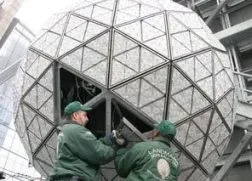
The famous ball is updated almost every year
Paul Bennett, author of the book "A History of Time," notes that the tradition of marking the passage of time with the ringing of bells was first established in Milan, Italy in 1335. At that time, a bell installed in the bell tower of the Church of San Gottardo began to function as follows: at one in the morning it rang once, and midnight was marked by 24 strokes. In fact, for the first time in human history, a large group of people was informed about the passage of time (even at the beginning of the 20th century, Native Americans were astonished by the commitment of Americans and Europeans to dividing the day into parts).
After that, the ringing of church bells marking the hours, and much rarer tower clocks, became the basis for timekeeping – their accuracy was extremely low. The vast majority of the planet's inhabitants had no idea of precise time until the beginning of the 18th century. The first pocket watches with a minute hand were made around 1700.
Perhaps one of the main reasons why the accuracy of timekeeping became important was the interests of navigators – precise time was necessary for successful navigation. Arthur Herman, author of the book "To Rule the Waves: How the British Navy Changed the Modern World," provides the following data: first, English watchmaker John Harrison invented the chronometer in 1761. After that, the need for synchronization of clocks arose. Robert Wauchope, a captain of the British Navy, proposed a simple solution: a special signal should appear in every harbor – captains could notice it and accurately set their ship's chronometers. In 1829, the British Admiralty first began this operation in the port of Portsmouth: a red ball (a wooden frame covered with leather) dropped from a spire exactly at 12:58 p.m. – its fall ended exactly at 1:00 p.m. The U.S. Navy borrowed this idea in 1845, and from 1877 the ball dropped in New York Harbor.
Nancy Lee and Clyde Haberman in the book "A Century of Times Square" describe the process of inventing the New Year's tradition as follows. In 1907, the New York Times newspaper, whose editorial office was located on Times Square (the square had gotten its name three years earlier when the newspaper moved into the building), first dropped a ball to mark the arrival of the New Year. The reason was quite prosaic – city authorities banned fireworks, and the newspaper staff decided to adopt a maritime custom. The first ball in history consisted of a frame (made of metal brackets and wooden spacers) on which 100 electric bulbs were installed. The ball was 1.5 meters in diameter. It was dropped a second after the start of the New Year. In 1914, the New York Times moved to another building, but the tradition continued.
The further history of this tradition is also quite interesting. During the war years of 1942-1943, the ball was not dropped – for reasons of blackout and energy conservation. In 1955, the ball was first made of aluminum. The colors of the bulbs changed periodically: initially they were white, in the 1980s red-green, and later white again.
In 2000 – on the eve of the new millennium – the ball was completely replaced. In its new form, it had a diameter of 1.9 meters. It contained more than 600 bulbs glowing white, red, blue, green, and yellow. Various inscriptions were engraved on the glass, matching the spirit of the holiday: for example, "Hope for Wisdom" and "Hope for Courage."
In 2008 – to mark the 100th anniversary of the tradition – the ball was improved again. Its glow was provided by nearly 9,600 bulbs capable of reproducing more than 16.7 million color shades. For the first time, energy efficiency was considered in the ball's manufacture, and it was emphasized that the ball consumes as much electricity as ten toasters.
The ball that was dropped on December 31, 2008, was again updated and became larger (diameter 3.7 m). In addition, the pole on which it is mounted was rebuilt. For the first time, the ball remained in the square after the holiday ended and could be admired all year round.
In recent years, this ceremony has attracted more than 1 million people, and more than 1 billion have watched it on television.
Based on materials from Washington ProFile.