
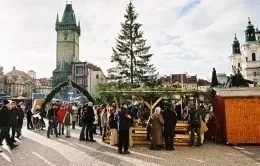
The main Christmas tree of the Czech Republic is traditionally set up on Old Town Square in Prague
However, there is another scenario: it's +12°C outside, the lawns are as green as in May, pansies are blooming, and it seems that winter won't come this year. And that's when the pre-Christmas bustle comes to the rescue, to bring people back down to earth and reconcile them with the calendar.
There is no third option: a snowy Christmas in Prague is an unaffordable luxury. Everyone dreams of it, but few have seen it.
In either case, people prepare for the main holiday of the year thoughtfully and for a long time, but they snap out of the winter revelry all at once. Everyone except Russian tourists, who even on January 10 still feel that everything is just beginning.
November 11. Daylight hours have already shortened so much that a pick-me-up is needed. For some, it's the first snow (traditionally expected on this day – St. Martin's Day), for others, it's young wine, ceremoniously uncorked at 11/11 at 11:11. Snow usually doesn't come (Martin increasingly enters Czech cities not on the legendary white horse but on some other means of transport), but there's plenty of wine at fairs, restaurants, and shops for everyone.
November 20. The media spreads the joyful news that the country's future main Christmas tree has been chosen. The tree has been measured, photographed from all sides, and tested for strength to prevent a repeat of the tragedy that occurred several years ago, when an oversized tree couldn't withstand a December storm and fell on tourists strolling across Old Town Square.
November 26. Under cover of night, the country's main Christmas tree arrives at Old Town Square, is erected, and begins to be decorated. At the same time, fairs open on other Prague squares, featuring nativity scenes, Christmas fairies, witches, straw angels, hand-painted ornaments, and, of course, mulled wine.
November 28–29. "One, two, three – let the tree shine!" After reciting something like that, the mayor of Prague kicks off the pre-Christmas festivities, first on Old Town Square and then on Wenceslas Square. The president's wife acts as the Snow Maiden at Prague Castle. A guard of honor is posted near the modest "presidential" tree, hidden behind St. Vitus Cathedral.
December 5. The first serious pre-Christmas rehearsal. On this day – the eve of St. Mikuláš Day (in Russian, St. Nicholas the Wonderworker, who in English-speaking countries transformed into Santa Claus) – children receive gifts. Adults remember their childhood and have fun in carnival costumes until they get tired, because Mikuláš is also the Czech "Halloween." The local Santa Claus comes accompanied by a Devil and an Angel, who help decide who deserves gifts and who deserves punishment.
Hundreds of "Mikulášes" and "angels" and thousands of "devils" take to the streets. Children are scared but overcome their fear to receive a candy or chocolate from the fairy-tale visitors. Adults drink mulled wine (in Czech, svařené víno, or svařák) and snack on trdelník – a festive pastry, bramboráky – potato pancakes, a whole roast boar's knee, and Václav sausages.
December 6. Christmas tree markets open. You can buy a live tree – "stromeček" – for every taste, and they will even wrap it in a special tree-rolling machine, like a suitcase at the airport. It's said that buyers are shamelessly cheated by measuring trees diagonally instead of from top to bottom, but the linear meter is cheap anyway.
December 7–22. In Prague, and not only in Prague, fairs gain momentum. The bestseller is gingerbread houses, which have only one drawback: it's a pity to eat them. To enhance the festive mood, market visitors are invited to work on Christmas paraphernalia: making candles, decorating gingerbread, etc. If by this time svařák has become boring, you can switch to grog or punch.
By the way, it's better not to wear light-colored clothes to the fairs: if you don't spill on yourself, others will spill on you. If neither punch nor grog appeals to you, you can go, for example, to Plzeň: there, all pre-Christmas festivities have a distinct beer flavor, and on one of the weekends, you can win a year's supply of the foamy beverage by guessing how many lights adorn the city's Christmas tree.
December 20. Huge tubs appear in squares and on sidewalks, in which carp the size of a medium piglet swirl. Without carp (in Czech, kapr), ideally, no Christmas feast is complete.
True, in recent years, fish often play the role not of a traditional dish but of companions: they swim in the bathtub for a couple of days eating bread crumbs, and spend the fateful evening in a basin of water placed among other dishes. Then the fish are released into the Vltava. Few farmed carp can appreciate such a heartfelt impulse, but fishermen and river predators have a field day.
Stores switch to extended hours: gifts can be bought until midnight, and treats around the clock.
December 24. Tourists arrive, enticed by "Christmas in Prague™." Woe to those who flew in for three days: shortly after noon, all fairs close (most will not reopen), and service workers, who have worked year-round without days off, flee their posts. Some go to Christmas masses that evening, others straight home, where carp, live or fried, potato salad, and a second batch of gifts brought this time by the baby Jesus await.
The next day, nothing works; the day after, almost nothing. However, there are exceptions to every "nothing" – central clubs and restaurants with Moscow prices, and immigrant shops, for whom Catholic Christmas differs from other days only by the opportunity to earn more.
December 25. The dreams of Russians who hoped for free Christmas trees shatter: the tree markets have disappeared as if they never existed.
December 31. Czechs have only a couple of days off ahead, but that doesn't stop them from celebrating the New Year (locally called Sylvester) with a bang – nostalgic television from early morning, street concerts, champagne, and fireworks. The artillery barrage on Wenceslas Square and Old Town Square begins with the chiming of the clock (instead of the Kremlin chimes, the astronomical clock Orloj serves as the New Year's fetish) and ends when the pyrotechnics run out. Local TV operators strive to climb higher to film this mess and bend over backwards to avoid being shot.
When it gets quieter, international participants of the festivities rush to congratulate acquaintances and random passersby, everything is smoking, bottles and plastic cups lie underfoot, raising serious concerns for the city's safety. But by noon on January 1, only pitiful remnants of the holiday debris remain: the municipal services are on the ball.
January 2 – January 10. Most fairs have already closed, but the largest ones used to stay open until January 3, and this year they might last until the 10th – to the delight of Russian tourists who wondered 'how can you celebrate the New Year in just one day?'
It's simple: you need to start earlier, preferably in November, then on January 3 you can return to work with a clear conscience. After all, the day has finally started to lengthen, and the festive lights are already making your eyes ache.
Alexander KIRICHENKO,
Chief Editor of the Russian-language online publication about the Czech Republic Utro.cz.