
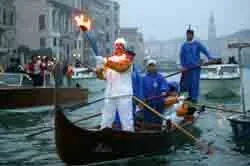
In general, fans who will follow the vicissitudes of the Olympic Games can be divided into two unequal categories. The first includes those who like to be present in the stands, the second – fans of a more comfortable rest in front of the TV. Of course, reference information about the upcoming Olympic Games will be needed by both groups. With the only difference that activists, in addition to data on where and when certain competitions will take place, will also need practical advice. We will try to give it, relying on the experience of people who have lived in Italy for a considerable time.
About the road to Turin
For most fans, Turin-2006 will begin with Milan. It is in this city that Malpensa Airport is located – the main air gate of Northern Italy. However, slightly north of Turin there is also an airport – Caselle, but apparently the main burden will have to be borne by Milan. Moreover, for those who land at Caselle, the information written below is unlikely to be useful. And the threats of Turin airport employees to stage a serious strike during the Olympic Games could significantly affect capacity.
So, for those who landed in Milan (more precisely, at Malpensa) and intend to get to Turin on their own, without the help of a travel agency. Buses leave directly from the airport about once every 20 minutes and will take you to Milan's central station in just over an hour. And from there by direct train in one and a half or two hours you will get to Turin.
There is another option – a two-story electric train, which also departs from the airport towards Milan. But, firstly, you will have to spend some time looking for the place where the train stops, and secondly, it costs twice as much (strange, in Ukraine railway transport is cheaper than automobile). In addition, the electric train arrives not at Milan's central station, but at one of the auxiliary ones, from where you will have to get to the central station for some time. Also, do not forget to validate the electric train tickets in a special machine, while bus tickets can be bought directly from the driver. In short, nothing but a headache.
There is another nuance that not everyone will be able to understand. In Italy, since this year, smoking in public places is strictly prohibited. The fines for violation are serious. Now you can't just light up in a restaurant or cafe – you need to look for establishments that have special smoking rooms, but it's not easy to do in a foreign country. But a bus ride (which, in fact, is what the conversation was started about) allows you to enjoy a cigarette right next to the vehicle. No one will chase anyone for this.
Advice from a veteran
It is best to navigate in a foreign country if there is someone nearby who has already been to these places and knows something about local customs and nuances. One of such experienced people in our case is the Russian journalist Georgy Kudinov, who has been living in Italy for a long time. He even published in the newspaper “Sport-Express” something like cheat sheets for those starting to study Italy. So, “advice from an experienced person”.
“From the airport to Milan, or even to Turin (if you have money to burn), you can get by taxi. Finding an official stand will not be difficult, but I do not advise trusting all sorts of suspicious types who offer you private services. As for paying taxi drivers, they usually do without tips. True, this is in peacetime, but in a tense Olympic time, the driver may well make unambiguous hints. You can with a clear conscience ignore hints. No, of course, if the trip cost nine euros eighty cents, rewarding the “boss” with a ten-euro bill without change is not a sin, but do not agree to more.
Since your road there and back goes through Milan, allow me a few kind words about the city dear to my heart - in case you want to make a short stop here. So, in February Milan may appeal to you with echoes of sales - here you have fashionable clothes and shoes; matches of the football Serie “A”, fashionable shops for the rich, as well as Fashion Week and a series of major exhibitions. And also in Milan we have the majestic cathedral and the famous “Last Supper” by Leonardo da Vinci, the Brera Museum and the pedestrian area of Navigli. Plus... However, enough. You already understand everything: Milan is worth spending time on both on the way to Turin and back.
But let's not get distracted. So, what awaits you in Turin? I will answer briefly: chaos. If I am wrong and you are lucky, you can throw a stone at me. However, so far there are all the prerequisites for Turin, which even today in places resembles a post-war city in the grip of devastation, to finally go crazy from the influx of guests. Chaos, as my Italian experience suggests, will, for example, manifest itself in monstrous traffic jams on city streets, the inability of Italians to express themselves in English, the presence of a large number of good-natured but clueless volunteers, and the passionate desire of restaurant and bar owners to earn as much as possible without bothering too much to improve the quality of dishes and the level of service.
Here is another fundamental piece of advice: in Italy, better a sparrow in the hand than a crane in the sky. If you have to choose between an earlier train (bus) and the last train (bus), do not take risks – leave earlier: the last train (bus) may not appear.
If a knowledgeable person offers you to have lunch in a restaurant at noon, and it seems too early to you, agree anyway: otherwise you may not eat at all – due to queues and the early closing of the kitchen.
If you have the opportunity to go on this or that excursion or visit this or that notable place today, do not put it off until tomorrow: tomorrow fog, a strike, an unexpected and mysterious illness of your guide, a breakdown of a car or bus, and anything at all may interfere.
And one more thing: don’t be surprised by anything. If one fine day it turns out that you cannot get by train from Turin to the mountains where the competitions are held, because some strange people have lain down on the rails, know that this is how Italians protest against the construction of the high-speed Turin–Lyon railway. There are about 50,000 of them, rebels, so a dozen or two may well turn up on your way. If one fine day some guide or travel agency representative forgets to pick you up or send a bus, don’t grieve or be surprised: the person has already received all your money in advance, why should they bother now?
About roads and maps
Before heading to the Olympic Games, it would be a good idea to thoroughly familiarize yourself with the area. The fact that the Games will be held in Turin does not mean that you will spend all your sports leisure in this large city. After all, by and large, Turin is only the capital of the sports festival, and only one of three Olympic villages will be located there. It is, of course, the largest (designed for 2,500 people) and is intended for athletes and coaches in hockey, figure skating, short track, speed skating and curling. The NOC offices are planned to be located on the ground floors of the buildings where the delegation will be housed. The two-story dining hall has 824 seats. The village has three fitness rooms, an internet café, an arcade hall, and a DVD hall.
The Turin Olympic Village is quite far from the places where biathlon, cross-country skiing, alpine skiing, ski jumping and freestyle competitions will take place – almost 100 kilometers. Therefore, many of those staying in Turin will have to do a fair amount of driving along the mountain roads of Piedmont. After all, only some competitions will be held in Turin itself (although the number of events is greater than in other places). The Oval Lingotto sports complex (capacity 8,463 spectators) will host the speed skating competitions. The Palavela (8,285 spectators) will become the arena for figure skating and short track representatives. And the hockey tournament among men and women will take place in two complexes at once – Palasport Olimpico (designed for 12,116 people) and Torino Esposizioni (6,165 people).
Not far from Turin (about 40 kilometers from the Olympic Village to the southwest) is the curling center – the town of Pinerolo. The local sports complex Pinerolo Palaghiaccio, designed for 2,982 people, will host all Olympic competitions in this sport. By the way, if you head northwest from Pinerolo, you can soon reach the places where representatives of alpine skiing disciplines will compete for medals. But there, to Pragelato, a different, much more convenient route leads from Turin.
To get to Pinerolo, to the southwest, you should leave Turin along the A55 highway; to the west, where the two other Olympic villages are located, leads the A32 highway. The road is long – almost 100 kilometers. And the first serious stop is in Sauze d’Oulx-Jouvenceaux. Here, 84 kilometers from Turin, freestyle competitions will take place, and the spectator stands are designed for 8,460 people.
It is here that the road for Olympic tourists forks. The main highway you were driving on will lead to the Olympic Village in Bardonecchia, intended for athletes and specialists in biathlon, freestyle and snowboarding. For accommodation, three fully reconstructed hotel buildings will be provided. The village is designed for 700 people. At the same time, only snowboarding competitions will be held in Bardonecchia itself (the stands can accommodate 7,646 people).
Beyond Bardonecchia is already the French border, and there is no point going there if you don’t want to leave Italy. But if you return to Sauze d’Oulx-Jouvenceaux, where, as we remember, there was a fork, you can head south – to where a whole series of Olympic venues are located. There, near the town of Cesana, biathletes will compete (in Cesana San Sicario). The local track for representatives of this sport, according to many, partly resembles a course for alpine skiers, but spectators (along the ski track and at the shooting ranges can accommodate 6,420 people) should only like it. And nearby, in San Sicario Fraiteve, where the slopes are an order of magnitude steeper, female alpine skiers will compete for medals. Their competitions can be watched by 6,160 people. And finally, in Cesana Pariol, at the stadium whose stands can hold 7,130 spectators, competitions for bobsledders, luge riders and skeleton athletes will be held.
Higher up in the mountains is the Olympic Village in Sestriere. It is located at an altitude of 2,035 meters above sea level and is designed for 1,700 athletes and coaches in alpine skiing, cross-country skiing, bobsleigh, luge, skeleton, Nordic combined and ski jumping. The organizers are obliged to create equally comfortable conditions for living and recreation for athletes in all three villages. The village is divided into an international zone and a residential zone. A bus is planned to circulate around the village.
Here, in Sestriere Colle and Sestriere Borgata, alpine skiing competitions will take place (stands for 9,250 and 8,560 people respectively). A little further are Pragelato Plan and Pragelato. There, cross-country skiers, ski jumpers and Nordic combined athletes will compete for the title of Olympic champion. The ski stadium in Pragelato Plan can accommodate 8,166 people. Exactly the same number of spectators will be able to watch ski jumping in Pragelato.