
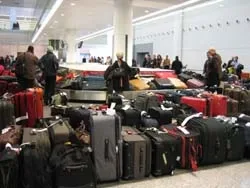
According to the Association of European Airlines, in 2007 in Europe, for every thousand passengers transported, there were an average of 16.6 pieces of lost luggage. The worst were TAP Portugal (27.8 pieces per 1,000 people) and British Airways (26.5 pieces). In 2008, British Airways will most likely reclaim its 'prize' place: at the end of March this year, after the opening of the new Terminal 5 at Heathrow, due to failures in the automatic baggage sorting system, several dozen flights were canceled and about 28,000 suitcases were lost. Due to the subsequent scandal, BA CEO Willie Walsh even gave up his annual bonus of $1.2 million.
Passenger luggage is a headache for airlines. A large number of suitcases slows down their loading onto the plane, and the financial losses of airlines related to the search for missing items and compensation payments reached $3.8 billion in 2007. Even luggage taken into the cabin by a passenger can potentially slow down boarding, and consequently cause flight delays. It is not surprising that companies have begun to encourage passengers to travel with as little luggage as possible. Some major carriers have started charging an additional fee for a second suitcase, and some low-cost airlines have introduced separate fees for any checked baggage.
Of course, the best way not to lose your luggage is to take it with you into the aircraft cabin. However, security rules currently introduced by most airlines make this extremely inconvenient, as many hygiene items simply cannot be taken on board. In addition, when buying bags or a suitcase with expandable capacity, marked 'Cabin Friendly', keep in mind that you will only be allowed into the cabin with it if you do not use its extra capacity. Otherwise, it will not fit within the permitted dimensions.
According to SITA data, 16% of lost luggage was simply not loaded onto the plane. The main reasons for this include: loss or incorrect identification of the baggage tag, late check-in for the flight, and overbooking. You can reduce the likelihood of these events by arriving for check-in at least 2 hours before departure. In addition, you should take care to remove all previous baggage tags and attach the new one only to one handle of the bag (in this case, there is less chance that the tag will be torn off during handling). If, due to overbooking, you are sent on another flight, it makes sense to additionally clarify the fate of your own luggage.
The likelihood of losing your favorite suitcase can be reduced by following simple rules.
1. A bright tag or unusual coloring will help to clearly identify your luggage on the carousel. Of course, some companies produce very convenient and high-quality suitcases, but only an eagle eye can find their own among a dozen look-alikes. Expensive items from famous designers are best left for a private plane or always taken into the cabin.
2. Do not overstuff your suitcase. An overloaded one has a higher chance of being lost or damaged. Keep in mind that loaders dislike heavy luggage, and their main priority is speed, not careful handling of each bag. In addition, if problems arise, the airline will refuse to pay compensation if it is determined that the suitcase was excessively loaded. If your shopping during the trip was successful, be sure to secure the suitcase with tape or wrap it in cellophane.
3. Do not lock your belongings with a lock. This will not protect against thieves, but if customs or security need to open the suitcase, they will have to find its owner. If that proves difficult (and not all passengers listen carefully to airport announcements), the luggage simply will not be loaded onto the plane.
4. The likelihood of not finding your suitcase on the carousel increases by 1.5 times when flying on a connecting flight. In this case, when booking tickets, you should ensure that the layover time is at least one hour.
If, despite all precautions, the suitcase does not appear on the carousel at the arrival airport, you should immediately report the lost luggage and fill out a special form. In the case of a connecting flight, you should contact the last carrier. Currently, most airlines in the world are connected to the WorldTracer lost luggage search system, which contains information about all lost and found items and their descriptions.
When packing suitcases, always remember that they may be lost, and take simple actions that increase the likelihood of their speedy recovery.
1. Be sure to leave your contact information both outside and inside the suitcase.
2. Take a photo of the suitcase from the outside and its contents.
3. Make a list of items inside.
4. Find out the approximate weight of the luggage.
These measures may seem excessive, but the main difficulties with luggage retrieval are related to the fact that the passenger often cannot correctly indicate the main features of their suitcase (and sometimes even incorrectly states its color!). And in the event of loss of the baggage tag, luggage can only be found by its description.
And although in 2007, 42 million pieces of luggage were lost worldwide, if you do not find your suitcase on the carousel, do not despair. According to SITA statistics, only 3% of all passengers' items that did not arrive on time are irretrievably lost; most missing items are returned to their owners within 48 hours.