
In the end, of course, I began to feel that I was the only one left on the stock market, so I started calling those I hadn't heard from since the onset of the recession, convincing them that I had pulled my money out long ago.
This finally shattered my nerves, and I made the only right decision: rather than sit and stare with mad eyes at the downward trend of the RTS chart, it was better to leave this crazy world for a few days. And head to northern Vietnam, to exotic ethnic groups that the global financial crisis would never touch.
Especially since my local guide, Tung, who met me at dawn at the Lao Cai train station, promised to take me to a real wilderness. And he kept his word. In northern Vietnam, I was greeted by the charm of sharp green mountains, the dangers of suspension bridges made of reeds, the stunning costumes of black-toothed natives – in short, everything a passionate traveler could dream of.
Lao Cai is located in the north of the country, right at the Chinese border: across the river, Chinese high-rises of glass and billboards with Chinese characters already loom over Vietnam. The train from Hanoi runs all night to get here, and from here tourists spread out to various mountain villages in search of colorful markets and picturesque mountain landscapes. The main tourist base of the region is the highland town of Sapa (this name, as everywhere in Vietnam, actually consists of two words), a former French resort that saved colonists from Hanoi's summer heat. Sapa has good infrastructure of hotels, restaurants, and shops, but at the same time offers the opportunity to admire the numerous local ethnic groups living in and around it, diverse in origin, appearance, religion, and culture.
They all gather at the markets that happen daily in some village around Sapa (but only they themselves know which one). I was easily convinced that on Saturday the market would be in the village of Can Cau, and on Sunday I had to rush to the market in Bac Ha, unless, of course, I set myself the task of going to the Tuesday market in Muong Khuong. I didn't.
Each ethnic group here lives in its own way and emphasizes its dissimilarity from others. There is no 21st century here, and it won't come anytime soon. There is almost no asphalt, very few cars, no supermarkets, almost no fences even. What stock market? I forgot about it within fifteen minutes! People all walk around in traditional colorful costumes that they make and dye themselves, and they are engaged in growing rice on terraces or on burnt forest plots. The latter greatly worries the Vietnamese government, because every time there is a threat of burning down half of Vietnam, and therefore slash-and-burn agriculture is strictly prohibited for the mountain tribes. But growing opium poppies is also prohibited – but even to my not very inquisitive eye, this ban, to put it mildly, doesn't work.
The government has provided electricity to those villages it could reach, but was too lazy to put up poles, so the wires usually hang from trees along mountain paths. It also allocates money to the ethnic groups to buy televisions and books, but the women of the Red Dao tribe confessed to me that they spent every last cent on buying a motorcycle, which they use to go to Sapa to speculate in souvenirs.
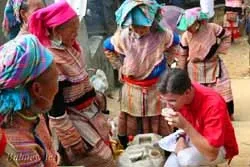
The Red Dao are one of the most colorful ethnic groups in Vietnam. They live in huge houses designed for several generations of a family and grow rice using some clever method that brings them incredible harvests and the envy of neighboring tribes. When we showed up in their village, the rice had just been harvested, and straw was being burned in all the fields around to fertilize the land, so the scene was no less majestic than the Moscow fire of 1812. Along the smoke-filled streets, women in giant red headdresses resembling inflatable balloons strolled calmly. It is because of these headdresses that the Red Dao got their second name, and it is because of them that groups of tourists trickle here from Sapa. As a result, the village women speak excellent English, although they walk barefoot and live on bare earth, and understand Vietnamese much less well.
"Buy this thing from me," a woman of about ten with a melancholy baby slung on her back addressed me with a brash Hollywood accent, pulling a pillowcase with an indescribable pattern out of her bag.
"I don't need it," I replied in the same tone, although her tone seemed somewhat threatening to me.
"What do you need then? This huge bag?"
"No, not that either."
"Well, buy this belt for your girlfriend."
"I have no money," I put forward my last argument, but was surprised to hear in response:
"If you had no money, you wouldn't have come here" ("you bastard," she almost added, it seemed to me).
We walked in silence for a while.
"So, are you very hungry here?" I asked, observing the piles of rice bags stacked near every hut.
"Well, not hungry, but not very happy either," she answered instantly.
"Well, I'm not very happy either," I replied. "Margin calls hit the market, the RTS fell below the floor, have you heard?.."
But she hadn't heard. A survey of the villagers showed that they don't even know what Russia is, although they listed a dozen European countries – Russian tourists simply never come here. Having made sure that the pillowcase hadn't excited me, my interlocutor and her child expressed their unfriendliness by switching to an idyllic French couple, instantly brought down to earth.
The Black Dao behave very differently; they come from the high mountains far away to the market in Bac Ha. Actually, the Dao ethnic group in southern China (where they originated) are called Yao, in Thailand they are called Mien, and they are famous in the region for their bright clothing, tea plantations, and beautiful women. True, I think that besides beauty, a girl should also have minimal communication skills. These women, however, at the sight of a more or less white person, would become severely stupefied. But the Black Dao indeed had amazingly beautiful hats with colorful ribbons, and I had to get one for my collection at all costs.
We picked out a Dao woman who seemed the most reasonable among them, but my guide tried unsuccessfully to communicate with her in Vietnamese - it quickly turned out that she could not even count to five in any decent language. Losing her hat, even for money, was something beyond reality for her, and it took a long time before she internally realized that they were asking the impossible. Then, after consulting with her tribesmen, the beauty, whom I took for 16 and even briefly tried to flirt with through gestures, took off her hat (turning out, to my horror, to be a gray-haired old woman) and announced a price that literally made the market groan: two hundred thousand dong (about $12).
She can be forgiven: she didn't know. Only people desperately close to me know how cruel I can be to ethnic minorities when it's time to haggle for a hat. But this one - this was one of the toughest deals of my life. A silent duel of burning eyes, gesturing that cut the air, an electrified atmosphere of the subtlest war of nerves over a thousand Vietnamese dong. But that day she didn't stand a chance. After it became clear on how many different languages this woman and I were speaking, I bought my coveted hat for 150 thousand from her neighbor. And as we were crawling away from the market in defeat, that neighbor, in pure Vietnamese, offered my guide to buy from her the goods she had laid out for sale and for which she had descended into the valley for two days: all for 50 thousand dong…
At the only hotel in the district center of Bac Ha, whose exterior did not make one shudder, I asked to change the assigned room so that the windows did not face the street. 'But then they'll face the market,' the hotel staff exchanged glances, and a barely perceptible shadow passed over their faces, which, however, I did not catch. And, not sensing a catch, I agreed. At sunset, the empty market from my window looked quite picturesque and completely deserted.
It all started at dawn, because that was the moment when all the peoples of northern Vietnam rushed to the market. All the sounds that a person could imagine were heard: people shouting at each other, trucks roaring deep, black pigs squealing, and the engines of a hundred ancient mopeds refusing to start right under my window. Someone was laughing hysterically, choosing the most piercing chords, and somewhere there were blood-curdling death cries that made me jump in bed. Some guy at five in the morning connected his TV - apparently the only one in the area - to powerful amplifiers and broadcast a Chinese movie with terrible but surprisingly monotonous music throughout the valley. It's a pity that my fond dream of finding and destroying this guy will never come true. But after such a wake-up call, I was full of energy all day.
At the market in Bac Ha, the dominant group is the striped (or flowery) Hmong, who live up to their name with the coloring of their clothes. They are nice, good-natured people, living in small hamlets on the nearby high hills. They raise black pigs, ride black horses, plow with black water buffaloes, and their settlements have black dogs. When I pointed out this romantic peculiarity to the guide, he shrugged: 'The Hmong themselves will soon turn black. They live in dirt…'
And indeed: in the vicinity of Sapa, the Black Hmong also live, wearing colorful long indigo jackets, matching turbans, and black leggings with intricate patterns to complete the ensemble. They also love jewelry, parading through the streets of Sapa. Besides silver trinkets strung on all parts of the body, they proudly glisten in the sun with their golden teeth. This is a common feature of Southeast Asian tribes, but only now, thanks to my guide Tung, I uncovered the secret of these teeth: they are not gold at all, only coated with gilding, and any dentist in Lao Cai stamps out a dozen such teeth a day.
Here I proudly saw that not all mountain tribes are ignorant of Russia. Old man Se, whom we found in a village of the Black Hmong, had fought victoriously against the Americans, and after them against the Chinese, and even received a certificate for excellent service from the military leadership of Vietnam, which still adorns the wooden wall of his home. Learning that I was from Russia, he looked at my good-natured grimace, chewed his lips for a few seconds, resurrecting the memory of international friendship, and addressed my guide: 'Tell him: wherever he goes in Vietnam, people will help him anywhere…'
In addition to the Hmong and Dzao, the surroundings of Lao Cai are also home to the Phuna, Tai, Zai, Safo and other peoples less known to science. Each of them has its own reputation, its own charming and unique costume, lifestyle, and customs. It is well known that the Hmong live high in the mountains, and the Zai in the river valleys. The Tai (by the way, the closest relatives of the inhabitants of Thailand) speak Vietnamese perfectly, build stone houses and are considered successful businessmen. One of them - the most successful - no older than a first-grader, tried for a long time to charge me money for crossing a village bridge over a stream. He convinced Tung that his family built the bridge, and the passage cost 2,000 dong. At that moment, unfortunately for him, a group of locals loaded with bags rumbled across the bridge, completely ignoring this child, which settled our argument. But the enterprising boy still extracted a promise from my guide 'for next time'.
In contrast, the Phuna tribe is considered a model of human laziness. If there is food in the house, they don't go out for days, Tung told me. And if the rice is eaten, they will eat bamboo shoots, because they are too lazy to raise pigs.
Well, it's good that they are lazy - I was already terribly tired of pork. In northern Vietnam I constantly ate it, and I could not diversify the menu. Once we were crossing a rattan suspension bridge over a picturesque stream, and I bloodthirstily asked my friend if there were any fish here. 'Fish?' Tung was surprised. 'No! If it were here, the locals would have eaten it long ago!'
Apparently, that is why on the last evening before leaving for Hanoi, my guide advised me to try dog for dinner. I had never eaten dog before, although I studied Korean for five years, and my whole life I was blamed for both. On the other hand, it's not very pleasant to live the rest of your life with the feeling that for your dinner some poor Druzhok was beaten to death.
But Tung was adamant on this issue. He told me that dog meat is a national dish of any Vietnamese. And the 54 minorities of the country also do not disdain it: dog, he said, is eaten by the Zai, Bana, Phuna, Hmong, White Dzao. The Red and Black Dzao also eat dog. The entire multinational might of the country stood before me as a stern instruction for dinner. And I decided to try dog.
That evening it was accompanied by wild mushroom soup, fried rice, lemongrass stalks and vegetables, and all this somewhat softened the sharpness of the psychological sensations. Moreover, the four-legged friend, frankly, is quite pleasant food to my taste, although not much different from pork, especially when sprinkled with soy sauce. I ate quickly, trying not to look around.
- Do you have a dog at home? - asked Tung, picking a fatter piece from the plate.
- I did, - I replied in a faltering voice. - As a child, a red one. So fluffy...
- Eaten? - he inquired businesslike.
I attacked the fried rice.
- You did the right thing, - my guide clarified. - We Vietnamese have a belief: if you eat a dog on the first day after the full moon, the biggest problem will disappear from your life.
I looked out the window. Dusk and silence were quickly descending on the Bac Ha valley, and the mist was already stretching its translucent white tongues from behind the sharp-pointed mountains, behind which a perfectly round lunar disk was rising over Vietnam.
And I remembered. After all, there was also a problem in my life. Finishing dinner, with trembling hands, I opened the financial quotes site on my smartphone - and could not believe my eyes. Trading on the Russian market had just ended, the index had risen by 28%. Perhaps my country will never know what solved our biggest problem that day.
Well, I can forgive her for that. After all, now I can surely prove to anyone that I've eaten a dog on stock market speculation.
Kirill BABAEV.
babaev.net