
July journeys across Europe promise vivid encounters with works of great artists
AUSTRIA
Art Bodensee 2010, July 22-25, Dornbirn. The international art fair Art Bodensee, celebrating its 10th anniversary this year, will showcase contemporary art from the 1960s-2000s. 50 galleries from Germany, Spain, the USA, Austria, and Switzerland will present paintings, sculptures, graphics, photographs, and installations by 500 artists. The main exhibition events will take place at the Dornbirn Exhibition Center, while sculptures by Swiss artist Beat Zoderer can be viewed on the shores of Lake Constance in Bregenz, located 8 kilometers from Dornbirn. //www.dornbirnermesse.at
“Sleeping Beauty,” through October 30, Vienna. The Austrian Belvedere Gallery recently opened its main summer exhibition dedicated to the currently fashionable Pre-Raphaelite painting. All the paintings gathered for this exhibition arrived in Vienna from the Museo de Arte de Ponce (Puerto Rico). Salon art of Victorian academism will be represented by paintings such as Edward Burne-Jones’s “Sleeping Beauty” (1871-1873) and “The Sleep of King Arthur in Avalon” (1881-1898), Frederic Leighton’s “Flaming June” (1895), Dante Gabriel Rossetti’s “The Roman Widow” (1874), and works by other painters. //www.belvedere.at
Josef Maria Olbrich – Architect and Designer, through September 28, Vienna. The Leopold Museum in Vienna has opened a retrospective exhibition of the renowned Art Nouveau architect Josef Olbrich (1867-1908), who designed the Secession exhibition pavilion in Vienna, the Tietz department store in Düsseldorf, the Karlsplatz Stadtbahn station pavilion, and the artists’ colony house on the Mathildenhöhe in Darmstadt. The exhibition features over 300 exhibits from museums and private collections in Austria, Germany, and the USA, including architectural projects and models, photographs, drawings, watercolors, furniture pieces, and textiles. Olbrich’s fascination with Art Nouveau is also evidenced by canvases by his favorite artists Gustav Klimt, Otto Wagner, and Koloman Moser, which are also included in the exhibition. //www.leopoldmuseum.org
GREAT BRITAIN
“Sargent and the Sea,” through September 26, London. This exhibition, recently opened at the Royal Academy, is organized jointly with museums and art foundations in New York and Washington. The main goal of the exhibition is to introduce European art lovers to the lesser-known side of the talent of American artist John Singer Sargent (1856-1925). The artist spent much time in London and Paris: he exhibited at the Paris Salons, became a member of the Royal Academy in London in 1897, and gained fame exclusively as a salon portraitist. The exhibition offers a chance to discover Sargent the landscape painter, featuring his early and late seascapes. //www.royalacademy.org.uk
“Fakes, Mistakes, Discoveries,” June 30 – September 12; Exhibition of Frederick Cayley Robinson, July 14 – October 17, London. Two exhibitions will soon open at the National Gallery in London. The first is dedicated to the latest technologies and developments in the field of authenticity examination of works of art. Disputed authorship or date, copy or original, forgery or genuine work – these are issues constantly faced by experts and art historians. This exhibition will present the most interesting cases from the work of the National Gallery’s scientific department, including the story of the painting “Male Portrait with a Skull.” The canvas was acquired by the museum in 1845 as a work by Hans Holbein the Younger, but modern researchers have proven it to be a later forgery. The second exhibition is dedicated to the little-known early 20th-century English artist Frederick Cayley Robinson (1862-1927), close to the Symbolists. The focal point of the exhibition will be his works created during World War I, a pictorial cycle “Mercy,” built on Gospel reminiscences. /www.nationalgallery.org.uk
GERMANY
“Bright Colors of Antiquity,” July 13 – October 3, Berlin. The main goal of the new exhibition at the Pergamon Museum in Berlin is to destroy stereotypical ideas about the dominance of white color in the ancient world. Numerous testimonies from ancient authors and archaeological finds confirm the bright vividness of sculptures and buildings of ancient Greece and Rome. At the Berlin exhibition, visitors will see numerous artifacts with well-preserved painted surfaces from European museums, as well as ancient sculptures and their painted copies. //www.smb.museum
“Construction of History,” July 15 – October 31, Munich. In mid-July, the Pinakothek der Moderne in Munich will open an exhibition dedicated to the history of building reconstruction. Reconstruction usually takes into account technological, historical, social, and political aspects, but undoubtedly, “the construction of history” always remains a complex issue and sparks much discussion in society. This exhibition will tell about the reconstruction of 150 architectural objects, featuring models, drawings, plans, photographs, as well as installations and animated films. //www.pinakothek.de
SPAIN
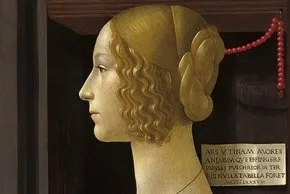
Ghirlandaio and the Florentine Renaissance, June 23 – October 10, Madrid. The Thyssen-Bornemisza Museum in Madrid recently opened an exhibition dedicated to Florentine Quattrocento painting and the special role of Florentine artist Domenico Ghirlandaio (1449-1494) in Renaissance art. A separate section of the exhibition is devoted to the religious painting of the Florentines, but the main “action” unfolds around the “Portrait of Giovanna Tornabuoni,” created in 1488. The art of portraiture, brought to exquisite perfection, is the main theme of the exhibition. In addition to Ghirlandaio’s works, visitors will see paintings by Sandro Botticelli and Antonio Pollaiuolo. //www.museothyssen.org
Exhibition of Bill Viola, June 28 – September 12, Malaga. An exhibition of three works by popular contemporary American video artist Bill Viola (born 1951) opened at the Picasso Museum in Malaga. Viola has long worked in the genre of video art. The main theme of the master's works can be defined in his own words: the artist tries to tell about 'transformation, the threshold between life and death, and the slowing down of time.' The exhibition features the work 'Composition' from the series 'Ocean Without a Shore,' which caused a sensation at the Venice Biennale in 2007, and two works from the 2008 series: Transfigurations – 'The Embodiment' and 'Three Women.' Specially for this exhibition, an 11-minute film has been prepared that draws parallels between Pablo Picasso's 'Blue Period' works and the works of Bill Viola on display. //www.museopicassomalaga.org
ITALY
Vinum nostrum, July 20 – May 15, Florence. The history and culture of viticulture and winemaking of ancient Mediterranean civilizations is the theme of a new Florentine exhibition, which will soon open in the halls of Palazzo Pitti and last almost a year. Vases, sculptures, frescoes and mosaics, as well as modern interactive objects, will allow visitors to immerse themselves in the ancient myths and religious rites associated with the cult of wine. The exhibition will introduce the history of vineyard cultivation, scientific and practical rules for planting and caring for vines, various wine-making technologies, and wine-drinking traditions of different eras. The halls feature baskets for grape picking, barrels, amphorae, craters and other artifacts. One of the surprises of the exhibition is a 'stage' recreated wine cellar from Pompeii. //www.palazzopitti.it
Roman Flora, until October 31, Tivoli. Villa d'Este is one of the most famous 16th-century Italian villas. It is located in the town of Tivoli, 24 kilometers northeast of Rome. The palace, garden, grottoes, and singing fountains became a model for the construction of many European villas. It is there that one can see an exhibition of the once very famous, but now forgotten, Baroque artist Mario de' Fiori (real name Mario Nuzzi, 1603-1673). In his time, he became famous for his exquisite flower still lifes and decorative fabric designs. The organizers did not accidentally name the exhibition 'Roman Flora,' since today his painting is also interesting from the perspective of getting acquainted with 'historical' botany. The exhibition presents more than 60 works by the artist, which blend organically into the villa interiors and look very successful in the context of the living gardens of the present time and the live Baroque music that can be heard at evening concerts in July and September. //www.villadestetivoli.info
NETHERLANDS
Exhibition of Jacques Villon, July 9 – September 26, Amsterdam. The Van Gogh Museum in Amsterdam will soon open an exhibition of French artist Jacques Villon (1875-1963). The artist's real name was Gaston Duchamp, and he was the brother of the famous Marcel Duchamp, with whom in 1911, during a period of fascination with Cubism, he organized the creative group 'Puteaux.' The group successfully participated in Salons and international exhibitions. In his theory and practice as a painter, Villon synthesized Cubist composition and Impressionist color, calling himself a 'Cubist-Impressionist.' Graphics occupy a large place in Villon's work. He worked in the techniques of burin engraving, etching, and aquatint, skillfully conveying light vibrations, the breath of the airy environment, and subtle psychological states with strokes. It is Villon's graphic works from the private collection of the Van der Vossen-Delbrück family that will form the basis of the Amsterdam exhibition. //www.vangoghmuseum.nl
FRANCE
History of Video Games, June 22 – November 7, Paris. The Musée des Arts et Métiers in Paris is the oldest technical museum in Europe. It is located in the former Abbey of Saint-Martin-des-Champs, the buildings of which were rebuilt for the new museum by 1802. The museum's main principle is interactivity: almost all technical exhibits from the 19th-20th centuries can be tried out in action. It is there that the MuseoGames exhibition has just opened, which will be interesting for both adults and children, as it features all popular video games from the 1970s-2000s. The exhibition is prepared by the CNAM (Conservatoire des Arts et Métiers), which has existed since 1794. //www.arts-et-metiers.net
'Roads of Arabia,' July 14 – September 27, Paris. This summer, the Louvre in Paris invites visitors to get acquainted with the ancient history and culture of the Kingdom of Saudi Arabia, the largest state on the Arabian Peninsula, often called the 'land of the two mosques,' because its territory contains the two main holy cities of Islam – Mecca and Medina. The territory of present-day Saudi Arabia is the historical homeland of the Arab tribes, who originally lived in the northeast and by the 2nd millennium BC occupied the entire Arabian Peninsula. The ancient history of Arabia (before the 7th century) will also be reflected in the exhibition, although the main emphasis will certainly be on Islamic history and culture of Arabia. The exhibition will feature more than 300 objects, and will be accompanied by photo illustrations of modern life in Saudi Arabia. //www.louvre.fr
SWITZERLAND
'Bhutan: Sacred Art of the Himalayas,' July 4 – October 17, Zurich. Museum Rietberg in Zurich is the only museum of non-European art in Switzerland. The specialization of this museum is the culture of countries in Asia, Africa, America, and Oceania. It is there that an exhibition dedicated to the art of the Kingdom of Bhutan will soon open, on whose small territory there are more than 2,000 Buddhist monasteries. The exhibition will feature 117 works of art from Buddhist temples and monasteries – most of the exhibits have never left Bhutan. The acquaintance with spiritual art will be accompanied by daily sacred rituals conducted by Buddhist monks. //www.rietberg.ch
Nyuta KUKUSHKINA.
Газета.Ru er="0">