
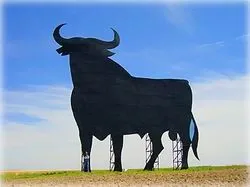
The bulls were painted black, and now among the picturesque hills and yellow meadows of the Iberian Peninsula against the blue sky, giant figures of the most famous animal appear everywhere, each time reminding tourists: you are in Spain, guys.
We had already been here once in our youth, spending two weeks of student holidays on the coast of Catalonia. And this time we simply wanted southern sun. For the May holidays we could have gone to the East, but by then the trip to Vietnam, Laos and Cambodia had not yet faded from our memory, and so the craving for a comfortable vacation outweighed the spirit of adventure. Reasoning that in Northern Europe, apart from rain and frost on the ground, there was nothing to catch in this season anyway (we knew this well from experience), we settled on the Iberian Peninsula, hoping that the sun would inevitably catch up with us there.
By that time Spain had already switched to the euro, but prices in the country had not yet reached the general European level. It is even surprising to recall now, but a decent room with a bathroom and air conditioning could be rented for €40 - today for the same money in Europe they will only spit in your face. As a rule, we stayed in establishments called Hostal, which roughly corresponds to the English guesthouse. They do not pay taxes like hotels, do not have a 24-hour doorman at the entrance, and contain four or five rooms, no more. Prices here are lower, the service is quite decent for a person who uses hotels not for living, but for overnight stays. In some hostales, guests are given a key to the front door, and the owner disappears somewhere all day, and to pay, you need to call him on his mobile and arrange a meeting.
Instead of the frantic Renault Clio with which the car rental company Europa Rent-a-car in Malaga threatened us, we got a Ford Fusion, almost unknown in our country. It turned out to be a very decent thing. Worse was that at Malaga airport, a polyglot woman in police uniform absolutely refused to let me into the car rental hall. She demanded a freight ticket, which I personally, with my reverent attitude to linguistics, understood as "a ticket for freight/rental of cargo transport". No matter how much I explained to her (with facial expressions, gestures and in the languages of the peoples of the world) that I didn't need a truck, that I wanted a passenger car, everything was useless. Naturally, I could not have any freight/rental receipt for a car, because I booked it via the Internet.
Dozens of people walked past me. In the end, after half an hour of observation, even I noticed that none of them showed the woman any receipts, but simply showed their airline ticket and walked past, casting contemptuous glances at me. I pulled out my charter ticket.
"Aha!" said the polyglot woman, "So this is the freight ticket!" "It's a FLIGHT ticket!" From committing a serious crime I was then saved by my wife Lyudmila. We arrived at the Hotel Lis in Malaga at two in the morning local time. In one of the stories read on the Internet, a Russian tourist told that in a similar situation he walked around the city's pubs until dawn and admired the beauties of nocturnal Malaga. When we checked into the hotel, I suggested my wife consider the same option. Exactly half a minute later we fell asleep.
The next day the Alhambra awaited us. Once, as is known, this fortress in the city of Granada served for two centuries as the last refuge for Arab conquerors on European soil. They, as was their custom, built mosques here, palaces with openwork patterns on the ceilings and semicircular windows, kept harems with eunuchs. Apart from the eunuchs, everything has been preserved in excellent condition, just as old Granada itself has been preserved, whose panorama, opening from the top of the fortress, with a view of the snowy peaks of the Sierra Nevada, is no less picturesque than the Alhambra itself.
The queue to the fortress stretched like a kilometer-long boa constrictor - it was nine in the morning. We walked along it with satisfaction without hurrying, because we were heading to the pre-order window. Tickets to the Alhambra can be purchased by phone with a credit card, at the same price. This is doubly useful, given that when buying tickets a person is not allowed into the fortress immediately, but is told a specific time at which he can visit it. And if it is morning outside and the visit time is 16:30, the wait can disappoint even the most patient tourist. We knew our time in advance.
In Granada, right next to the Alhambra, I first tried cold tomato soup gazpacho, which did not pass without a trace for my health, exhausted by years of grueling PR activity. Later we found out that in every city in Spain gazpacho is prepared differently, but invariably excellently.
From Granada, having enjoyed the views of the old city, we set off for Cordoba - another outpost of the Arab conquest of Spain. It is here that the famous Mezquita stands, a former mosque and now a cathedral, built by Muslims back in the 9th century. After Cordoba returned to the bosom of the Christian church, the king decided to raze the mosque to the ground, although even then it was considered a wonder of the world. But the local residents (Christians, by the way) made him understand that he had better not do that. As a result, the Christian cathedral was, as it were, built into the mosque, preserving for posterity one of the best monuments of Muslim architecture in Europe.
It is best to get into the Mezquita between eight and nine in the morning - they let you in for free, and there are no tourists at all. At this time a mass is held here.
Cordoba is a fairly large city, and here you can spend a day or two quite well exploring the city's and nearby attractions. If you find a parking spot, you can stay in the cozy Hotel Boston, where the tower clock from the city's central square will inevitably remind you of the time even when you don't need it.
On the famous Street of Flowers, flowers grow in pots on windowsills. There are a myriad of them, as are tourists, though. But from here there is an excellent view of the former minaret, now the bell tower of the Mezquita. The surroundings of the city present a rather picturesque landscape of hills and ravines, crossed by countless "guadals" - rivulets with ancient Arabic names. I think it is unbearably hot here in summer, but in May the weather was very comfortable, allowing one to enjoy the sun and gloat over the Moscow frosts.
Having sensibly reasoned that it is better not to go to Madrid by car (as in any big city), we stopped to stay in Toledo, the ancient capital of the Kingdom of Castile, in the old hotel Santa-Isabel on one of the streets of the old town, located at a 45-degree angle to the ground. Toledo stands on a high cliff, and most of its streets are exactly like that. This is a very remarkable city - primarily due to its untouched medieval architecture, production of souvenir weapons and "mazapanes", local high-calorie sweets.
Toledo is small, but one can spend more than a day walking around it - almost all the houses in the old city were built in the 12th-16th centuries, and some even under the Visigoths, who also used Toledo as a capital. After I told my wife in detail about the customs and legends of Spain of that time, she could not sleep peacefully. In the morning it became clear to me that the gloomy Middle Ages had kept her awake all night. She said that under our windows someone was galloping over the cobblestones on a horse, carriages were constantly passing by, and from the church opposite a witch came to her and tried to kill her. I explained that this is all nonsense - it is not a witch at all, but merely the ghost of Saint Isabel, who has been wandering for centuries through this house, where she once had her head cut off.
The next night we both did not sleep. This was also facilitated by the visit to the gallery of the artist El Greco, who worked in Toledo. He created many masterpieces here, but in all 12 apostles he depicted, the eyes are somehow frighteningly asymmetrical. It resembles the Kunstkamera.
By evening, all tourists gather on the neighboring hill to watch the setting sun illuminate the old Toledo. The tower of the openwork Gothic cathedral strikes the last hours of the passing day. On the edge of the cliff shine the spiers of the ancient fortress of Alcázar, where Columbus persuaded Isabel of Aragon and her dim-witted husband Ferdinand to sponsor his voyage across the ocean, and later scattered before them the American gold that ruined great Spain. Hundreds of sellers of ancient weapons stop clanking their rapiers and two-handed swords, but the ghosts of the prisoners of the Inquisition come out into the streets. Yes, the city of Toledo has something to remember on such evenings.
In addition, Toledo has the important advantage of being only an hour's bus ride from Madrid. Like any European metropolis, Madrid is tightly enveloped in multi-level road interchanges and armadas of cars, among which it is better not to expose oneself to stress in one's own car. But the bus takes you to one of the central bus stations, from where by metro you can visit all the sights of the capital.
In the Royal Palace lives King Juan Carlos - the one who once succeeded the famous dictator Francisco Franco. As a result, for 30 years Spain has been getting rid of the heavy legacy of the fascist regime. Recently, for example, the last monument to Franco was removed from Madrid. This is a great joy for the townspeople, especially since it was Madrid during the civil war of the thirties that was the main stronghold of the Republicans until the last day.
People here remember this well: at May Day rallies, the flags of Republican Spain appeared noticeably more often than state flags. And the mayor of one of the small towns we passed on the way even hung this flag on the balcony of his residence.
Also popular are red flags with the image of V. I. Lenin, T-shirts with a hammer and sickle, and other souvenir items, for which our country (as the designer-manufacturer) will never receive royalties. We told the local "Reds" that we are Russians, after which we were almost carried in their arms. Unlike America, Russia is very much loved here.
The historical center of Madrid is built up with 18th-century style buildings: the shine of gilding, stucco facades and other attributes of nostalgia for the former power of Spain. There are no world-famous architectural monuments in Madrid (except perhaps the Escorial Palace in the suburbs, and that one makes a depressing impression). But here there is the Prado Gallery, where if desired one can get an idea of Spanish art of the last five or six centuries: Velázquez, El Greco, Murillo, Zurbarán, Goya and others. For some reason, a painting by Raphael is remembered, in which the trees are depicted so unnaturally straight, as if he had drawn them along a ruler.
In Madrid, as in many cities of Spain, there are many guest workers. Moreover, these are not so much blacks, which have become customary to see in European capitals, as South American Indians trading their simple handicrafts here. These guys look extremely exotic.
The legacy of the American conquest, however, is best seen in the region of Extremadura, west of Madrid, from which most of the Spanish conquistadors came. The guidebook told us, for example, that the architecture of the city of Cáceres shows Aztec influences. But due to our complete ignorance, we did not notice anything of the kind, although the city is very beautiful, worth seeing.
In Spain, every more or less large city has its own attraction. Avila is giant fortress walls, in excellent preservation, used as nesting sites for dozens of storks. Salamanca is a city of sand color and a magnificent cathedral of the same sunny color. Segovia has a Roman aqueduct as high as a five-story building, and Merida has a Roman bridge over the Tagus River, a Temple of Diana from the same era, and an amphitheater. Amphitheaters, however, can't surprise anyone in the Mediterranean. In any case, all the listed cities are worth including in a tour of the country.
After a brief visit to Portugal, which will be discussed in another essay, so as not to clutter this one, we returned again to the blessed Spanish land, where gasoline is noticeably cheaper and highways are free. However, as my wife noted, in Portugal you can park your car at a bus stop and nothing will happen to you for it. In Seville, we stayed at an establishment called Redes, geographically very convenient for sightseeing the city. Until that day, I had never seen a ten-meter winding corridor in a hotel room. Well, now I have.
In Seville, you should visit the Alcazar, built by Muslims, and look at the Giralda minaret, which has an absolute analogue in Moroccan Marrakesh. Seville is a fashionable city because it is hyped. Globalization has made hype the main factor of tourism - everyone knows about Notre-Dame de Paris, but only a few know about Angkor Wat, although in comparison Notre-Dame would seem like a simple barn. Similarly, in charming ancient Toledo it is relatively quiet, while in the industrial metropolis of Seville tourists are teeming.
Even some American citizens know about the existence of Seville. Of course, this brings a certain negative - there are many tourists here. They sit on the ground (steps, grass, sidewalk), form queues, fill cafes with their bodies, and contribute to the rise in food prices. But thanks to them, at least this food can be found at any time of day. The fact is that in Spain restaurants are completely closed from 15 to 19 hours, and finding even a shabby pizzeria at this time is already great happiness. In Seville, they came up with the so-called "tapas" - sandwiches measuring 3x3 cm, which are served in abundance in any bar in non-stop mode. This is national Andalusian food. The sandwiches are very different - fish, meat, cheese, salad, vegetable, mushroom, etc. Of course, paying €0.80 for one bite is not very desirable, but in case of hunger, it is better than surviving on chips.
In Andalusia, they also make the best jamón - cured meat. Here it is called "jamón ibérico" and is sold in any store. In Andalusia, there is a town of Jabugo, which is supposedly the birthplace of jamón - so says the guidebook. We passed through it on the way, wandered the streets for half an hour, but never found a single food store, not a single jamón shop. The locals looked at us as if we were crazy, from which we concluded that this is no birthplace of jamón. Moreover, after we brought home a whole pig leg of this jamón and hung it on the balcony, the neighboring neighborhoods made an unequivocal conclusion by smell that its birthplace is ours.
Almost the same thing happened with the birthplace of sherry - the city of Jerez de la Frontera. Passing by it on the way from Seville to Cadiz, we started a heated argument about whether to stop in Jerez. The thesis that we don't understand wine because we don't drink it seemed convincing. But the thesis won that relatives and friends still need to bring something as a gift - so it's better not to invent anything and bring a bottle of sherry from Jerez. So it turned out that we found ourselves in this hospitable city, where everything breathes the famous fortified wine.
And again, not much of it was in the air there. We walked around the entire historic center and did not find a single store - everything was closed. We even found a monument to a man with a barrel of sherry - but the barrel was bronze. We remembered that it was nine in the morning. In the end, in some vegetable (!) store they took pity on us and sold a bottle of sherry that miraculously was lying around there.
You can simply drive through the south of Andalusia for pleasure. This province is painted in white and blue. The bright blue sky given to it by nature is tastefully diluted with the dazzling white walls of towns scattered along the slopes of numerous mountain ranges. The so-called "white villages" fully justify their name thanks to houses painted with white paint, dazzlingly shining in the sun and causing a desire to stay here and live forever. In each of them, a castle and a church will be waiting for you, built back in the times when the population density in Russia was two bears per square kilometer. The most beautiful of these towns are considered to be Arcos and Ronda, although I would not make such absolute statements.
Ronda is also charming because a deep ravine runs through the city center, on the edge of which the white houses of the residents miraculously cling. If any thing accidentally falls out of a window, there will be no possibility to find it. Even the bridge over this gorge is itself a landmark, because its supports reach a height of 100 meters. During the Civil War, communist partisans and prisoners of war were thrown into the abyss from this bridge. I think that this kind of retribution, however, was invented much earlier, because Ronda has existed for no less than ten centuries, and perhaps since Roman times.
But the oldest city in Spain, and indeed in all of Europe, is Cadiz. It was built by the Phoenicians, then razed to the ground and rebuilt by the Greeks, Romans, Byzantines, Arabs; later galleons departed from here to America, and now it is a port town without any notable monuments. We strolled through the center, went to look at the ruins of something Roman, and realized that we couldn't stand a whole day here. So we saddled up our Ford Fusion and headed to the southernmost point of Europe - Cape Tarifa, where we easily rented a very decent room at the Hotel Alborada.
Tarifa is one of the most poetic places in Spain. Firstly, Africa is clearly visible from here. If you stand on the pier in the city port, on your left will be the calm Mediterranean Sea, on your right the raging Atlantic Ocean, and directly in front of you, across the strait, Moroccan villages on the slopes of the Atlas Mountains, giving rise to the desire to immediately swim across Gibraltar (it was then that I developed a dream to visit Morocco). The sun sets into the ocean, illuminating the medieval castle of the Guzman family, which was famous for its maniacal cruelty, I don't know why. At night, the ocean does not stop roaring and raging, creating the feeling of being in a cabin of some “Titanic”. Despite all this, Tarifa is a calm, cozy town with many shops selling Moroccan leather souvenirs, pleasant old quarters and inexpensive restaurants.
It cannot be said that the trip did not exhaust us. We made a circle through southern and central Spain with a length of 3,000 km. Therefore, the last two days of the trip we lay on the beach of the fashionable resort of Marbella, allowing ourselves a decent four-star hotel, drank sangria and looked through hundreds of photos taken during this time. I still can't do it for more than two days, because I start shaking, but here I had the excuse that a lot of work had been done.
We, in the end, visited about 20 cities in ten days, small and large, but always unique in their own way. Some of them we managed to see only briefly, in three or four hours. But I do not regret it.
Among tourists, there are two points of view on such trips. Some contemptuously say that it is impossible to see any Europe “at a gallop”, and you need to live in each city to feel its atmosphere. Others (to which the author of this essay belongs) understand that life is too short and the globe is too large to stay in one place. It is impossible to see the whole world in a lifetime. But in two weeks it is possible to feel the rhythms of real Spain: go to a bullfight, eat rabo de toro (bull's tail) or Valencian paella, see the Seville Alcazar and catch a stork on the fortress walls of Avila (then release it). And try, experience, feel and hear many other things. So that on the way back to the airport, wave your hand to a giant bull against the background of the blue sky with the consciousness of a completed mission - I have seen Spain.