
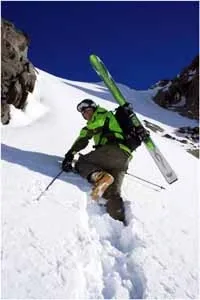
Extreme sports have always been considered the domain of the elite, firstly because they are expensive, and secondly because they are dangerous. But now, according to market analysts, this type of tourism is gradually becoming mainstream. “People have money that they are willing to spend on their leisure,” says Anatoly Pomortsev, a specialist at a marketing company. “And they want to try new entertainment. Moreover, such recreation not only provides an opportunity to get unforgettable sensations, but also emphasizes a person’s status.”
Take a guy to the mountains
The most well-known extreme sports are probably mountain sports: snowboarding, skiing. Mountaineering is considered the most difficult and risky. “It’s best to conquer mountain peaks in the summer, when the weather allows you to reach your goal with minimal effort,” says Larisa Startova, manager of a travel agency. “But adrenaline lovers don’t stop even in winter. Difficult weather conditions and avalanches only add excitement to the trip.”
To engage in mountaineering, it is desirable to have strong forearms, good flexibility, and a light weight, because you will have to hold on with just your fingers. This sport is not a cheap entertainment; a full set of high-quality equipment will cost an extreme sports enthusiast $1,500-2,000, but if you want to conquer Everest only once in your life, you can rent gear, which will be an order of magnitude cheaper. The most coveted routes for climbers are, of course, Elbrus and Kazbek, the Tien Shan in Uzbekistan and Kazakhstan, and the sharp peaks of Alaska. A ten-day tour in the near abroad will cost $500-600, and abroad – around $1,000.
Recently, so-called freeskiing – descending steep, unprepared slopes with complex terrain – and freeride – the same thing but using a helicopter as a means of delivery – have become very popular. Citizens have also taken a liking to ski mountaineering – climbing a mountain to then descend it on skis or a snowboard. Moreover, among true professionals, using insurance or any additional devices is considered bad form. Ski equipment is not as expensive as mountaineering equipment; a quality set will cost $700-800, rental – $30-40 per day. “It’s best to explore the mountain expanses in Europe: in Austria, Switzerland, Germany, France, and Italy,” asserts Larisa Startova. “But there are also places to roam in neighboring regions. Russian resorts, although inferior to foreign ones, are more attractive for tourists with average income. If the Alps cost $1,500-1,800 for 7-10 days, then to Cheget, the Elbrus region, Dombai, or the Urals you can go for $500, Krasnaya Polyana is a bit more expensive – $700-800.”
On the ground and underground
When the passion for adventure is in your blood, you don’t necessarily have to go to the mountains. Among ground-based extreme sports, mountain biking is becoming increasingly popular – obstacle racing on a mountain bike. This is not a sport for the faint-hearted; riders have to jump off rocks, weave between trees, descend steep slopes, all at a speed enormous for a bicycle – up to 50 km/h on the flat and up to 100 km/h downhill.
“To seriously engage in mountain biking, you’ll have to spend a lot of money,” says Sergey Kadyshev, director of a store for extreme sports enthusiasts. “A good bike costs around $2,000, and that’s just for a beginner. A professional bike can cost up to $10,000. And, of course, gear and various spare parts will cost a pretty penny – at least $800-1,000.” Specialists advise going to France, Germany, Italy, or Crimea. There, on Mount Ai-Petri, competitions for beginner and professional mountain bikers are held annually.
Speleology is entertainment for those who like to tickle their nerves underground. This is not only a sport but also research work. Of course, not everyone engages in serious science, so most fans of underground life go there to have fun. “To engage in speleology, you need serious training, not only physical but also psychological,” believes Sergey Kadyshev. “After all, a cave is a completely different world, where there are no familiar landmarks: no sky overhead and no horizon line.”
Compared to all other types of extreme recreation, speleology is the most budget-friendly option. The main thing is to always have a flashlight, batteries, and a helmet at hand. Specialists invite you to explore the beauties of the underground world in Bulgaria, the Czech Republic, Montenegro, and generally any mountainous area. The approximate price of a speleological expedition abroad is $600-800 per week. And those who are tight on funds can get their dose of adrenaline in their home country completely free.
Those who don't dive, raft
Among water-based extreme sports, diving holds a leading position. But admiring fish is the lot of beginners. Real adventure seekers choose wreck diving – diving on sunken objects, or cave diving – walks through underwater caves. These activities require professional training, because dives sometimes occur to depths of up to 50-70 meters. For the most desperate, there is freediving – diving without scuba gear while holding your breath. Masters are capable of not breathing underwater for up to 8 minutes! Experts call freediving the most dangerous of all sports, because sharp pressure changes and lack of oxygen can lead to cardiac arrest of the daredevil.
"Diving is also not a cheap pleasure," says Elena Golubkina, a manager of a sporting goods store. "A full set of equipment will cost about $1,500, but then you only have to spend on tickets and hotels." The best places for diving are considered to be the Philippines, Malaysia, Indonesia, Hawaii, and, of course, Egypt – little can compare with the beauty of the Red Sea. For fans of wreck diving, experts especially recommend visiting Crimea, where there are many sunken ships from World War II. An approximate trip price is $700–1,000.
Another way to get an adrenaline rush on the water is rafting and kayaking – rafting on mountain rivers. Rafting is not done alone – it is a team sport. It is absolutely safe even for children, so it has become widespread. "Raft tours come in several types: one-day trips costing $60–150 and multi-day trips during which tourists get to the most remote corners of the mountains with untouched nature, where they set up camp and, as they go along the route, explore the surroundings around the campsites," says Larisa Startova. "The approximate cost of such tours is $1,000–1,500." Kayaking, on the other hand, is a solo sport; although it lacks team spirit, it allows a person to challenge the elements and be one-on-one with them. It is good to raft on the rivers of North America, Canada or Alaska.
Flights in reality
No less than land and sea, the sky attracts extreme sports enthusiasts. Parachuting requires great courage, because even a standard tandem jump with an instructor makes inexperienced people's knees shake, but for true adrenaline lovers this is already a passed stage. Now they are interested in skysurfing and base jumping.
Skysurfing is performing various figures in free fall with a ski on your feet. The aerodynamics of a skier are very different from a simple jump, and to capture the beauty of the flight, the athlete must fly not alone, but in tandem with an operator who will film the first 50 seconds of the fall before the parachute opens.
Base jumping is parachuting from high-rise buildings, TV towers, bridges and steep slopes. "This kind of entertainment is considered the riskiest of air sports because jumps are made from a low height by parachute sport standards," says professional base jumper Kirill Bocharov. "And even if the parachute opens a few seconds later than necessary, it can lead to tragedy." In our country, jumping from high-rise buildings and structures is considered petty hooliganism and is punishable under the Criminal Code, so it is better to engage in base jumping outside the homeland. Experienced jumpers recommend the twin towers in Malaysia, as well as Norway, Switzerland or the USA.
Parachutists are superstitious people and do not trust someone else's equipment, so every self-respecting athlete must have a personal set. It consists of a special backpack and the parachute itself and costs around $1,000–1,500.