
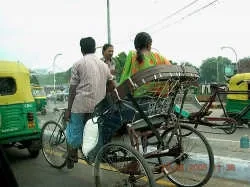
A velorickshaw is a convenient and fast means of transportation in Indian cities.
Despite the fact that Varanasi has more than a million inhabitants, it can be crossed by velorickshaw in about an hour. But here, as in any other city in the world, traffic jams occur. Given the medieval narrowness of the streets and the lack of public transport, a velorickshaw is the fastest and most convenient way to get to any corner of the city.
Motorickshaws provide rather weak competition, with fares twice as high. While a motorickshaw is a three-wheeled scooter with a cabin, a velorickshaw is a small pleasure carriage that lifts the passenger high above the bustle of the streets of an Indian city, powered by a driver pedaling. In general, the rickshaw in India replaced horse-drawn carriages. At first, riding the "wonder machine" was expensive, and only wealthy people could afford it. However, gradually the rickshaw became a truly popular means of transportation.
10 km from Varanasi there is a factory known throughout India that produces velorickshaws (these carriages). A new bicycle costs about 20,000 Indian rupees, while a used one can be bought for five, or even three thousand rupees. Each velorickshaw is a work of art. Drivers try to decorate their vehicle by applying magical symbols and painting it in all the colors of the rainbow, because the success of this craft, according to the beliefs of Indian rickshaw drivers, is connected to the favor of the gods.
To understand how Varanasi looks through the eyes of a "cabman," I rented a velorickshaw, leaving the owner a considerable sum by Indian standards. My "beauty" was only ten years old. According to its owner, this term is quite short, and the bicycle is considered almost new. Finally, after promising the owner not to forget to lubricate the chain and not to seat more than four people, Banglash disappeared into the darkness of the alley, returning from work on foot for the first time in many years.
It is worth noting that a rickshaw driver's workday begins early. Many drivers simply fall asleep on the seats of their bicycles closer to night, until they are awakened by the first morning passenger. So, I wrap a wide scarf around my head – one turn under the chin and a bit around the forehead, as professional velorickshaw drivers often do – and start the day. It turned out that this occupation requires not so much strength as endurance. Moving a bicycle with passengers from a standstill is not that difficult, but carrying them over a long distance is serious physical work. The distance for which you can hire a rickshaw is limited to about 5 km. Then you need to switch to another driver.
Of course, tourists are the greatest interest for velorickshaw drivers. Such luck does not occur often, but when it does, all the driver's ingenuity comes into play. Even the most basic knowledge of English can be a serious help. In its absence, with a well-practiced set of sounds and ambiguous gestures, the driver has every chance to inflate the cost of his service.
They say: "Beginners are lucky!" And my first passenger in India turned out to be an Israeli of medium build. After my disguise was recognized, I learned that his name was Zvi, and he was returning from his Indian friends. The buildings of the awakening city slowly floated past me. India captivates with its exoticism in everything.
It is quite humane that no one forces a rickshaw driver to constantly pedal the entire way. For example, on uphill slopes, the bicycle can simply be pushed, which is also more convenient on sections with poor road surfaces. Other traffic participants (bicycles, scooters, cattle, and pedestrians) treat the velorickshaw somewhat disdainfully, suddenly turning or stopping right in front of it. Then you have to slowly and laboriously pick up speed again. Often you hear a shout: "Hey, rickshaw!" demanding to immediately move aside and clear the road.
The serious difficulty I experienced during the work was the crowds of onlookers who gathered around me as soon as I stopped. On the road it was easier. Everyone was watching other vehicles and not staring at the drivers' faces. So I took rest stops like this: I parked my bicycle, jumped off, and immediately blended into the crowd. The rare passersby who momentarily noticed a person of "tourist" or European appearance behind the wheel of a velorickshaw simply did not believe their eyes.
The difficulties associated with my "foreign" origin in the carting of the local population in India forced me to reorient myself to carting tourists. Unlike the residents of Varanasi, who sometimes refused my services or suddenly jumped off the velorickshaw along the way and started helping me, the tourists turned out to be more favorable to such an experiment. They willingly showed the way, eagerly asked about the rickshaw work, and paid twice as much as the local population for the same distances.
By noon I felt exhausted after a ride of "three trips" and decided to have a snack. As it turned out, in the Indian city there are entire streets where rickshaw drivers eat, meet, and take a short rest. Food prices here are significantly lower than elsewhere. The variety of dishes comes down to rice with spicy sauces and tea. Apart from the rickshaw drivers themselves, almost no one visits these places.
In one day, or more precisely until sunset (in October it gets dark in Varanasi already at five o'clock in the evening), I earned 160 Indian rupees. This is a fairly good indicator, considering that I transported only six people, four of whom were tourists. For comparison: an ordinary rickshaw driver earns about 200-250 rupees per day, transporting 20-25 clients.
Anticipating inevitable leg pain from the unusual exertion, I made no plans for the next day and returned the bicycle rickshaw to its owner. The next day was the election of the mayor of Varanasi, and a government decree prohibited anyone from working from seven in the morning until five in the evening to encourage greater voter turnout. For one day, Varanasi acquired a rare face for itself: a city with streets without markets, without traffic, without rickshaws.