
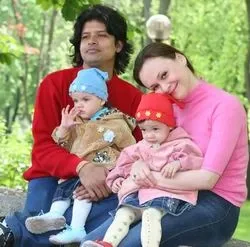
Ukrainian song on Indian soil
"If someone had told me in my youth that I would link my fate with India, I would probably have simply burst out laughing - at that time it was almost unreal," Anna recalls. "I graduated from the law faculty of Kiev University named after Taras Shevchenko, then worked for ten years at the Institute of Forensic Examinations. In short, a serious education, a solid job. But... I loved dancing since childhood. At first it was ballet, then a folk dance ensemble. During my student years I became interested in yoga and started attending an Indian dance school at the Indian embassy. And then, as part of a project to support the study of Indian culture, I was offered to go to India and continue my training for real."
For five years Anna studied the mysteries of classical Indian dance at the Institute of Performing Arts in Delhi. "Did I think I would find a life partner in India? Well, firstly, it seemed to me that few husbands would accept such a passion in their wife. And secondly, my studies took so much time that I simply had no strength left for entertainment and dating. I traveled around India with my teacher, then began performing. I am proud that I managed to earn praise from colleagues and critics."
In India it is customary to invite teachers and friends to one's concerts. And so in the spring of 2002 Anna handed invitation tickets to her friend and her acquaintance - a tall, interesting young man...
It turned out that Sanjay Rajhans, a professional journalist, was studying vocal at the same institute. His family belongs to the Brahmin caste, and from childhood he grew up in an atmosphere of Indian philosophy and art. At one time Sanjay even thought about retiring to an ashram (sanctuary) and devoting himself to spiritual self-improvement. But fate decided otherwise.
"I began to notice Sanjay at all my performances. He helped me a lot: he translated the ancient classical texts for dances from Sanskrit. He knew Sanskrit as a spoken language, which is not so common in modern India. Even dance teachers do not always master this language well. And dancing without knowing the text is very difficult. Gradually Sanjay revealed more and more facets of Indian culture to me, and the more we talked, the clearer it became to me - we have a lot in common," Anna smiles. And Sanjay is more concise: "I realized - this is divine predestination."
From Sanskrit lessons to a marriage proposal
Their acquaintance and wedding are atypical for Indian traditions. "Sanjay's brothers saw photographs of their brides a week before the wedding. Both the choice and all the negotiations rested on the parents' shoulders," Anna smiles. "But we turned out to be more independent."
I am surprised: do arranged marriages still exist? Are young people happy in such marriages? Anna answers: "Everyone I know lives very well. Perhaps they are psychologically prepared from the start, perhaps parents really choose life partners that suit all parameters." Regarding the marriage of his brothers, Sanjay clarifies: if the girl suddenly didn't please, one could refuse, and the parents would find another bride.
And in the autumn of 2002, Sanjay and Anna went to an ancient temple in the Himalayas: there a clergyman married them according to an old rite. And after five honeymoon days, everyday life began. "In India it is customary to live in large families. But Sanjay comes from a small (by Indian standards) family: he is the youngest of six children. Moreover, his relatives live in various corners of the world - in India, the Arab Emirates, Canada. We rented an apartment together with his elder brother, so we had a very small "big family." Gradually I learned to cook Indian dishes and run a common household. It was very important for me that my husband supported me in my dance classes and other creative endeavors," Anna tells.
And how did the parents of our heroes react? Both families wisely decided to trust the children's choice. And only after some time did the girl go to visit her mom and dad in Kiev. The husband was soon to fly over as well, but then his father fell seriously ill... In short, Sanjay learned about the birth of twin daughters by phone. The happy father asked his mother-in-law to name the girls "like royalty." And so Ekaterina and Elizaveta appeared in their family. And they managed to get the whole family together only in the autumn of 2004 in Kiev.
Amazing India, Astonishing Ukraine
What turned out to be the most difficult in building a bridge between the two worlds? They think about it. "I became deeply imbued with Indian culture long ago. I liked the unhurried and quiet way of life. Perhaps the hardest thing was to accept a different time rhythm," Anna laughs. "In India people get up very early - by six in the morning everyone is already on their feet. Special ablution, meditation, visiting the temple - for Indians this is a familiar ritual that fills their day with strength and meaning. They go to bed at nine. Even the European New Year is celebrated only until twelve. Here in Kiev, Sanjay starts his day at half past four. And when the husband is awake, all the household must keep him company."
Very unusual for me was what my husband decided to feed our little daughters. Not every Ukrainian mother would agree to an exotic vegetable soup – potatoes, beetroot, prunes, dried apricots! But the little ones ate with great appetite – apparently, the father's genes had an effect.
Much in Ukraine also surprised Sanjay. First of all, of course, the snow. Secondly, our custom of relaxing at dachas: he really loves communing with nature. And thirdly (it is not too pleasant for us Ukrainians to hear), Sanjay cannot allow his daughters to be raised in a country where young people drink so much alcohol and smoke. "And you also have a strange attitude towards the older generation. In India, the word of an elderly person is always perceived with respect, even if he says something that is not too pleasant to hear. Here in Ukraine I am amazed that older people cannot make remarks to young people who behave too impudently - they can simply be insulted," Sanjay marvels.
And Anna confirms: “In India there is so-called apple beer, but it is rather something like our lemonade. Of course, in restaurants frequented by foreigners there is alcohol, but Indians themselves practically do not drink. It is very rare to see a girl in a miniskirt there, and never with a can of beer or a cigarette. Noisy parties in restaurants and discos are not customary there. Mostly, wealthy people hold receptions at home, to which they invite relatives and friends. Guests converse and dance, but they are very restrained about drinking.”
Now they live in the capital, for which they had to rent an apartment in Kiev. Sanjay covers events in Ukraine for the National Indian television news channel and organizes the publication of the magazine Pacific Rhythms, dedicated to the culture of the Pacific region countries. Among the authors are famous Indian cultural figures, renowned scientists, and the Indian ambassador to Ukraine. Anna, with the active support of her husband, continues to fulfill her calling: she teaches at the Indian dance school “Nakshastra” and recently successfully organized an international festival attended by famous performers from India, Sweden, France, and Japan.
Ukrainian-Indian “meditations” on everyday life
Where is it easier to live? Anya sighs: of course, a journalist and a dance teacher in India live more comfortably than in Ukraine. What do Indian families usually spend money on? Anya smiles: “In India, money is not spent — it is saved. The largest expenditure item is children’s education. Families tend to have many children, and education at good schools and universities costs a considerable amount. Wealthy families send their children to study in the USA and England. Those who cannot financially afford to get an education in India come to study in Ukraine. Now Indian specialists are in demand all over the world, especially in pharmacology, computer technology, and marketing.”
Oddly enough, Indian beauties do not spend much money on shoes and clothes. A typical wardrobe is five or six saris or shalwar kameez sets (tunic, trousers, and shawl). There are, of course, very expensive ones, but a perfectly decent sari can be bought for $50–100. Even in wealthy families, it is not customary to dress flashily or too expensively on a daily basis. The interior of the home also follows the principle of “more space, fewer things.” Thanks to the mild climate, one can get by with a warm shawl and light shoes during the cold season. And jewelry is passed down by inheritance.
And is it comfortable for a European woman in such an exotic, by our standards, outfit? “I always wore a sari in India: first, I really like this clothing, and second, I did not want to be perceived as a foreigner,” says Anna. “Besides, classes at the institute require wearing a sari, and one can even be expelled for appearing in jeans. Generally, women in India are more feminine and very beautiful. Huge eyes, amazing hair — most simply wear it loose or braid it. I even felt a little inferior because of their beauty.”
On the pitfalls of international marriages
Our conversation imperceptibly turns to the problems of different mentalities. Anna confirms: yes, there are difficulties. Most girls who married Indian students knew only that it was very hot in their chosen one’s homeland and that the Taj Mahal was there. Therefore, having arrived in this completely unknown country, they usually face very great difficulties.
In India, it is not customary to go to discos, drink alcoholic beverages, wear too revealing clothing, or flirt... One must listen to the advice of elders and not argue. Such is the dictate of centuries-old traditions, and trying to change anything is pointless. Even their husbands, who behaved completely freely in Ukraine, instantly adopt the established way of life at home. Ignorance of the language, lack of work, conflict with the older generation, and spicy unfamiliar food — all of this combined can greatly complicate life.
Open confrontation with relatives leads to no good. For example, Anna heard that once a servant from a wealthy family called the Uzbek embassy and reported that a young Uzbek wife was being treated very badly. When they arrived, embassy staff found her locked in a closet, beaten, and hungry. The only way to resolve the conflict was to send the woman back to Uzbekistan.
Of course, intelligent people are more tolerant and welcome a democratic way of life. They visit relatives — but not the way we do. Indians do not sit all day drinking tea: a visit lasts a couple of hours, no more. Families with children spend weekends in parks. They have no dachas — only the very rich have summer residences in the Himalayas, where they can escape the summer city heat. Before tying your fate to a person of different traditions, it is better to learn more about the country you are going to. Family life in India is not a sightseeing tour or a sentimental movie with songs and dances.
...And yet, where is their home? Sanjay only smiles — for him the answer is clear. Anya quietly shakes her head: “Once my mother warned me: ‘Look, India is a dangerous country: so many famous Russian people were forever charmed by it.’ And now, when I come to Kiev, I feel like a guest here. India is becoming my home...”