
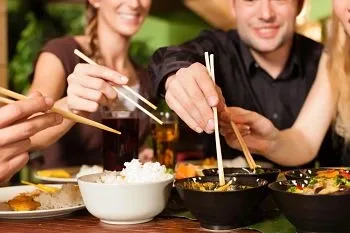
'Chigola ma?' (Have you eaten yet?) – this common Chinese greeting testifies to the great importance attached to food in China. Despite the countless floods and famines that have befallen the country over many centuries, and the fact that its population, comprising one-fifth of humanity, possesses only seven percent of the world's total arable land, the Chinese have created the most exquisite, diverse, and inventive cuisine, varying from one region to another.
Chinese cuisine is one of the most widespread in the world, thanks to the extensive colonies of Chinese emigrants in Southeast Asia, the United States, Australia, and many European countries. Since most Chinese emigrants came from the southern province of Guangdong, the cuisine of this region, known as Cantonese, is considered Chinese in many European countries. However, as demands for food in the West became more refined, many Chinese restaurants abroad began to offer customers dishes typical of other regions of China, especially dishes of Sichuan cuisine and the cuisine of northern China.
What can be said about Chinese food in general? Some of those who have been to China claim that they enjoyed more delicious Chinese dishes at home, and in some cases this is true. China is still experiencing development difficulties, so the quality of food in certain regions of the country does not always meet the standards that have become typical for other Asian countries and the West.
A meal in a Chinese restaurant at a hotel or in one of the many private restaurants can be either a supreme delight or a great disappointment. In principle, restaurants in large international hotels are usually first-class (usually Cantonese cuisine is overseen by chefs from Hong Kong). Moreover, those who find the strength to learn Chinese may discover that street kitchens in many large Chinese cities offer excellent snacks and dishes like dumplings and noodles at incredibly low prices.
Despite local differences and peculiarities, Chinese cuisine as a whole retains many common features. Due to the traditional shortage of firewood, inventive Chinese usually chop all components of a dish into very small pieces so that the cooking process takes a minimum of time. Deep-frying, steaming, and braising are common methods used by Chinese cooks. However, since private homes lack ovens, fried or roasted meat dishes are prepared only in restaurant kitchens.
The most common seasonings are soy sauce, ginger, vinegar, garlic, sesame oil, soybean paste, and spring onion (shallot). However, dishes made from the same ingredients by a chef in Sichuan or, say, Guangzhou will be completely different.
All Chinese cuisines strive to maintain a certain balance of texture, aroma, and color in each dish. For many centuries, the Chinese have regarded food as a medicinal or health-strengthening agent. Some dishes, in their view, belong to the category of 'yin' (cooling), others to the category of 'yang' (warming). Ideally, each dish should represent a balance between the two.
There is an opinion that the Chinese eat everything that has four legs except a table, and everything that flies except an airplane. And indeed, many raw ingredients that would never be considered suitable for cooking in the West are perfectly usable in Chinese cuisine. Besides snake meat, bear paw, dog meat, and other exotic items, the most ordinary products acquire an unusual taste in Chinese cuisine.
In the next publication, we will talk about the cuisines of Chinese regions.