
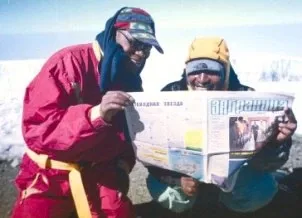
African guides even read Ukrainian press at the summit of Kilimanjaro
– Mister. Mister...
Struggling to open my eyes, in the darkness of the tent I made out the white-toothed smile of our guide Sanari.
– Mister, ti, – he whispered again and disappeared.
This 'ti' meant that it was already 2:30 AM, time to get dressed and go drink tea. At 3:00 AM we were to leave camp and assault the last 1,400 meters. Why at night? I got the answer to this question only when it was all over: so that we wouldn't see WHAT we had to overcome. Officially, to meet the dawn in the mountains.
'This is no plain for you – the climate is different...'
Oh, Internet-Internet! People are right – don't believe it until you see it yourself. When I first learned that the 'Equites' team was inviting journalists for a joint ascent of Kilimanjaro, naturally, the first thing I did was dive into the world wide web to 'be in the know'. And I learned a lot of interesting things about this volcano. Including that there is no consensus on what the name 'Kilimanjaro' means. Ernest Hemingway has one version, others have another. I quote: 'Kilimanjaro in the Maasai language sounds like 'Ngaiye ngaiya', which means 'house of God'. Or 'In Swahili, 'Kilimanjaro' means 'shining mountain'. But as soon as your correspondent flew, drove, walked a couple thousand miles horizontally and 20,000 feet vertically, everything became clear. My version: 'In the local dialect, 'Kilimanjaro' means 'difficult mountain'. And believe me, they are not wrong...
Kilimanjaro is the highest mountain on the African continent and is among the largest dormant volcanoes on the planet. Moreover, it is the most solitary mountain in the world. It is located in Tanzania, south of the equator, near the border with Kenya. The volcano with its cloud-piercing peaks was formed by the eruption of more than four billion cubic meters of volcanic rock from the Earth's interior.
Its enormous size is emphasized by the fact that there is nothing around – a flat plain! Rising to a height of 5,895 meters, it stands alone above the hot Maasai savannah, located at an altitude of 900 meters above sea level. So it is no surprise that Kilimanjaro is called the 'Roof of Africa'. It was also called the 'mountain of caravans' because its shining glaciers, like a bright white beacon, are visible for hundreds of kilometers from all sides. In past centuries, its white cap often served as a landmark for caravans transporting ivory, gold, and slaves...
'Others will come, exchanging comfort
for risk and immense toil...'
To get directly to the foot of Kilimanjaro, you need to use at least two airlines plus a five-hour bus ride. I suspect that the 'Equites' would have done just that – rushed straight to the mountain – but this time they had a heavy ballast in the form of pampered capital journalists, eager to gather impressions for a year ahead along the way.
Who was honored with the happiness (or the opposite) of visiting three countries (UAE, Kenya, and Tanzania) in two weeks and climbing the famous volcano? The expedition (let's call it that, since after 3,000 meters it hardly resembled a hike) consisted of a rather motley crowd in terms of age, preferences, and attitude to mountaineering. The unifying factor was a general sympathy for the 'riders', whom Moscow colleagues, during the expedition, nicknamed 'titans'. So, the 'head of the column' – Goltis, Sasha Komarov, and Kostya Mogilnik. In Moscow, we were joined by the president of the Himalayan Club, Sergei Vertelov, and video operator Alexander Belousov. These guys have spent more time in the mountains than on the plains. Moreover, Sasha Belousov had already climbed Kilimanjaro about five years ago, so he became our second guide. You'll agree, personal experience is more valuable than any guidebook.
Oleg Mazur – also not a random person in the mountains. A reserve lieutenant colonel, instructor in mountaineering, parachuting... (the rest is a military secret). On his shoulders lies the preparation of the 'riders' for almost all previous 'steps to Africa'. A specialist of the kind who is always behind the scenes. Next, in tight formation, comes our brotherhood: Andrei Sokolovsky ('Komsomolskaya Pravda'), Andrei /.../ ('Galician Contracts'), Igor /.../ ('TV Week'), Mikhail /.../ ('Day'), Zhenya Khozyainova ('Mirror of the Week'), Sergei Mamin (the permanent photo and video guru of the 'Equites' team), and me (if you forgot – Alexander Provozin). Total – the lucky number '13'. By the way, we also started the ascent on the 13th.
Now it's clear why our 'titans' were slightly burdened not only with their own 20-kilogram backpacks? Of course, no one wiped our noses – we are old enough. But taking care of our daily needs is sacred!.. So on the eve of the ascent, the town of Arusha (Tanzania) was given to us for two days. Well, 'given' is, of course, a strong word... In short, we gathered impressions to the fullest (about this and much more in the next issues of 'Zagranitsa' – author's note).
'Who hasn't been here, who hasn't taken a risk –
that person hasn't tested themselves...'
At half past eight in the morning, a bus pulled up to the hotel, packed to the brim with equipment, tents, utensils, food, and porters. Somehow squeezing in our things, we sucked in our stomachs and filtered into the cabin. After half an hour of driving, the things and passengers settled, and some even got comfortable.
The road from Arusha to /.../ took about two hours. The last part of the journey, the bus boldly climbed up an African dirt road along a rather steep trajectory. Banana groves (orchards?) floated by, and my soul sang a hymn to the Toyota corporation as the driver strained to overcome each steep incline. And here, before us, the gates of Kilimanjaro! We unloaded, weighed ourselves (backpacks), left our details in the book (just in case?!), and without any 'Farewell of Slavyanka', simply set off. Our caravan had grown significantly: the thirteen of us, 20 porters, 2 cooks, and a guide with an assistant. How about that?
The path from Mashame Gate to Mashame Hut camp, according to the instructions (?), takes 6 hours. Six hours along a trail crisscrossed by roots of tropical trees and patches of liquid mud. Taking a sharp start, Oleg Mazur and I 'knocked off' the first stage in 4 hours. I have never sweated so much in my life. It seems even the Kyiv beer came out of me (if anything was left there). Arriving at the camp, I walked in circles for about forty minutes without stopping. I was afraid of 'muscle soreness' the next day. The 'titans' in full gear (they carried their own backpacks throughout the ascent) arrived right after us. Goltis with a smile from ear to ear (aesthete), Sasha with a philosophical look (pragmatist), Kostya arm in arm with Zhenya (mountain gentleman). First dinner in the mountains, first overnight stay. Not bad, it's pleasant when you are fed, and your bed is carried for you...
'And you could turn back, go around the cliff –
But we choose the difficult path,
Dangerous, like a war trail'
For us – 'newbies' – the 'experienced' gave a course of lectures on mountaineering along the way. I learned with some anxiety that the 'Equites' insisted on taking the Magame route, which differs from the well-trodden 'Coca-Cola' trail in that far from everyone reaches the summit. I also learned that the route category is roughly 2-B (honestly, neither the number nor the letter appealed to me) and that last year an American and a German died of heart attacks on the way to the summit. And ahead of us awaited 'altitude sickness', we would have to walk on 'scree', and sub-zero temperatures at night... As an experienced person (only such work at 'Zagranitsa'), I mentally prepared for the trials, while simultaneously overcoming what the mountain threw at us daily. This included gradual air rarefaction, treacherous sun, suspicious water from the stream (bottled water was sold at camps for $5 per 1.5 L), and sheer cliffs with sharp stones and unpleasant abysses.
Already on the third day, when all muscles had resigned to the fact that they would have to work, and my head to the fact that I could think of nothing, I understood what mountaineers get high on and why, actually, they climb mountains. It turns out, to catch a buzz in the evening after taking off boots and plugging your nose. And also to see beauty that is accessible to mere mortals only in the form of postcards and photographs in magazines. For example, I saw clouds (view from above) for the first time not from an airplane window, but in real life. Standing on the mountain slope and surveying a herd of heavenly lambs with the gaze of a conqueror. I am not sentimental. That's Goltis who manages to see beauty in everything. But here I said to myself: 'This is – good!'
'Down below you won't meet, no matter how you stretch,
In all your happy life,
A tenth of such beauties and wonders'
In fairness, it should be noted that Kilimanjaro National Park is indeed one of the most unique places on earth. It is here that a person has the opportunity to come into contact with nature, feel its diversity, beauty, strength, and at the same time remind themselves once again that they are a ti-ny bug, and not the master of the Earth...
On the lower slopes of the mountain, locals grow coffee and corn, and up to about 3,000 meters, a humid tropical forest grows. Even higher, at about 4,400 meters, meadows give way to high-altitude lichens and mosses. They say that only in the Congo Basin can one still see such virgin, almost impenetrable forests, a true riot of tall grasses and giant mossy tree trunks intertwined with lianas. The foliage blocks sunlight, and undisturbed exotic animals – from monkeys and leopards to mighty elephants – feel perfectly at home under this green canopy. Even higher stretches a zone of mountain meadows with bright flowers and amazing tree-like plants – senecios – that grow to enormous sizes. Just above the ground, their trunk splits into two thick branches, resembling giant candelabras. Another, also unusual inhabitant of the mountain meadows – lobelia – stretches upward like a column, reaching four and a half meters in height, and ends with a candle-like cluster of blue flowers. After the 4,000-meter mark, the meadows give way to a zone of high-altitude lichens and mosses, and at the very summit, only stone and ice reign.
The snow cap itself also looks impressive. We saw the volcano's summit with our own eyes only on the second day of the ascent, in the evening. During dinner, we were congratulating Sasha Belousov on his birthday, and at one of the climax moments, someone jumped into the dining tent with a shout: 'The summit has opened up!' Everyone rolled outside and saw this beauty. Zhenya (oh, woman!) immediately modestly said: 'And this, Sasha, is my gift to you!' As they say, from artist to artist... Well, and to you, dear readers, I will give a legend.
In ancient times, they say, local tribes believed that the summit was made of silver. They can be understood – they had never seen snow and ice. But none of the locals dared to climb Kilimanjaro and check their guess. The fact is that, according to belief, the slopes of the mountain were the abode of evil spirits, who would severely punish anyone who disturbed their peace. They say, however, that one local chief did send his warriors to the summit of Kibo to get silver. But when the warriors filled their hands with the 'noble metal', it melted in their hands. The warriors returned to the chief empty-handed... Such bad luck.
'Sheer walls – hey, don't yawn!
Here you don't rely on luck.
In the mountains, neither stone, nor ice, nor rock is reliable'
Barranco Camp (3,650 m) is located in a nice valley at the foot of a long vertical rock ridge over 150 meters high. We were to 'storm' the wall and in three hours reach the last, assault camp, Barafu Camp, located at an altitude of 4,560 meters. Colleagues looked at the stone wall with doubt, but my soul was calm and cheerful. The fact is that the day before, our 'experienced' had transferred me from the category of 'newbie' to, presumably, 'coffee pot' and dragged me along on an excursion to Lava Town – a rock of volcanic rock rising 100 meters from the volcano's slope. I fully felt the thrill of climbing without a safety rope on almost sheer walls and passed the final exam by learning what 'turkeys' are and distinguishing them from ordinary stones. Along the way, we (it turns out) underwent acclimatization, and our precious organisms became ready for the hardships and adversities of high altitude.
The 'Equites' hung on ropes to their heart's content, tested some unknown device for descending and ascending, and finally snapped a photo at the first peak on the way to the main one. That's why everything sang and rejoiced on the eve of the wall assault. Oleg, casting a glance at the rock, said that he would do it in about 15 minutes. I added another 15 to myself and mentally prepared to spit out the remains of my lungs somewhere in the middle. The rest began to lighten and repack their backpacks...
Right hand, right foot... At least three points of support... Aha, found it. Forward. Up... You know, it's gripping. Only the video camera gets more and more in the way, the backpack gets heavier. Inhale – step, exhale – step. In the mountains, speeds are completely different. After twenty minutes, the summit appeared. Yee-ess!!! Further on, an almost gentle path among volcanic rock.
'The whole world is in the palm of your hand – you are happy and mute
And only a little envious of those,
Others – who still have a summit ahead'
At the assault camp, we gathered for a war council. The guides insisted that we set out at 12 AM, arguing that all groups leave that way to meet the dawn at the summit. We didn't need the dawn (no, we did, of course, but not at such a cost). We needed time for filming. Half an hour of sunny morning. That's all. You can't endure more at the summit. We bargained to leave at 2 AM. At that, I already knew that in Tanzania everyone is late by an average of half an hour. Buses, guides...
– Mister! Mister!
Struggling to open my eyes, in the darkness of the tent I made out the white-toothed smile of our guide Sanari.
– Mister, ti, – he whispered again and disappeared.
This 'ti' meant that it was already 2:30 AM, time to get dressed and go drink tea. At 3:00 AM we were to leave camp and assault the last 1,400 meters. In the darkness, the headlamps of the assaulters flicker. There are fewer of us. In the camp remain 'the old, women, and children'. Four in total. So, nine people and three guides go for the assault. Two of them in case someone has to be evacuated down.
• By the way, it is in such conditions that it becomes clear what a huge role every accessory and equipment plays in a hike. Take the same flashlights – we bought Fenix in Kyiv, and it turned out to be much more profitable than renting equipment on the spot.
What is a night ascent? Before your eyes, a spot of light from the flashlight. You hear only your own puffing and the puffing of your comrade. Step – exhale, step – inhale. The slope steepness is 30-35 degrees. Time flows like resin from a barrel. After half an hour, you start cursing, then you send everything to hell. Then you start thinking about a retreat plan. Another half hour later (you have to crawl for 7-9 hours total), you shame yourself for cowardice, draw pictures of how your colleagues will look at you reproachfully, how they will mock you. The next thirty minutes are given to thoughts that it's too late, apparently, I quit smoking. There's no breath left... And it's hard to believe that I lived in Kyiv... I'll need to lift the body on the UAZ... These boots slip on the marble floor... The water froze in the drinking bottle... Someone dropped out on the rocks... Where did that leopard lie...
Far ahead (or above), the flashlights of some group are visible. God! How much further to go!
– Rest stop!
– Sanya, how are the sensations?
– Livable.
– Give me water.
– It's frozen.
– I told you, hide the container under your jacket.
– I stuffed the video camera under my jacket...
Again the flickering of flashlights, the rustle of 'scree', short curses... We reached Stella Point (the last 200 meters) missing one 'fighter'. 400 meters short, Andrei went back to camp – altitude sickness did its job. The rest, with pain in their heads and devils in their eyes, dragged themselves to the summit. The last meters on snow, past a blue (!), 50-meter ice cap...
– Guys, hurray! We made it!
– Goltis, get the flag!..
– Ukraine has not yet perished!
– Look, the earth is round...
Already descending, we learned from the guides that a group of Italians had gone before us. 16 people in total. NONE of them reached the summit...
Alexander PROVOZIN,
Kyiv – 8,300 km horizontally – 5,895 vertically.