
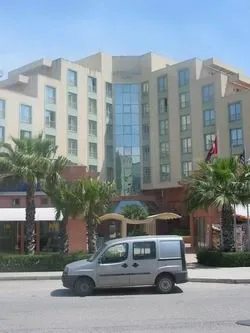
Discovering this resort in 2005 was interesting to me for two reasons. First, there was something to compare it with. Second, Antalya's infrastructure is developing very quickly, and today there is much more worth seeing here than three to five years ago.
Hotel oasis
This summer new hotels have sprung up on the Antalya coast like mushrooms after rain. One of the richest in novelties 'clearings' is the coastal zone half an hour's drive from Antalya, between the villages of Lara and Aksu. These parts have clean sea (thousands of tourists have not yet had time to make their 'contribution' to it, and this brings considerable luck to local fishermen), light sandy beaches, in the distance a romantic halo of the Taurus mountain range, and lemon and eucalyptus trees stretch along the roads. (In general, Antalya is a real country of Limonia: fragrant yellow fruits are everywhere here, and they are harvested twice a year.) But, of course, tourists come here not for the landscape alone: when it comes to hotel service and improvement of hotel grounds, the Turks are great craftsmen. And your author was able to see this from his own experience.
Arriving on the eve of the season at one of these 'freshly baked' hotels - Barut Lara Resort & Spa 5*, we found the extensive hotel grounds almost at the construction stage and were initially even disappointed: neither greenery nor sun loungers on the beach... Imagine our surprise when the next morning after our arrival, along the edge of the sea, which had been bare the previous evening, there appeared... tall palm trees! By lunchtime, grass had miraculously spread throughout the grounds - it was brought in small rolls already in soil and literally laid wherever needed. By evening, the borders were framed with decorative stones and bright fragrant shrubs, and along the lawns ran neat tiled paths like little snakes. In two days, 11 hectares around the hotel turned from almost a desert into a real oasis.
The technology of this miracle is polished in Turkey to the point of automatism: one worker plants a bush in the ground, another immediately ties it up, the third lays decorative pebbles nearby, the fourth smears cement on the tile, and so on until the victorious end. On the way to the sea, appetizing girls in swimsuits step over the working natives, but the workers, paying no attention to them, phlegmatically continue their work. In short, by the beginning of the season the five-star looked perfect.
Antalya
Not all tourists vacationing on the Antalya coast take the time to see the city itself. And in vain - even the most committed beach lounger should once sacrifice an 'all-inclusive' hotel meal and spend at least half a day there. The history of Antalya began in the 2nd century BC, when, according to legend, King Attalus II of Pergamon ordered his servants to find an earthly paradise. The king's retinue traveled the whole wide world until they finally found a picturesque place on the shores of the Mediterranean Sea. There they built a city, originally named Attalia in honor of the monarch. Over its history, it passed into the hands of the Macedonians, Romans, Byzantines...
Already on the approach to the center of Antalya, tourists are greeted by its symbol - the elegant Yivli Minaret, built about 800 years ago, with the advent of the era of Turkish sultans. Its end is reminded by a monument to the first president of the Turkish Republic, Mustafa Kemal, nicknamed Atatürk, which means 'father of the Turks'. It was he who turned a medieval Muslim country into a secular republic. Looking at the majestic stone horseman under the waving red flag with a star and crescent, one involuntarily thinks: most likely, had it not been for those fateful changes for the country, we would not today be freely strolling under the hot Antalya sun in short skirts! And the seaside promenade here, although not long, is quite picturesque: the blue of the water is emphasized by a string of red tiled roofs, from the coastal cafes there is a view of the ancient fortress walls and snow-white yachts waiting on the waves for their hour.
Turkey would not be Turkey without local shopping. Be sure to walk along the narrow cobblestone streets, along which traders lay out their simple goods: 'big-eyed' glass amulets protecting from the evil eye, woven rugs with oriental patterns, ceramics and leather trinket accessories. You need to bargain here, but before achieving a significant discount, you will have to show persistence. For example, in one of the jewelry shops, they did not want to lower the price of a gold chain for a long time and reduced it from $50 to $20 only after I, carefully furrowing my brow and depicting on my face a titanic effort of calculation, finally drawled theatrically: well, at home I'd find one twice as cheap...
About the morals of guests and hosts
It must be said that our compatriots sometimes behave unexpectedly on vacation. On the way back, on the plane, I accidentally overheard two pretty girls exchanging impressions about the trip. The dialogue was roughly as follows: 'Well, how did you like the hotel?' - 'Oh, we took everything out of it, even the wall clock!'
Sometimes simple economy looks comical. Once we were having lunch with a large company in a restaurant of one of the hotels in the center of Antalya. After a two-hour walk on a hot day, everyone was thirsty, but when they announced that tea and coffee were not included in the price of the set lunch, our compatriots all stood up and left. And my companion and I stayed, chatted with the bartender over a cup of this and that and... as a result, they didn't take a penny from us. That's how sometimes a generous person doesn't pay at all.
However, it is obvious that such cases do not affect the overall attitude towards us. Do you know what I found most unusual in Turkey? The fact that you could speak Russian with every single hotel employee and street vendor. Never abroad had I ever used my native language so extensively to communicate with the locals. Of course, today at many Eastern resorts you can hear 'Hello, pretty, come in!' But in Antalya, phrases sometimes reached me from behind that were strikingly far from primitive in construction: 'Would you like to see the handbags?' Or: 'Please, take a look!' Nevertheless, it is pleasant to realize that in at least one foreign country you are regarded not as an exception or an outright exotic insect, but as a source of stable income that is taken into account - and therefore respected.