
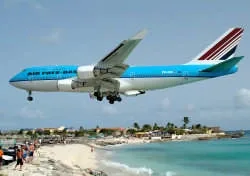
On the island of Saint Martin, airliners begin their descent directly over the heads of vacationers
As Turist.ru notes, sooner or later any tourist may end up in one of these places. That is why the publication's experts warn travelers: fly with your eyes open. Perhaps you will never get to see such a sight again anywhere.
1. Paro Airport, Bhutan. All tourists wishing to visit Bhutan and walk the land of the Fire Dragon among the sacred peaks of the Himalayas arrive here. However, even without climbing any of the planet's highest peaks, travelers risk their lives before even arriving in the Kingdom. Bhutan's only airport is surrounded by Himalayan peaks rising to 4,880 m. Only a superbly trained pilot, well acquainted with local conditions, can maneuver the aircraft between the slopes covered with tall trees without hitting the peaks and safely land the plane on the world's most dangerous runway.
2. Saint Martin Island International Airport. Princess Juliana Airport is one of the largest transport hubs in the Caribbean region. However, the length of the runway here is only 2,180 m. That is enough for small and medium-sized aircraft, but not at all for the wide-body Boeing-747 and Airbus-A340 carrying tourists that this air hub regularly receives. Pilots have to approach very low, so that the airliner almost hits the runway fence. Moreover, the beginning of the runway is located right on the seashore, and airliners approach the strip directly over the heads of vacationers relaxing on the beach behind a fence made of profiled sheeting. So the risk is double — one never knows what might fall out of the plane before landing...
3. Ronald Reagan National Airport, Washington, USA. It is even strange that such a large airport made it into the top three of the world's most dangerous runways, but you cannot escape the truth. Reagan Airport is located between two no-fly zones, so pilots need to demonstrate miracles of skill to stay away from strategically important objects — the Pentagon and CIA headquarters. During takeoff, the aircraft must gain altitude as quickly as possible and make a sharp left turn to avoid flying over the White House. After September 11, security services monitor compliance with these rules extremely strictly, and if the airliner's movement seems suspicious to them, unfortunate travelers risk paying with their lives for the pilot's whims.
4. Gibraltar Airport. Squeezed between the Mediterranean Sea and Algeciras Bay, the runway is only 1,830 m long, forcing pilots to be extremely precise and careful. But that is not all. The runway is crossed by a highway leading to Spain. During takeoff and landing, the road is closed with barriers, and the police keep a sharp eye to ensure that no reckless driver darts out in front of the plane. On the other hand, there is always the risk that surveillance is not all that strict...
5. Matekane Runway, Lesotho. The 416-meter-long runway is located on the edge of a mountain gorge at an altitude of 2,303 m, so all tourists leaving Lesotho should keep in mind: if the plane starts falling immediately after takeoff, it is not so dangerous. Much worse is if an inexperienced pilot decides to take a risk and try to clear the mountain in one go. “The rule for mountain flying is this: it is better to take off downwind and downhill than into the wind and uphill, because in Lesotho the mountains will most likely defeat you,” shares pilot Tom Claytor from his personal experience.
6. Barra Airport, Scotland. The airport is located on the tiny island of Barra in the Outer Hebrides and consists of a shallow bay where planes regularly land. The degree of “hardness” of the landing depends on the tides. So for pilots who regularly bring tourists to the island, the expression “to land in a puddle” is far from a metaphor.
7. Toncontín Airport, Tegucigalpa, Honduras. To successfully land at Toncontín, pilots must fly over the mountains and turn left at a 45-degree angle just minutes before the plane touches the runway. The runway itself is not very long — only 1,864 m — and is located in a bowl-shaped valley. The airport, built at an altitude of 1,005 m above sea level, cannot accept aircraft larger than a Boeing-757. Moreover, it is densely surrounded by residential buildings, roads, restaurants, and gas stations. And we all well remember the tragedy that occurred in Brazil in 2007, when a passenger airliner that skidded off the runway due to rain crashed into the terminal building and burned to the ground with its passengers.
8. John F. Kennedy International Airport, New York. Pilots arriving at this airport need to be vigilant to avoid colliding with aircraft arriving at two other nearby airports — LaGuardia and Newark. Such proximity forces pilots to maintain a ceiling of 4,575 m and visibility of 8.25 km before approaching runway 13L. And each of them remembers the terrible tragedy that occurred here in 1960, when a United Airlines plane collided with a TWA airliner, causing both planes to crash and killing 127 passengers and crew. And also the 1965 incident, when a Douglas DC-7, facing a collision threat with a Boeing-707 during takeoff, made the wrong maneuver and fell near Jones Beach Park.
9. Madeira Airport, Portugal. Pilots must approach Madeira Airport, squeezed between mountains and the Atlantic Ocean, strictly clockwise, and pilots must be specially trained for this maneuver. First, pilots aim the plane at the mountains, and at the very last minute sharply turn right. The Portuguese built one of the most unusual airports in the world, whose runway is not on the ground but in the air. The 2,800-meter-long runway is built like a huge bridge and stands on 180 columns 80 meters high. And under the runway there is a parking lot for cars – not a single meter of space is wasted.
10. Juancho Airport, Saba Island, Dutch Antilles. This airport is famous not only for the shortest runway of 396.5 meters, but also for terrible weather conditions – when landing at the airport located on a peninsula, pilots have to cope with strong winds and sea spray.