
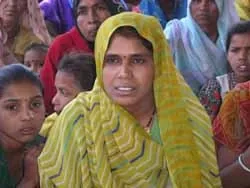
The organizers of the action claim that this is the largest non-violent conversion of followers of one faith to another, occurring moreover in a single day. Until last Sunday, the Untouchables periodically renounced the faith of their ancestors and went either to Buddhist monks dressed in orange robes or under the wing of Christian missionaries. Sometimes entire villages. But such a large-scale conversion had not happened before.
‘Dalits convert to Buddhism because it is a free religion, open to all. It preaches non-violence and does not divide people into castes,’ said Ramdas Athawale, current leader of the Republican Party of India, which tries to defend the rights of lower castes in society and political circles. In fact, the founder of this party, Dr. B. R. Ambedkar, was one of the first to show Dalits such a way out of the closed caste circle. On October 14, 1956, he along with three associates was publicly converted to Buddhism. The half-century anniversary of this event, Dalits marked with a mass renunciation of Hinduism. About 10,000 people underwent religious rites last October, adopting Buddhism and Christianity. This time there were ten times more converts. And, as leaders of the Dalit movement believe, the number of renouncers will grow over time.
According to official statistics, representatives of lower castes make up about 16% of India's population, or about 167 million people. And although, as BBC reminds, the democratic constitution, in the drafting of which Dr. Ambedkar also participated, promises jobs and social status for those who were formerly called Untouchables in India (even the slightest contact with them was considered unacceptable for representatives of other castes), the economic situation of this category of citizens is not improving. They are still entrusted only with the dirtiest work, and it is practically impossible for people from these lower strata to get into good educational institutions. Athawale is the only one who represents the lower classes in the Indian parliament. Leaders of the RPI seriously believe that the mass conversion of Dalits to Buddhism will allow them to get rid of the stigma of the eternally oppressed.
The religious solution to the caste problem, tacitly approved by many leaders of major world faiths, is not too pleasing to the ruling circles of a number of Indian states where Dalits constitute a significant part of the population. In recent years, laws have been passed at the regional level that restrict or even prohibit conversion. According to Indian media, attacks on missionaries who preach the values of Christianity too actively among the Untouchables have also been recorded. Moreover, the Buddhist leader, the Dalai Lama, prefers to observe from the sidelines the rapid increase of his flock. The leaders of the RPI had high hopes for his presence at the ceremony of mass conversion of Dalits to Buddhism. However, the spiritual leader limited himself to a greeting message in which he emphasized that the conversion itself is, in his view, a less significant event than the attempt by Dalits to change all of Indian society.