
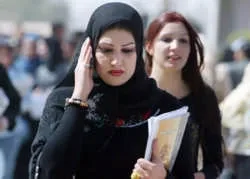
Norwegian society cannot make up its mind about Muslim women's headgear
«Hello, I am a 23-year-old Muslim woman from Algeria. I want to study with you, but I am worried whether I can wear a hijab during studies and subsequent service?» «We do not set our own rules regarding uniforms. Please contact the appropriate authorities.» It was these short lines from the correspondence between the Arab woman Keltoum Hassnaoui Missoum, who arrived in Norway 8 years ago, and the leadership of the Norwegian Police University College that started the most fierce political debate in Norway in recent years.
Keltoum Hassnaoui, a Muslim and mother of three, is a Norwegian citizen and, by law, has the right to apply for any public service. Until now, she has worked in various private security firms and wore a hijab everywhere, although sometimes because of her fidelity to religious tradition she had to change jobs.
«How do things stand with religious tolerance in state institutions?» – pondering this critical question, the thoughtful lady sent inquiries to dozens of institutions, from the military department to the customs service. Everywhere she received an encouraging answer: in the Ministry of Defense, in customs, and even in hospitals, employees were allowed to wear turbans, kippahs, or burqas of specially designed cuts and colors depending on their religious beliefs. The only stumbling block was the police.
The Ministry of Justice and the Police Directorate confirmed the applicant's right to wrap herself in a scarf during service, but the police union and the public objected. The union stated that it would not allow the law enforcement service to turn into a religious institution and that uniforms must be the same for everyone. According to polls, 8 out of 10 Norwegians supported this view.
In February, the debate moved from newspaper pages to the parliamentary level. «We must welcome ethnic diversity in state institutions and promote the involvement of representatives of different national and religious groups in the life of the country» – this was how Prime Minister Jens Stoltenberg reacted to Ms. Missoum's struggle for the rights of Muslim women. And he was immediately rebuked by the secretary of his Labour Party, Martin Kolberg, who called for stopping the 'Islamization of Norway'.
His ally was the right-wing Progress Party, which had long been drawing compatriots' attention to the 'gradual transformation of the country into a Muslim state.' This included the construction of mosques, increasingly popular calls to introduce Sharia law and oaths on the Quran into legal proceedings, the appearance of officers and bus drivers in formal turbans, and hidden polygamy among immigrants from Arab countries. The clash over hijabs in the police became a kind of 'last stand' for defenders of traditional values. On March 8, actions of demonstrative burning of headscarves by 'liberated women of the East' took place in Norway, parallel to which demonstrations by their opponents, wrapped in burqas, were held, thus trying to show Scandinavians the freedom of their choice.
The front line also ran through government corridors. The Ministry of Justice developed amendments to the Civil Service Act, according to which employers were required to take into account 'religious aspects' concerning employees. The ministries of labor and health opposed this. Doctors, in particular, were concerned that ladies wrapped from head to toe in thick scarves would not receive enough vitamin D, which is already scarce in the gloomy north. And officials at the labor department were worried that scarves, impairing visibility and catching on various obstacles, would lead to an increase in workplace injuries.
The discussion about hijabs has now engulfed all of Norway. The head of government announced that Muslim women's head coverings would be a topic of discussion at all levels before a final decision is made on the permissible degree of their integration into Norwegian society.
Alexei SMIRNOV.
Novye Izvestia