
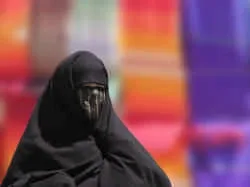
As Novye Izvestia writes, the case reported by Le Monde once again raises the problem of compatibility of different cultures in one society. To what extent is French society, which prides itself on its exclusively secular character and equality of people of all religions, cultures, and races, ready to accept people's religious peculiarities?
Faiza M. is a 32-year-old Moroccan, married to a French citizen (also a Muslim) and has given birth to three children by him in France. She has been living permanently in the country since 2000, speaks French, and asked to be granted French citizenship. The refusal was motivated by a single reason: wearing the burqa. That is what Arabs call the black or dark women's clothing that covers the entire body, leaving only a slit for the eyes. For the first time in French history, the Council of State – the highest judicial body in the country – took religious practice into account when ruling on a foreigner's ability to integrate into French society, notes Le Monde. Faiza M., according to the ruling, "in the name of a radical practice of her religion, exhibited such social behavior that is incompatible with the basic values of the French community, namely the principle of gender equality." In 2005, a lower court denied Faiza M. on the grounds of "insufficient assimilation." After the Council of State, she has no further avenue of appeal.
Judging by the initial reaction, political circles in France generally approve of this decision. According to the first secretary of the Socialist Party, François Hollande, "the law has been applied correctly" and "we should not make concessions." In granting citizenship, the degree of assimilation must be taken into account on a case-by-case basis. The same opinion is held by the French Minister of Higher Education, Valérie Pécresse. Speaking on the radio, she stated that "the principle of gender equality is non-negotiable in the French Republic." "The fact of wearing the 'burqa' is accompanied by the facts that this woman did not vote, had no independent life in society, and moved about only accompanied by her husband," the minister emphasized.
In France in recent years, the debate has mainly revolved around the hijab – a Muslim headscarf that covers the head and neck. A law of March 15, 2004 prohibits wearing conspicuous signs of belonging to any religion in some public institutions, including schools, colleges, and lycées. Theoretically, the hijab is allowed everywhere else. But from time to time, incidents occur here and there, especially in town halls.
By law, any foreigner who marries a French citizen receives the right to French citizenship after two years. But some articles of the same law restrict it. The spouse must prove "their assimilation into the French community, in particular, sufficient knowledge, depending on conditions, of the French language and of the rights and duties associated with French citizenship." The authorities may refuse in case of insufficient assimilation, manifested in particular by "the dissemination of extremist ideas rejecting the basic values of French society."
In this respect, the emphatically secular France is perhaps stricter than other countries of the European Union, which on the whole espouse the same basic values.
In Germany, for an identity card one must be photographed with an uncovered face, but clothing, including the burqa, is not among the conditions for obtaining citizenship. It is enough to live in the country for at least 8 years, have a clean police record, and pass a language exam with clearly defined criteria. Starting this autumn, a mandatory quiz of 33 questions about the state and social order of the Federal Republic of Germany will be introduced.
In Italy, a candidate for naturalization, after 10 years of permanent residence, sends their dossier to the Ministry of the Interior, where a special commission evaluates their economic situation and checks for absence of criminal offenses. The Administrative Court of the Lazio region issued a precedent-setting ruling that "following the cultural traditions" of the country of origin, insofar as it does not violate current legislation, should not affect naturalization.
In the Netherlands, in whose large cities there are almost as many immigrants as the population of the "titular" nation, citizenship is granted automatically after five years of legal residence. Recently, stricter conditions have been introduced: immigrants must pass a language exam and, upon obtaining citizenship, take an oath at a special ceremony.
In the United Kingdom, which for a long time was distinguished by particular liberality, they also decided to make naturalization somewhat more difficult: it must be "earned." There is a mandatory exam on knowledge of the foundations of British society. However, Home Secretary Jacqui Smith wants to go further. According to her, British citizenship should be granted "only to those who speak English, work well, and pay taxes." But there are no problems with clothing peculiarities.