
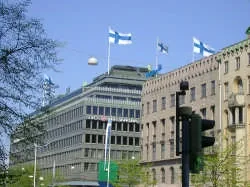
People from other countries make up a third of Helsinki's residents
According to Novye Izvestia, the anti-immigrant speech by the capital's mayor immediately met with a sharp rebuke from Prime Minister Matti Vanhanen, the leader of the Centre Party, who stated that "foreigners are not a threat to our country, but a source of additional labor." "People in the modern world are mobile, and therefore the task of the state is not to erect walls, but to dismantle them," the head of government believes.
And indeed, Finns are traditionally known for their hospitality and respect for visitors. Already, of the 1 million 200 thousand residents of Helsinki, at least 400 thousand are people from other countries. About a fifth are immigrants from Russia and other CIS countries.
In this situation, the capital's mayor considers it necessary to limit the entry of guest workers in order to preserve for Finns "jobs, which are becoming fewer and fewer in the crisis." Indeed, unemployment in Suomi, spurred by the crisis, is literally galloping. Before the New Year, thousands of people received layoff notices.
But it is unlikely that Finns themselves will benefit from a reduction in the number of migrants. Commenting on the conservative mayor's remarks, supporters of centrist and left-wing parties emphasize that competition for jobs between Finnish citizens and foreigners is largely a myth. For the most part, immigrants, including those from the CIS, usually take on hard or menial work that native residents disdain. The average salary in Finland is 2.5 thousand euros, and newcomers, often even highly qualified specialists, say doctors, agree to work for 1 thousand. Cheap labor helps the Finnish economy develop.
There is also another aspect of the problem that manifests itself at the everyday level. If you compare the prices of fast food in the center of Helsinki and in neighborhoods where people from Asia – Chinese, Indians, Turks – live, it turns out that, for example, pizza in immigrant areas is sold half price. Therefore, many residents of the Finnish capital increasingly prefer to eat in cafes owned by people from the "third world."
• While migrants try to get to the capital – Helsinki – the eyes of wealthier foreigners are turned to the Finnish countryside. After all, today buying a house in Finland is not particularly difficult, and many investors are interested in having real estate in quiet Finnish towns surrounded by forests. Finnish cottages located in ecologically clean areas of the country near water bodies are also in high demand.