
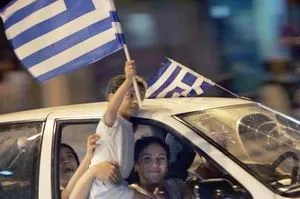
Even from what happened after the quarterfinal and semifinal, it was absolutely clear: a large part of Greece's population lived and breathed football during those days. Here is what journalists report from Athens, the capital of today's celebrations. Literally a few seconds (!) after the end of the match, church bells rang, fireworks began to explode, car horns blared... And most importantly, fans poured into the streets, who had spent two hours in incredible tension. Some still cannot believe that their Dream has come true.
Omonia Square in the center of Athens instantly filled with jubilant fans. Corks popped, flying out of champagne bottles; people in ecstasy danced on car roofs—whether their own or someone else's—singing the national anthem. Acquaintances and strangers rushed into each other's arms. Even fire trucks and police cars joined the celebrations, taking to the streets to maintain order. This is the biggest sporting celebration since the Greek basketball team won the European Championship in 1987.
Something similar is happening all over the country. Moreover, reports of the Greeks' jubilation are coming in from all over the world—from Britain to Australia.
"Greece is the best, time to play the Brazilians!" shouts a group of young people running down the central street of Athens with Greek flags in their hands.
This day showed that Greeks "can look other Europeans in the eye without an inferiority complex," says Nikas Kavalinneas, an Athens resident.
And here is the testimony of Stavros Labropoulos, the owner of a small café in London: "When the ball went into the net, my customers, overjoyed, smashed a whole mountain of plates. I will probably incur a considerable loss that night, but what does it matter—we are the European champions!"
Meanwhile, the hosts of the championship are in mourning. No one in Portugal wanted to believe, even for a minute, that the beloved team could lose in the final to underdogs, on whom bookmakers had accepted bets at odds of 1:50 at the beginning of the championship, giving the brave a chance to earn a hundred euros for two. But all experts, including Portugal's coach Luiz Felipe Scolari, agree that the Greeks looked better and truly deserved their victory.
However, this European Championship will be remembered by many not only because the Greeks won it—for the first time in their history. The results of Euro-2004—financial, social, cultural, and others—are still ahead, and soon statistical reports will draw a line under the Portuguese forum.
Now it can be said that the 2004 European Championship was a success. A total of 1,165,192 people attended the matches in Portugal, surpassing the figures of four years earlier, when the tournament was held in Belgium and the Netherlands (1,126,443). And how many people watched the progress of Euro-2004 worldwide is difficult to calculate. Fantastic figures of several billion people were mentioned, which, in principle, is hard to believe (the entire population of the Earth is about seven billion). But then more realistic figures began to appear. For example, about 50 million people in China followed the matches in Portugal (almost the entire population of Ukraine). And some individual games were watched by record-breaking groups of fans in their own way (the match Italy - Bulgaria was watched by 21.4 million Italians, which is more than the Italian audience for the final match of Euro-2000 France - Italy).
Overall, it is clear that the organizers are very pleased with the course of the championship. Each of them noted that Euro-2004 was better prepared and conducted in all respects than previous continental tournaments. The work of volunteers was particularly praised; they acted flawlessly despite working virtually for free.
Even before the start, there were many concerns for various reasons. There were fears of terrorist attacks, rioting football fans, ticket speculation, an increase in crime, traffic jams, and other things that inevitably accompany this kind of competition with a large number of tourists.
In general, the ticket situation turned out to be rather curious. It is known that the bulk of them were distributed through national federations, which for the most part cheerfully reported that all tickets had found their owners. They did find them, but not in retail, but in wholesale. The Portuguese, diligently suppressing any attempts at speculation, caught quite a few dealers (even more remained beyond the authorities' view). It is noteworthy that trade was conducted with those 'extra tickets' that were among those handed over for sale to national federations. The Russian one especially tried, according to news reports...
Meanwhile, many fans who arrived in Portugal could not get into the matches, and at the stadiums themselves, huge gaps often yawned. True, far-sighted builders came up with a way out in advance: realizing that such an audience as at the Euro would not be at domestic championship matches, they installed seats of different colors mixed together. Such a cacophony of colors creates the illusion that the stadium is full.
There were no mass brawls among fans in Portugal either—just a few minor scuffles. But Ukrainians distinguished themselves, having gone to Euro-2004 to earn money. One of our pickpockets, unsuccessfully attempting to rob one of the English fans, ended up killing the Briton out of frustration, for which he could receive a very serious punishment—under Portuguese law, around 25 years in prison.
The Russians also stood out. One of our eastern neighbors managed to drive his car into... a police car while drunk. Is it any wonder that the overly cautious Portuguese authorities immediately deported the 'distinguished ones' from the country. According to news reports, Russians and Englishmen were the most numerous among them.