
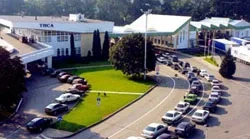
The measure is temporary, until September 1. The formal reason is preparation for the Eurovision-2005 contest. But if the experiment proves successful, it will most likely be extended. As a result, an unsanctioned window to Europe will appear for Russia as well - given its visa-free friendship with Ukraine and an essentially transparent common border. By abolishing the visa regime with Europe, Viktor Yushchenko "opened" Russia, writes the weekly "Itogi".
To spite the conductor
Officially, Moscow reacted in silence to the Kiev initiative. Unofficially, they admit: there is a problem. But what exactly? A possible invasion of 007 agents? They will find their way through other "windows" if needed. Though, it must be admitted, it is not so difficult even now for a Western citizen with not entirely honest intentions to end up on Russian territory: the sparse checkpoints at railway and road crossings from Ukraine to Russia can simply be bypassed "through the vegetable gardens." However, special services exist precisely to track such pedestrians. One should hardly fear a mass influx of illegal immigrants from the European Union onto Russian expanses.
The problem is rather something else: energetic Kiev, clearly claiming the role of a new, advanced capital of the post-Soviet space, has again beaten Moscow to the punch. It is rapidly gaining political points in the eyes of both the West and its former USSR brethren, and thus the chances of reshaping the post-Soviet space along a "Kiev-centric" pattern. Moscow, meanwhile, is gradually losing its primacy in the CIS. Thus, in opening the country to the outside world, Ukraine has overtaken Russia.
It is no secret that the West has long called on Russia to unilaterally adopt visa-free friendship with the European Union and the United States, including through the mouth of the dean of the diplomatic corps in Moscow, Swedish ambassador Sven Hirdman. But Moscow, which never tires of declaring its openness to the whole world, "bargains carefully, afraid to give anything away" - in visa matters it sacredly observes the rather dilapidated principle of reciprocity. This is when states step by step grant each other equal visa privileges: they speed up visa issuance for businessmen, and so do we. They lower visa prices, and we will not skimp either. And so on, seemingly endlessly.
What do Russian legislators think about this? They have decided to strengthen the visa fence from the western side - to add to the blacklist of persons barred from entering Russia those caught in a disrespectful attitude toward it. Also to cancel visa-free stays in Russia for cruise ship passengers. The corresponding amendments to the Federal Law "On the Procedure for Exit from the Russian Federation and Entry into the Russian Federation" were approved in the first reading by an absolute majority of lawmakers. One must suppose that behind this innovation lies not so much offense on behalf of the state as a passionate desire to wall oneself off by law from the "orange plague," which looks quite amusing in the age of global technology.
But the most curious thing is that the dividends from the unilateral abolition of visas for the West could more than offset the losses - the loss of consular fees and visa charges. This includes an improved international image and investment climate, and greater attractiveness for tourists.
After all, the visa barrier is an obstacle primarily for illegal labor and other economic refugees. Russia, for well-known reasons, need not fear these woes from Europe and America. As for a possible invasion of Russian cities and villages by cunning agents and saboteurs, for them, as is known, even a visa fence is no obstacle. Moreover, a legion of dubious firms is successfully plying its trade in obtaining entry documents to Russia, long ago turning this procedure into a purely commercial affair.
Does Moscow have the right to claim full visa reciprocity with the West? Strictly speaking, it will achieve it only after putting its own house in order, above all by ensuring full and reliable passportization of its citizens, and in accordance with European standards, and by strengthening its borders with CIS countries, from where uninvited guests flow in a wide stream and without much difficulty through Russian territory to the West. At the very least, Moscow must agree to pay in rubles for all these shortcomings by signing a readmission agreement with the Europeans.
Asymmetric reciprocity
Today's expanded Europe really has quite a few problems with an excess of labor. "Old" Europeans are simply overwhelmed by labor migrants, primarily from the EU's new member countries, fencing off their labor markets and social security institutions from them in every possible way.
For example, Italy restricted the influx of labor onto its market with quotas, and in super-politically-correct Holland, people from new EU countries are allowed to work only in certain sectors where there is a shortage of labor and where "old" Europeans and the Dutch themselves do not want to work (shipping, bus driving, lower medical personnel, work at meat-packing plants). France, for at least three years, does not intend to open its market to newcomers, and Portugal has simply left in place the same restrictions for them as for citizens of third countries.
Germany also introduced considerable restrictions. In the United Kingdom, one must work legally and without interruption for a year to receive the same social guarantees as the British. In Ireland, this period is two years. Other countries have generally limited the provision of social guarantees to people from new EU countries to seven years.
So Ukraine's introduction of a visa-free regime with Europe, of course, does not at all mean the imminent abolition of EU visas for Ukrainians. Lithuania, for example, unilaterally abolished visas for Americans, but still, even after becoming a member of NATO and the EU, it has been unsuccessfully seeking reciprocal hospitality.
The fact is that a third of Lithuanian 'tourists' and 'business travelers' become illegal immigrants in the United States every year. Ukrainian 'tourists' cause no less of a headache for Europe. Recently, German Foreign Minister Joschka Fischer got burned on them, as the opposition accused him of conniving at the influx of guest workers from Ukraine. For example, an investigation into the practice of issuing German visas to Ukrainians revealed that almost every second Ukrainian guest wrote in the application that the purpose of visiting Germany was 'visiting Cologne Cathedral'. Apparently, the suppliers of labor, operating under the guise of Ukrainian travel agencies, did not have enough imagination for more. It is clear that no one saw these 'tourists' near the masterpiece of Gothic architecture.
Actually, Kiev does not count on visa-free reciprocity from Europe. It hopes for a speedy easing of visa procedures for reliable Ukrainians (students, diplomats, businessmen and journalists) and, above all, for an improvement in the overall tone of relations with Europe. Its specific immediate goals are accession to the WTO, obtaining the status of a country with a market economy, and creating a free trade zone with the EU. And it seems that the new Ukrainian authorities will quickly cope with these ambitious tasks. In any case, abroad will help them - if not with big money and investments, then with friendly advice and moral support. As for investments, that is for Russia.