
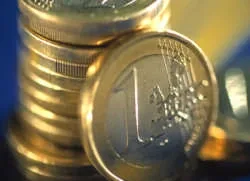
By its anniversary, the single European currency has arrived in good shape
"If we didn't have the euro, the consequences of the crisis in Europe would have been much more severe," believes the Governor of the Bank of France, Christian Noyer. "It must be acknowledged that the euro has passed this test mostly successfully and emerged stronger from it." As Itogi notes, it is significant that Mr. Noyer's speech, delivered in the birthplace of the dollar, was titled: "The Euro as a Global Currency."
If we set aside all these French niceties, the bottom line comes down to very concrete things. The single EU currency gave its financial system the completeness that the founding fathers of the European Union had been striving for for nearly half a century. And most importantly, it allowed a united Europe to challenge America's financial dominance. In the midst of the current crisis, the euro is clearly outperforming the dollar.
In the beginning of glorious deeds
So, let's try to fill out a kind of questionnaire for the single European currency. Name? Euro. Place of birth? Of course, Europe. Parents? Too many to remember! The roots of the euro must be sought in the first post-war decades. Then, the firm handshakes of French President Charles de Gaulle and German Chancellor Konrad Adenauer instilled in the hearts of Europeans the hope that peace on the continent would be lasting. "United Europe," which emerged around the Franco-German Coal and Steel Union, sooner or later had to think about a common financial policy. Serious discussions about this began as early as the early 60s. It was then that the idea of creating a "snake in the tunnel" was born - the nickname for the system of coordinating the exchange rates of European states, introduced in 1972. Their currencies fluctuated synchronously relative to the monetary units of other states, while changes relative to each other were minimized.
This was the first step towards the unification of the eurozone, and today it looks very modest, but behind it lay the great ambitions of the continent's leaders, who set out to create a monetary union by 1980. Most likely, it would have happened if not for the deterioration of the global economic situation. Two oil shocks plunged Western countries into crisis. And plans for creating the euro-money had to be adjusted. Worse still: the "currency snake" that already existed by that time kept trying to "shed its skin." The system was under severe strain due to differences in the level of economic development of European countries. The temperamental French twice left the overly wiggly "snake" and twice returned. The British, Irish, and Italians also refused to "swim" collectively because, due to the instability of their own economic situation, they could not meet the strict requirements...
And yet the ship of a united Europe was confidently moving towards its goal. Its charts included, in particular, the Scandinavian and Latin Monetary Unions, whose principles proved quite sensible. Its compass was sound logic: since borders are transparent, duties are absent, and labor moves freely from country to country, why should EU states annually lose huge amounts due to the crowding of currencies in a tight trading space? On foreign exchange transactions alone, European companies "burned" up to $60 billion a year.
The next stop on the path to monetary union was the creation of the European Monetary System (EMS) in 1978. The ERM was created, an abbreviation that has nothing to do with the International Olympic Committee and stands for "Exchange Rate Mechanism." The countries in this system committed to keeping exchange rate fluctuations within fairly narrow limits. In fact, this was a continuation and development of the principles of the "currency snake." For example, for "strong" currencies - the German mark or the French franc - the limits of permissible fluctuations relative to each other were 2.25% above or below a pre-agreed rate, while for "weak" ones - the British pound sterling or the Spanish peseta - about 6%. When the deviation of any European currency approached a critical level, central banks would begin to systematically buy it up. Such large-scale exercises required considerable skill and clear coordination from European bankers. It was during this period that the first prototype of the cherished euro was introduced - the European Currency Unit.
Musketeer currency
The European Currency Unit was non-cash and was called the ECU. It sounds beautifully musketeer-like. However, the very semantics of the ancient term, as if from the pages of the novels of Dumas père, concealed the roots of enduring European discord.
The ECU stood for European Currency Unit - a single accounting unit. According to the descendants of the Gauls, it was not worth translating the name of the ancient French coin into a set of English terms. In the view of the British and Germans, however, the ECU sounded too French and embodied Parisian snobbery. Bonn proposed a dubious compromise to Paris: let the single European currency be called the "euromark," but in the Fifth Republic this idea was nipped in the bud. And so the Europeans lived, squabbling over the name of the future currency.
However, something else was more important: with the help of the ERM, it was possible to create a zone of currency stability in Europe. This was recorded during the Hanover summit in June 1988. Under the leadership of the then President of the European Commission, Jacques Delors, a group of representatives of European central banks and independent experts presented a plan for creating a European monetary union. It was called the "Delors Plan." It contained a detailed program for a three-stage transition of EU states to a common currency.
The first stage - from July 1, 1990 to December 31, 1993. During this period, it was necessary to liberalize capital movements within the EU and unify economic standards. All EU member states were obliged to join the Exchange Rate Mechanism, which established a fluctuation band for currency exchange rates. The second stage - from January 1, 1994 to December 31, 1998. During this time, new institutions necessary for the functioning of the euro currency were to be created. The legal basis for the activities of the European System of Central Banks was to be developed. The European Monetary Institute was to be established to manage the project of creating a single currency. And the third, final stage: from January 1, 1999 to June 30, 2002. The European Monetary Institute turned into the European Central Bank. Its functions now included managing the monetary system of the EU countries. Finally, a real opportunity arose to establish a common currency for all Western Europeans. All that remained was to introduce fixed exchange rates of the participating countries in relation to the future single currency and then put into circulation the single European coins and banknotes.
After a long 'wrangling' of politicians and financiers - even the 'immortals', members of the academic Institut de France, were involved in the discussions - in December 1995 in Madrid, the European Council approved the name 'euro' for the future single currency. In all European languages, it echoed the word 'Europe'. And if the cradle of Europe is ancient Greece, then the basis for the graphic symbol of the new currency was the Greek letter 'upsilon'. The design of the new currency was also discussed in general terms. On the banknotes - no physical persons that could be seen as a hint of national content.
As a result, the Austrian Robert Kalina drew a map of Europe that did not include Scotland, the Canary Islands, and the Azores. On the coins: one side is standard, European, with common symbolism, the other side is national, preserving the local flavor of each minting country. A compromise was also the name of the small coin. It was dubbed the eurocent. Not as a hint of a parallel with the dollar, but as a tribute to the Latin roots of Europeans. However, the concept of 'cent' did not take hold in some countries. In France, for example, euro coins are still traditionally called centimes.
Now all that remained was to implement the ambitious, truly imperial 'Delors Plan'. With the entry into force on November 1, 1993 of the Treaty on European Union, the countries of Europe took the last step towards the introduction of a single currency. In the treaty signed in Dutch Maastricht, the EU member states created an economic and monetary union and fixed the rules for creating a single money.
Atlantic duel
'The history of the euro's emergence became an example of a stunning failure,' formulated the position of eurosceptics by Matthew Parry, an analyst at the London-based Economist Intelligence Unit (EIU). Euro-optimists perceived the events quite differently. As the Italian Romano Prodi, one of the architects of a united Europe, says, a 'new protagonist' appeared in the world economy - the euro.
And indeed: the new currency had the highest total value of cash in circulation worldwide. The euro zone surpassed the US in population as well, although in terms of GDP, while twice that of Japan, it was slightly behind the US. And here is a paradox: if earlier such European backwardness and the underdevelopment of their stock markets were regarded as the Achilles heel of the EU, now, in the context of the stock exchange crisis, this turned out to be a trump card. The American stock giants NYSE and NASDAQ went to hell, but the scattered European exchanges suffered much less.
So, from 1999, the non-cash euro was introduced, and from 2002, when euro coins and banknotes appeared, it completely replaced the national currencies of the twelve countries that joined the eurozone. And from the first days of its life, the chronicle of confrontation with the dollar resembled reports from a theater of war. The initial exchange rate of the euro - $1.17 - was, as later admitted in European power echelons, deliberately overestimated. From January 1999 to October 2000, the euro currency depreciated against the dollar by almost 30 percent. It is not surprising that the single European money was rapidly losing popularity. As reported - not without gloating - by the BBC in mid-January 2001, the share of euro opponents among residents of EU countries increased from 36% to 52% in 2000.
It must be admitted that this was caused not only by objective economic reasons, but also by quite subjective political circumstances. The unexpected resignation of the European Commission, the war in Yugoslavia, the Middle East crisis, the uproar over the sharp 'rightward shift' of Austria - all these are links of one chain forged with dollars. Initially, the White House's efforts to reduce the popularity of the euro currency and discredit it bore fruit. I remember a time when in Paris exchange offices they gave at most $0.8 for a euro. However, in 2001, the euro currency slowly but surely began to rise. The September 11, 2001 attacks in the US weakened the dollar. In the second half of 2003, the euro returned to its initial exchange rate and stubbornly continued to appreciate against the dollar. At the turn of 2004-2005, the value of the euro currency in dollars varied in the range of $1.30-1.35. The rate could have risen further, but in the EU it was artificially held back: a rapid depreciation of the dollar could cause considerable damage to Europe itself, for example, make European exports less efficient.
It was then that it became clear that the outcome of the euro-dollar competition largely depends not only on the specifics of economic rivalry between Europe and America, but also on whether the EU can secure the support of as many third countries as possible that will bet on the euro as the world's main reserve currency. The process of tying other countries to the euro has been very active recently. And as the current financial crisis expands, it is only accelerating.
The first Eastern Europeans to adopt the euro, even before joining a "united Europe," were the Montenegrins. And from January 1, 2009, the euro currency officially became the money of Slovakia. Soon the same will happen with the Czech Republic, Poland, Hungary... One could argue at length that due to the crisis, these countries "will still have to adjust their plans" (a BBC expression), but something else is obvious: without the euro as a national currency, a full-fledged "return to Europe" of former Soviet satellites is hardly possible. And in the United Kingdom itself, where the euro today has become equal to the pound in exchange offices, people occasionally talk about the advantages of a single currency.
"Financial markets expect a troubled decade for the single currency," prophesies The Wall Street Journal. "The fifteen eurozone states are now entering a phase of economic downturn, perhaps the worst since the end of World War II... Investors are alarmed: they are worried about weak eurozone countries such as Italy or Greece. What is happening there in the credit markets suggests that these countries may default on external debt or leave the currency union." Analysts from Copenhagen's Saxo Bank (Denmark has not adopted the euro) go even further. Among the ten biggest threats for 2009, they predict the euro falling against the dollar to 95 cents. They say serious difficulties for the eurozone will be linked to growing problems in the economies of Eastern European countries.
But, as they say, the devil is not as scary as he is painted. In America, which continues to gleefully profit from printing dollars and exporting them, the situation is now no easier than in Europe. The essence of the current political-economic axiom is that de facto the dollar is no longer the world's sole reserve currency. The share of the euro in the gold and foreign exchange reserves of major countries is constantly growing.
There are, however, experts who argue that the rise in the European currency is caused more by negative events in America than by positive processes in the European Union itself. To some extent, that is true. But without waiting for Europe to catch up with and surpass America in total economic potential, people in different regions of the globe, in times of crisis, have started converting their assets and reserves from dollars to euros. And this is being done by companies, individuals, and entire countries. This is happening not only because dollar holders remembered the old adage not to put all eggs in one basket, but also because in the perception of most people, the euro is not associated with Wall Street and its currency turmoil and speculation. In people's eyes, the euro is not yet linked to defaults, recessions, market chaos... Whether confidence in the euro persists depends primarily on a "united Europe" itself, on its policy and economy.