
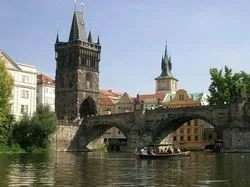
According to legend, Prague was founded in the 9th century by the Czech princess-prophetess Libuše. The name of the city comes from the word "prah" - "threshold", as there once was a ford across the Vltava River at this place. Now it divides the modern city into two parts, which are connected by eighteen bridges. The most famous of them is Charles Bridge. It was built for more than fifty years under King Charles IV, who ruled in the 14th century, and it was named in his honor. As early as the 17th century, the bridge was decorated with sculptures modeled on the Bridge of Angels in Rome. The most popular statue on the bridge is that of Saint John of Nepomuk. According to legend, he, the confessor of the royal family, refused to reveal to the king the secret of confession of the queen suspected of infidelity. For this, the steadfast priest was thrown off the bridge and later canonized. You will recognize the statue immediately - there is always a crowd of people and artists near it, from whom you can order a portrait from a photograph, and the bas-relief at the base of the statue is polished to a shine: it is believed that if you touch it with your hand and make a wish, it will certainly come true.
However, it is still better to start getting acquainted with Prague from the Old Town Square. If the concept "cozy" can be applied to a square, then the Old Town Square is exactly that: not pompous, but at the same time very solemn and beautiful. Here, on the Old Town Hall, there are the famous astronomical clock, which has become the hallmark of Prague: every hour a cute little skeleton, reminding us of the transience of existence, rings its bell, and a procession of twelve apostles appears in the window. Their procession ends with the cheerful crow of a rooster. After such an unusual spectacle, you can go up to the observation deck of the town hall: the "city of a hundred spires" will appear before you in all its glory. By the way, photographs taken from this observation deck, which are sure to also appear in your photo album, adorn the covers of many guidebooks and Czech language textbooks, because the panorama opening onto the city is truly mesmerizing.
Almost every house on the Old Town Square has its own history. In one of them, for example, was born the writer of Jewish origin Franz Kafka. In general, Jews, whose first settlements appeared here already in the 11th century, played a large role in the history and cultural life of Prague. In the area of the Old Jewish Town, which stretches not far from the Old Town Square, the oldest synagogue in all of Europe has been preserved - its oldest parts date back to the 13th century.
On the western bank of the Vltava is also one of the highest points of Prague - the Vyšehrad district. Unlike other tourist sites, it is surprisingly calm and quiet here. And a stunning view of the city leads to complete peace, which is especially beautiful at sunset: the fiery sun, reflecting in the waters of the Vltava, completes the fantastic picture. Above Vyšehrad rises the majestic Church of Saints Peter and Paul - it is worth visiting for sure. Next to it is a cemetery where famous Czech artists and scientists are buried: surprisingly, a walk through the cemetery brings true pleasure, because the sculptural groups erected over the graves are real works of art.
On the other side of the Vltava is a district called "Lesser Town". If Old Town, where the Old Town Square is located, is purely Gothic in style, then here the architecture is dominated by the Baroque style, striving for grandeur and splendor. The most important attraction of these places is the huge Church of Saint Nicholas, where Mozart himself once played.
On the same side is Prague Castle, the residence of the president of the republic, the political and historical center of the city. The most impressive of its buildings is St. Vitus Cathedral. It amazes with its size and height - a person simply cannot take it all in with one glance. Inside, Gothic architecture seems to lift you up to the sky, regardless of whether you believe in God or not. Through the huge stained glass windows, created already in the 20th century by the most celebrated Czech artists, the sun scarcely penetrates - therefore, inside the cathedral, being in a mysterious twilight, you feel both breathtaking excitement and the solemnity of everything happening.
Next to Prague Castle is the well-known Golden Lane. Long ago, alchemists lived here in small colorful houses, whom King Rudolf II settled closer to himself, so that under his supervision they would learn to produce gold literally from nothing. However, they never managed to obtain the precious metal, and the street still retains its former name - Golden Lane. Now souvenir shops are located on the lower floors of the houses, and on one of the upper floors there is a museum where knightly armor and weapons are exhibited: its long corridors seem to transport you to those distant times when crusades were held and brave knights fought for the honor of fair ladies.
In general, there are a lot of museums in Prague - there is the Alphonse Mucha Museum, the Smetana Museum, the Museum of Czech Glass, the Jewish Museum, the National Museum, and for lovers of thrills - the Torture Museum, where you can get acquainted with the torture instruments of old times. If you are traveling with children, they will most like the Puppet Museum.
Not for children, but exclusively for you - daily discos. Prague's nightlife will definitely please you. Even the trams in the city run all night. Special night routes gather tourists who are out on the town every half hour and take them from one club to another.
And, of course, what fun without beer! Even the biggest lovers of this drink admit that Czech beer is something extraordinary. Ancient brewing recipes and good, almost healing water from which it is made - these are the components of an amazing, excellent taste. You can taste beer in any restaurant in the city. Some pubs have become famous thanks to personalities who visited them. So, for example, they say that the brave soldier Schweik liked to sit in the pub U Kalicha, and in the restaurant U Zlateho tygra, Vaclav Havel and Bill Clinton met over a mug of beer. As a snack, you should definitely try the excellent tender cheese in breadcrumbs and the famous Czech dumplings.
This city is beautiful and cozy. Here you will not find the gray monotony of London and the tiresome pageantry of Paris. Prague is infinitely sweet and charming. Stroll through its narrow streets, breathe its air, sit in pubs and restaurants - and you will certainly agree with this.