
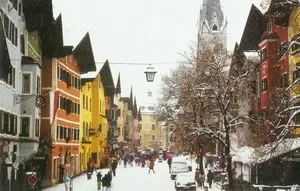
Die Kitze kommen - "The Goats Are Coming". The local residents, who adore their guardians and providers, held such a sculpture festival at the turn of the millennium, thereby increasing the already considerable population of charming cloven-hoofed animals. The free inhabitant of high-mountain pastures, the Kitz is both the coat of arms, the symbol, and the abbreviated name of Kitzbühel, the world-famous ski resort, which together with St. Anton, Lech, and Seefeld represents Austria in the elite club of the best Alpine resorts, Best of the Alps.
"In the twilight, the snow-covered town with cheerful little lights along the railway laid at the foot of the hills of Tyrol, covered with a white winter blanket, shone like a Christmas display. People, both locals and those who came to ski, all in bright, festive clothes, smiled broadly at each other, meeting on the snowy streets; on the doors and windows of the white-and-brown houses hung wreaths of pine needles, because tomorrow a new 1938 was beginning..."
Kitzbühel - and it is precisely this place, in all likelihood, that Irwin Shaw describes in the novel "The Young Lions" - was quite popular even before World War II. Although at the beginning of the last century no one here even thought about tourism. For eight centuries Kitz lived a calm, somewhat agricultural, somewhat commercial life. By the way, it is the same age as Moscow - the first mention of it dates back to 1165. In 1271, Ludwig II of Bavaria approved the city charter, in 1504 Kitzbühel became part of Tyrol... All this I am saying to the point that, arriving here today, you do not find yourself at a new ski station where there is nothing but lifts and slopes, but in a charming medieval town with a rich history.
To complete the experience, you can stay, for example, right in the center, at the Goldener Greif hotel: a 13th-century inn that now has four stars; by the way, the local casino is also located here, where gambling guests will be offered both PokerStars and roulette. Or you can stay a little further away, on a hill with a wonderful view of all of Kitz, in a genuine 15th-century castle, Schloss Lebenberg (four stars). I don't know whether there are ghosts in it, but there are definitely suites with fireplaces and enormous canopy beds, a dining hall finished in silk and wood, a winter garden, and a large relaxation center with a swimming pool, Jacuzzi, and other modern amusements - I saw them with my own eyes.
There are two dozen four-star hotels in Kitzbühel, but in my opinion, at least a third of them clearly deserve five stars. For example, Reisch, located at Franz-Reisch-Straße 3. This street is named after the man who opened a new, skiing page in the history of Kitz, and the hotel still belongs to representatives of this glorious family.
It all began in 1892, when Franz Reisch, the future mayor of Kitzbühel, got hold of a book about skiing down mountains in Norway. Impressed by what he read, and deciding that his native Kitzbühel Alps were no less suited for this pursuit, Reisch ordered some outlandish skis from the distant northern country, climbed with them up the Kitzbüheler Horn, and, with a mixed feeling of surprise and delight, rushed down, laying the first ski track in these parts.
A couple of years later, a whole batch of skis was delivered from Norway to Kitz, and the first competitions were held. The new pastime gained more and more fans, and in 1902 the Kitzbühel Ski Club (K.S.C.) was founded. Today it has four and a half thousand members - from ordinary amateurs to outstanding athletes, such as, for example, Toni Sailer, three-time Olympic champion and seven-time world champion. At one time, in the middle of the last century, according to some polls, he was the second most popular Austrian after... Mozart! He went to Hollywood, where he appeared in a good two dozen films, then returned home, opened a hotel in Kitzbühel and his own ski school. To this day he still works there - moreover, he puts the very youngest on skis. The school of the brothers Rudi and Toni Sailer is for some reason called Rote Teufel - "Red Devils", or "Little Devils". A greeting from "The Elusive Avengers"?.. But that's just by the way.
In 1928, the first lift was built on the Hahnenkamm (1668) - "Rooster's Comb". And in 1931, another milestone in the modern history of Kitzbühel - the "Hahnenkamm Races" took place for the first time. Since then, every January, these most prestigious competitions, a stage of the World Cup, gather the most star-studded field of participants. The point is that in the skiing world there are not many slopes that can compare in difficulty and unpredictability with the legendary Streif, laid on the northeastern slope of the "Rooster's Comb" - Face Bellevarde in France's Val d'Isère, the "black" slope of Lauberhorn in Switzerland's Wengen... The downhill on the Streif is literally a descent at a speed of 140 km/h. Length 3.5 km, elevation difference 860 m, incline angle up to 85%!..
If you happen to watch professional starts here, I advise you to choose a spot somewhere near a steep turn or a jump in the middle part of the slope and try to convince yourself that these guys are not fighting for their lives but simply having fun. But don't even think about repeating the same thing when the gates are removed, riding in the same style - you will most likely end up in a hospital bed. Even the parallel Familien-Streif, which has a "red" marking, requires a very careful, respectful, I would say, gentle attitude.
Generally, as one of the regulars of the local slopes aptly noted, you shouldn't fight the mountain - you should love it. Philosophy... Of course, the forbidden is all the more alluring, and there are hunters. They will find a run "blacker" and harder, and just go up and down it nonstop from morning to evening. Everyone entertains themselves as their imagination dictates. Personally, in Kitz (and not only in Kitz, but everywhere where the chairlift infrastructure allows it), I find something else far more interesting - ski-safari, multi-hour skiing journeys from valley to valley, always promising new alpine skiing impressions.
Setting off along the route of the famous Kitzbühel safari, if you do not want to lose your way and get lost in the web of cable cars and runs, follow the signs depicting a funny elephant jumping over bumps on skis.
From Kitzbühel via Hahnenkamm or from neighboring Kirchberg, we go directly up to the summit of Ehrenbachhohe (1,802). Opposite, on the northern side of Steinbergkogel (1,972), there are several interesting "black" runs, unfortunately often lacking snow. So let's not waste time - we move on to Pengelstein (1,938). Here there is a temptation to linger on the slopes of Schwarzkogel (2,030), but you should keep in mind: if you ski down to the village of Aschau, you will have to take a bus to get back, and your safari for today will be over. If you wish to continue the journey, follow the longest (7.2 km) and one of the most scenic runs in the region, the red Pengelstein-Sud.
Up - and forward, not back the way you came. Through Wurzhohe (1,739) and Barenbadkogel (1,883) - in the winter of 2002-2003 a new six-person chairlift was launched here - the elephant will lead you to Trattenbach. It is hard to deny yourself the pleasure of skiing on the slopes of Kl. Rettenstein (2,216). And again up - and forward, to Zweitausender (2,004), where instead of parallel T-bars there is now a high-speed eight-person chairlift. Traverse along wide and bright runs to Resterhohe (1,894) and finally the last descent to the Pass Thurn mountain pass. Here Tyrol ends and Salzburgerland begins. You can return to Kitzbühel by bus, or you can do part of the return route on skis. If it has not become completely dark and you still have strength left. However, I doubt it: the described route is - in a straight line, without any deviations or delays - at least 35 km and 6,000 meters of vertical, and you no longer feel your legs under you.
Such journeys work up a ravenous appetite! Fortunately, dozens of mountain restaurants lie in wait along the way, each more charming than the last - you just have to choose where to stop. Take, for example, Moscow mayor Luzhkov, while conquering the Kitzbühel slopes, reportedly liked to rest at Hahnenkamm Stuberi, taste traditional Tyrolean cheese noodles and the most delicate strudel - apple pie. The simple food, the relaxed atmosphere of a mountain hut, its hostess, the beautiful and cheerful Sisi, the very embodiment of local hospitality, so, they say, pleased the mayor that Sisi soon received a parcel from Moscow, containing a painted shawl of rare beauty...