
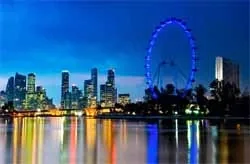
Amusement parks are also an adornment of any city
The very first amusement park is considered to be the Danish "Bakken" north of Copenhagen – it opened way back in 1583. However, to be fair, it must be said that this Danish creation had little in common with what we understand today as an "amusement park." People there played hide-and-seek and other children's games, and in the evenings watched fireworks.
Medieval Europe began to thrill its citizens with amusement parks in the early 18th century – after the first "pleasure gardens" sprang up in the suburbs of Old World capitals, featuring fountains, tightrope walkers, clowns, dancing, and, most importantly, the first attempts to build something resembling modern rides. A century later, the entertainment industry reached America. That's where the real "fun" began: widespread urbanization after the Civil War led to every town in the United States having its own streetcar company, to which local authorities presented electric bills that were wild even by today's standards. The streetcar operators, trying to make ends meet, wanted to get residents to ride not only on weekdays hurrying to work, but also on weekends, and preferably somewhere farther out of town. An unusual move was devised: all streetcar owners pooled money to build amusement parks. Hence the typical picture – these parks were located right at the terminal stations of streetcar routes and consisted of a few dance halls, a picnic area, a small restaurant, game areas where balls or darts were thrown, and several rides.
Still, the true golden age for amusement parks came after the 1893 Chicago World's Fair, where the assembled public was amazed by the first Ferris wheel, 80 meters high. And so it began... The very next year, entrepreneur Paul Boyton opened the first park in Chicago that more or less resembled modern ones. "Water slides" with an admission fee (unprecedented audacity at the time) attracting people not with outdoor barbecues but with powerful rides.
Unsurprisingly, by the end of World War I, there were two thousand amusement parks operating in the United States alone. However, the euphoria soon ended. First, the spread of private automobiles undermined the new industry (car owners preferred to relax away from mass gatherings), then the Great Depression, and finally the war. After the war, there was another surge in "park building" in Europe and the United States. In America, targeting the baby boomer generation, the world's premier park – Disneyland – opened in 1955, costing a staggering $17 million at the time. It paid off in less than a year, with more than four million visitors.
Europe tried to keep up, but more conservative views on life had their say. So initially, the parks of the Old World lagged behind their overseas counterparts in every respect. Surprisingly, the Italians made the main contribution to breaking stereotypes, having built five world-famous parks by now, including Mirabilandia, Gardaland, and Acquafan. According to the Italians, the success of the enterprise probably came from the adventurous southern temperament, constantly demanding entertainment. From the mid-1970s, the rest of Western Europe began to catch up. Great Britain, Germany, the Scandinavian countries, and the Netherlands increasingly incorporated modern technologies into existing but rather dull amusement parks. It is safe to say that from this point on, the competition among parks shifted from "we also have a park" to uniqueness, excitement, and exclusivity.
The largest and most famous park is undoubtedly the aforementioned Disneyland. By the way, several Disneylands have been built around the world, but each is far from the park in Anaheim, California, in terms of interest and relevance. The author can confidently confirm that the Parisian park "named after Walt Disney" is quite boring and uninteresting, has a rather inconvenient location, and in general, most visitors leaving it do not look very cheerful – the park really displeases many people.
A completely different story is the Dutch Efteling. Not particularly colorful on the outside, it makes up for it with amazing rides. For example, its roller coaster was long considered the longest and "scariest." After riding it, I found absolutely all similar ones from competing parks uninteresting. By the way, the world's oldest carousel, built in 1865, is located in Efteling. Originally horse-powered, after renovation in the 1970s it now runs on electricity.
In the world ranking of the scariest park, the aging Funland in Little Rock, Arizona (USA) has long held the lead. In 2002, a special prize "Laughter in the Dark" was even established there, awarded to the "scariest of the best" by veteran of funny horror Leon Cassidy, who in 1928 patented the famous dark tunnel – a ride with skeletons, moans, and a creaky car.
On the contrary, the happiest is considered to be Expoland in Osaka, Japan. It has about 40 rides, an army of clowns entertaining children every 10 meters, and unexpected water jets appearing from nowhere. True, sometimes not-so-happy events occur there. In 2005, a derailment of roller coaster cars resulted in one death and 21 injuries. However, the park's press service assured that "the work on mistakes has been done, and nothing like that will ever happen again." Given the Japanese pedantry, one readily believes this.
The fame of the most unusual and strange park belongs to Ocean Dome. It is a man-made ocean, again in the Japanese city of Miyazaki. It is the largest water park in the world, equipped with a retractable roof that allows visitors to sunbathe on sunny days. In bad weather and in the evenings, the roof closes, and the park turns on a unique lighting system with ultraviolet rays. Inside the Japanese water park there is a man-made tropical forest and a mini-volcano that erupts every hour.
But the gloomiest amusement park is in Lithuania. Grutas Park reminds of the most tragic period in Soviet history. Huge sculptures of Joseph Stalin and Red Army soldiers coexist here with a zoo and a playground. The park is surrounded by a moat with watchtowers, turning it into an eerie illusion of the Gulag.