
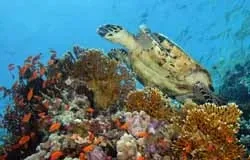
The Red Sea is unique: firstly, it is the warmest (the average water temperature in Egypt in February is +21°C, in August +27°C), and secondly, the cleanest. Perhaps that is why divers from all over the world have chosen the Red Sea. The diving service infrastructure there is excellently developed, but most importantly, nowhere else is there such a rich underwater world. The south of the Red Sea is literally teeming with life: stingrays swim by, starfish crawl along, and the amazed gaze of a diver encounters the round pufferfish or the Napoleon fish – a huge creature with a head resembling an emperor's hat. The coral settlement of the seabed is stunningly beautiful: it is a real city with 'houses' for a wide variety of creatures, from bacteria to the devil fish, and a fifth of all inhabitants live only in these waters and nowhere else in the world. And the north of the Red Sea surprises with a large number of sunken ships, among which sometimes there are huge vessels that sank during recent wars or after collisions with underwater reefs.
BY THE WAY If you are going on a diving tour not only to admire the beauties of the Red Sea, but also to capture the mesmerizing underwater world, you will need special equipment. So, both amateurs and professional photographers may need a universal underwater camera housing, which can be found in an online store. Moreover, the company Ewa-Marine – a manufacturer of such equipment – is famous not only for its German quality, but also for its versatility: an underwater camera housing can be selected for almost any camera.
And if there is a place on the coast of the Red Sea where all the listed beauties are combined with quite affordable prices, it is Egypt, which has already been fairly well explored by our compatriots. You can obtain an international certificate either at home or in Egypt. Training at a local school will be cheaper, and at the resort you don't have to waste precious time and money on training, splashing around in a pool and studying boring theory. The main thing is that after the course, you are given a certificate; otherwise, upon arrival you will have to do certification dives in 'open water,' which are also not free.
The advantages of training in Egypt are that you can complete it with one instructor. However, not all diving centers have Russian-speaking instructors. That said, the average cost of diving courses in Egypt, including equipment, is as follows: the most basic PADI Scuba Diver course (duration 2-3 days, 2 open water dives) costs about $200. PADI Open Water (4-5-day courses with theoretical classes and practical exercises, and 4 dives) costs $270-350. PADI Advanced Open Water (2-3 days, 5 dives, underwater navigation) costs $225. And you need to pay another $30 for the certificate itself.
To decide which diving tour to choose, you need to know that there are two main directions in dive tourism: dive safari and daily diving.
Dive Safari – when you spend a whole week on a yacht at sea with unlimited dives at any time of day or night. The daily routine is usually: wake up at 5 am, light breakfast, dive. A hearty breakfast, move to the next reef, and dive again. Lunch, and then dive again... And so on from three days to a week. Four days of safari cost approximately $375-400, including meals.
Daily Diving is the most common type of vacation. You stay at a hotel and go diving every day. Here it is possible to rent any equipment, do additional and night dives, and go on long trips. Egypt is good because both beginner divers and real fans and 'multi-star' professionals can find entertainment there.
Hurghada
On the northeastern coast of Egypt is the largest resort of the Red Sea - Hurghada, where the number of diving instructors per capita is the largest in the world. But above all, Hurghada is the optimal place for a first dive at sea. There are over forty dive sites, more than a hundred dive centers, and with bargaining skills, you can find very inexpensive courses. However, experienced divers are quite skeptical about Hurghada: you need to go out to sea as early as possible, because around each diving attraction by noon up to 200 divers gather, and movement underwater becomes as intense as in a metropolitan subway during rush hour.
Reefs worth seeing are located in Hurghada between the Laguna and Aqua Fun hotels, and near the Coral Beach hotel, which is a 20-minute drive from Hurghada. For boat divers, the most interesting is Careless Reef, rich in the flora and fauna of the Red Sea, and sometimes you can even spot a grey reef shark. It is hard to understand why this reef is called 'Careless': two treacherous rocks stick out of the water here, which have been the site of several shipwrecks. A little to the north is Um Kamar Reef, interesting for its caves and black corals. Near Small Gifton Island, along a high coral wall, you can often see large Napoleon fish. In the northeastern part of the island, at a vertical reef wall at a depth of 35 meters, there is a large cave, the two entrances of which are adorned with fan-shaped gorgonians.
The Abu Ramada reefs are a fantastic underwater landscape of vertical cliffs overgrown with corals, with depths of 12-18 meters. These reefs are quite suitable for beginner divers. Abu Nuhas Reef is the most interesting site near Shadwan Island northeast of Hurghada. It is a flat plateau more than a kilometer wide, located at a depth of about half a meter. For a long time there was no lighthouse here, so at the bottom at the foot of the reef lie four sunken ships - a real paradise for wreck divers, those who love to explore the holds of sunken vessels. Petra Reef is known as an ideal place for underwater photography. The depth here is shallow, the water is crystal clear, and the underwater landscape is unusually picturesque. In these places you can even find artists with scuba gear who paint underwater landscapes with special paints.
For those who do not want to go far from Hurghada but also dislike crowds, we suggest a trip to Safaga, a resort town 50 kilometers south of the popular tourist center. Close to the town is Safaga Island, an island surrounded by a coral reef. Here you will find clean, semi-empty beaches, extensive reef plateaus, and breathtaking underwater views. Near Safaga, in December 1991, the thousand-ton ferry Salem Express sank while carrying pilgrims returning from Saudi Arabia. 510 people died in this disaster. The Salem Express still lies at the southern end of Hyndman Reef at a depth of about 20 meters. And those who prefer to stay away from ships can dive near Panorama Reef, 20 kilometers east of Safaga. Actually, it is several reefs arranged like an amphitheater. And you can become a spectator of a daily show put on by the inhabitants of these depths: butterflyfish, clownfish, parrotfish, sharks, barracudas, moray eels, and giant rays.
The average cost of a dive in Hurghada is $50 for 2 dives per day, a 3-day package with 6 dives will cost about $135, and a 5-day package - $225. A private instructor costs about $100 per day.
Sharm el-Sheikh
In Sharm el-Sheikh there are three times fewer dive centers than in Hurghada, prices are slightly higher, and the vacation usually receives no complaints regarding organization and quality of service. But the main difference between Sharm el-Sheikh and Hurghada is the proximity of coral reefs. Here you don't need to go out to sea on a yacht, boat, or catamaran, as coral thickets in many places start almost right from the shore. Moreover, not far from Sharm el-Sheikh is one of the most beautiful Red Sea reserves, Ras Mohammed.
Ras Mohammed is the first marine national park in Egypt, founded in 1989. It is located 25 kilometers southwest of Sharm el-Sheikh, easily accessible by car or taxi. The park has many geological features: coral reefs, alluvial plateaus, and dry riverbeds. Along the coast of Ras Mohammed there are places offering exceptionally beautiful dives. For example, the so-called Mushroom - a large coral pillar with shipwreck debris nearby. The underwater landscapes of this area transition from flat plateaus to vertical cliffs. One of the most attractive sites is at Shark Reef. At its southern part lies the Yolanda, a 70-meter Cypriot cargo ship that sank during a storm in 1980. The cargo holds of the ship contain an unsold batch of plumbing fixtures and BMW-320 cars, and divers are amused, for example, by toilets standing on the flat area of the reef.
But a special dive adventure in Ras Mohammed is the exploration of the sunken ship Thistlegorm. In September 1941, this ship set off on its final voyage from Glasgow with a cargo of military equipment and ammunition for the needs of the British Army fighting in North Africa. The ship was attacked by a German bomber and sank. The location of the ship was discovered by Jacques-Yves Cousteau in the mid-1950s. In subsequent years, many divers unsuccessfully tried to follow his path, but it was only achieved in the early 1990s. This is a real underwater museum of military equipment: cannons, airplanes, motorcycles, small arms. On the port side of the Thistlegorm lies a steam locomotive, and nearby - dozens of motorcycles, cars, trucks. Some still have windows, but the steering wheels have been taken by divers as souvenirs.
And finally, experienced divers come to Sharm el-Sheikh to go from there to Dahab (100 km north). Until recently, Dahab was a Bedouin village, but today it is a destination for extreme divers from all over the world. What attracts them above all is the Blue Hole, a nearly vertical well several meters wide that goes deep into the coastal reef. This place is frightening and unlucky; few manage to successfully pass through the Blue Hole and emerge into the open sea on the other side. They say that down there is a real graveyard...
A dive day in Ras Mohammed costs about $60. Exploring the sunken ship with two dives - from $115, a 3-day package with 6 dives - from $150.
Marsa Alam
Marsa Alam is for lovers of calm swimming. This resort is located on the Red Sea, 240 km south of Hurghada, and its main attraction is the coral coast. Here the water is crystal clear, the underwater flora and fauna are rich, and the depth is suitable for divers of any level of professional training. Particularly popular is Dolphins House, a huge horseshoe-shaped reef where particularly lucky divers can encounter a pod of dolphins. There are several good reefs here: Marsa Alam, full of lionfish and where crocodile fish are found; Abu Dabbab Reef, where coral pillars rise to the surface; Elphistoune Reef is considered the pearl of the safari: its walls are completely covered with various corals, among which groupers, butterflyfish, and parrotfish dart about; and Zabargad Reef is interesting for night diving enthusiasts, where you can see unique emerald-colored corals, crocodile fish, and octopuses.
Brothers Islands
And finally, elite diving for very experienced professionals and quite wealthy travelers takes place on the Brothers Islands. Those who hate swimming among crowds of divers come here and are ready to sail a yacht hundreds of kilometers away from civilization for the sake of this. To go where the fish are not yet frightened by humans, where you can encounter rare marine life.
The Brothers Islands, or as locals call them, El-Akhawayn, are located six hours south of Hurghada. They are of volcanic origin and consist of two massive vertical pillars. On Big Brothers, the larger of the islands, there is a lighthouse built during the British colonial era. Right at the surface begin coral gardens of extraordinary beauty. The fauna is incredibly diverse, with surgeonfish, unicornfish, and snappers. Divers come here to see sharks: grey reef sharks, hammerhead sharks, tiger sharks, and even oceanic whitetip sharks, secretly dreaming of seeing majestic whale sharks, which only a few lucky ones have managed. And near the northwestern wall of the reef lies the large military transport ship 'Aida', which sank in 1957.
The Egyptian government allowed diving at the islands quite recently, so this underwater preserve remains to this day one of the most untouched places in the Red Sea. But not everyone can dive here: there are a number of restrictions for visiting. That is why only wealthy divers who can charter a five-star yacht can get there.
So, take a deep breath and dive in. Just don't try to take away some of these underwater treasures by breaking off a piece of coral as a souvenir. Firstly, coral taken out of water loses its color within a few minutes. Secondly, it smells very bad. And thirdly, if the customs officers catch you, the fine can reach up to $1,000.
_