
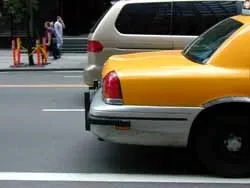
New York is preparing to celebrate the 100th anniversary of the taxi
The image of a yellow taxi is dear and close to every New York resident. Perhaps that is why the authors of one of the projects for organizing the upcoming festivities invited those interested to participate in creating a 'vernissage on wheels'. Recently, a kind of studio was opened in a hotel hall, where anyone can try their hand as an artist. Passenger-artists will be provided with paints of six colors. Then taxi company owners will be able to choose the pictures they like, which will then be placed on the cars during the anniversary days. The stickers can be seen on New York taxis until the end of the year.
In the coming years, Cyprus will not join the Schengen area
Cyprus's accession to the Schengen zone is impossible until 2010 'for political and technical reasons'. This was stated by Foreign Minister Georgios Lillikas.
Participating countries of the Schengen zone are required to maintain strict control over land, air, and sea. The Schengen Agreement abolishes checks at internal borders and creates a single external border where immigration checks are carried out according to a single set of rules. New EU member states can join the Schengen zone if they pass an assessment proving they meet the necessary criteria, reports the Cyprus Herald.
However, Cyprus has special problems related to the division of the island. Nicosia will be obliged to strictly control movement across the 'Green Line' and at checkpoints. 'On the one hand, we are trying to establish contact with Turkish Cypriots, on the other hand, strict checks related to the Schengen Agreement will create significant inconveniences for them,' the minister said. Another problem is the British bases, which, according to Cyprus's EU accession treaty, are not territory of the European Union.
As for infrastructure, a critical assessment of the country's airports will be conducted in 2009. According to the Schengen Agreement, airports must have separate entrances and exits for those arriving from Schengen zone countries and for everyone else. In the minister's opinion, this is impossible to do in Cyprus's current airports.
Total surveillance of passengers to begin on airplanes
British and German scientists involved in the Onboard Threat Detection System project, within which inventions are being created to prevent terrorist attacks on airplanes, have announced the creation of special video cameras that will be built into the backs of aircraft seats. With their help, it will be possible to notice suspicious passenger behavior and timely warn the crew and ground services of possible danger.
The OTDS project staff decided not to stop at visual observation alone and plan to equip seats with microphones to record passenger conversations. At the same time, project participants emphasize that with such surveillance methods, they will not have to worry about privacy, as all video and audio recordings will be destroyed immediately after the flight.
Presumably, a special software will determine the degree of danger of passenger behavior, capable of distinguishing a terrorist from an ordinary passenger who is afraid of flying. The commissioning of such a system will be the first stage of equipping European aircraft with new devices to prevent possible terrorist attacks. Thus, Europeans plan to equip pilot cabins with sensors capable of detecting explosives. True, it is still unknown when all these achievements of progress will appear on airplanes.
Every sixth European is below the poverty line
In the European Union, almost every sixth citizen (16% of the population) is below the poverty line, according to the European Commission's 2006 report on social protection. At the same time, every fifth child (under 18) lives below the poverty line, the authors of the document emphasize.
European experts explain the latter fact by the fact that most children come from families of immigrants from the African continent and Middle Eastern countries. They make up a significant mass of poor EU citizens.
The poverty threshold varies in each EU member state: it is set at 60% of the country's average salary. According to such calculations, the highest number of poor is in Lithuania and Poland - 21%. The lowest is in the Czech Republic and Sweden, where the poor make up only 9-10% of the population.
But many simply do not want to improve their situation: in rich EU countries, so-called 'voluntary unemployment' flourishes. In Belgium, for example, 20% of the unemployed only pretend to try to find a job – social benefits are enough to cover their expenses. Only 10% of able-bodied Europeans live in families without any working person. The highest number of such is in Poland and Belgium – 13%, the lowest (5%) in Luxembourg, Slovenia, and Cyprus.
If we take the parameter called 'purchasing power of Europeans', the richest region is London, where the figure reaches 305% of the EU average. The poorest is Romania with 24%.
The world's first kibbutz renounced communism
Residents of the world's first kibbutz, Degania, founded in 1910 at the confluence of the Sea of Galilee and the Jordan River, decided to abandon the communist principle of distributing material assets and privatize property.
As The Guardian reports, this decision was made by a general vote. Moreover, over the course of the year, 320 residents of the kibbutz had already been receiving salaries according to the work they performed. Previously, all earned money was communal – part of it went to pay utility bills, and the other part was distributed among community members according to family size. After privatization, residents will individually pay for electricity and water, as well as remit income tax to support the economy. The free cafeteria and free use of kibbutz transport will become a thing of the past.
Each resident of Degania has already been paying their own utility bills for several years, as it turns out to be cheaper. In addition, many members of the kibbutz have long stopped working at the community's joint enterprises and have moved to cities, where they run businesses or work in government service. In Degania, they grow avocados, bananas, and dates, and there is a dairy farm and a small production workshop. The kibbutz is known for being the birthplace of Israeli politician and military leader Moshe Dayan, who at various times headed the ministries of agriculture and finance, as well as served as Chief of Staff of the Israel Defense Forces.
As the newspaper notes, the privatization of Degania reflects the general process of changes taking place in Jewish communes. Currently, there are 268 kibbutzim in Israel, home to 117,000 people. Nearly two-thirds of these settlements have already been privatized. Moreover, most sites employ hired workers – often immigrants from Thailand.
Latvia wants to make its language fashionable
The Latvian State Language Agency has launched a program aimed at popularizing the Latvian language outside the republic, reports AFP.
As project director Inita Vitola stated, there is growing interest worldwide in national languages: proficiency in one of the world's languages is taken for granted, but it is precisely knowledge of the national language, according to Vitola, that is a distinguishing feature of a modern intellectual.
About $100,000 is planned to be allocated for the program. Interest has already been shown by Germany, Austria, Norway, Sweden, the United States, and other countries.