
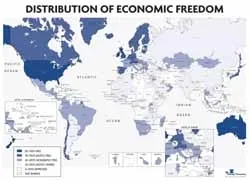
Economic Freedom: Ukraine ranks 125th
In the traditional economic freedom index, compiled by experts at the Heritage Foundation, Ukraine ranked 125th out of 161. Analysts rated Ukraine's business freedom at 60.9 points out of a possible 100.
The global leader was Hong Kong with 89.3 points. Second place went to Singapore (85.7 points), and third to Australia (82.7 points). The top ten continues as follows: USA (82 points), New Zealand (81.6 points), United Kingdom (81.6 points), Ireland (81.3 points), Luxembourg (79.3 points), Switzerland (79.1 points), and Canada (78.7 points).
Ukraine was surpassed in the economic freedom ranking by many post-Soviet countries. Specifically, Estonia ranked 12th, Lithuania 22nd, and Armenia 32nd. Georgia placed 35th, Kazakhstan 75th, Kyrgyzstan 79th, Moldova 81st, and Russia 120th.
The last places in the ranking were taken by Cuba and North Korea. Heritage Foundation experts were unable to assess Congo, Iraq, Serbia, and Sudan for various reasons.
The ranking is traditionally based on ten categories concerning economic, trade, and fiscal freedoms, as well as the degree of government intervention in the economy.
Euro surpasses US dollar in global circulation
Five years after its introduction, the single European currency has overtaken the US dollar in terms of cash circulation worldwide.
According to the British newspaper The Financial Times, the total value of euro banknotes now stands at €610 billion, equivalent to $800 billion at the current exchange rate. Meanwhile, based on October data from the European Central Bank (ECB) and the US Federal Reserve, the comparable figure for the dollar was $759 billion. The Financial Times statistics include reserves of private monetary institutions, excluding cash holdings of national banks. This year, the euro's exchange rate against the dollar has risen and set records.
Slovenians earn more than their neighbors
The average salary in Slovenia remains the highest among the other five republics of the former Yugoslavia: last year it exceeded $1,000 per month. Citizens of Macedonia earn the least, around $240.
These data are reported by the Belgrade newspaper Politika in an analytical article comparing incomes of residents of the former Yugoslav republics, as well as Bulgaria and Romania. According to the publication, in Serbia, Montenegro, Bosnia and Herzegovina, monthly salaries are roughly similar, ranging from $300 to $340, while in Croatia it is nearly $700.
As Politika notes, the most lucrative professions in the richest republic of the former SFRY are judge, lawyer, architect, programmer, and truck driver. However, the highest earners (up to $3,000 monthly) are specialists in the most developed industrial sector—pharmaceuticals.
In Serbia, the highest incomes are recorded in the tobacco industry, around $1,000. In Bulgaria and Romania, which joined the European Union on January 1, 2007, the average monthly salary is $500 and $640 respectively.
Italy will not deport immigrants to countries with the death penalty
The Italian cabinet has adopted a directive banning the deportation of illegal immigrants to countries where torture and the death penalty are used.
Official Rome is strongly opposed to the death penalty. As soon as Italy began its two-year term as a non-permanent member of the UN Security Council earlier this year, its ambassador to the UN, Marcello Spatafora, submitted a proposal from the Italian government for a universal moratorium on the death penalty for the Council's consideration.
Slovenia's national currency withdrawn from circulation
In Slovenia, the two-week period of parallel circulation of two currencies—the Slovenian tolar and the euro—ended last Sunday. Thus, the country is fully transitioning to the common European currency, which was introduced into circulation on January 1, 2007.
Metal tolar coins will be exchanged for euros free of charge at exchange offices, savings banks, and post offices until March 1, after which the exchange can only be done at state banks with a commission fee. This process will continue for another ten years. There is no time limit for exchanging banknotes.
The tolar was Slovenia's national currency since 1991, when this former Yugoslav republic was the first to secede from the SFRY. The transition to the euro in this European country with a population of two million did not occur in stages, as in many other states, but through a "big bang" approach.
Compensation memo misleads airline passengers
The European Union Ombudsman, Nikiforos Diamandouros, has called for changes to misleading information provided to airline passengers regarding compensation in the event of flight delays or cancellations, or being denied boarding.
Currently, tourists get the false impression that they are entitled to compensation in all cases, regardless of the reasons for delays. However, airlines are not obliged to pay, for example, if the flight was canceled due to force majeure, or if passengers were notified of the cancellation more than two weeks in advance. These and other amendments are expected to be incorporated into the EU's published passenger memos this year.
British Airways to pay new surcharge on behalf of passengers
British Airways has decided to cover the increase in the environmental surcharge effective February 1 for passengers who purchased tickets before the increase was announced. The surcharge was raised by £5 on European routes and £20 on long-haul routes. The surcharge, now reaching £80 for a long-haul flight in business class, has sparked a wave of discontent among airlines and their passengers.
Passengers of most other airlines (Ryanair, easyJet, Flybe, Virgin Atlantic, Monarch and Air Southwest) will have to pay the fee themselves – they were sent relevant notifications by email with a promise to deny boarding in case of non-payment. Moreover, easyJet even set a deadline of January 15 for payment. The need to pay extra money applies to those passengers who bought a ticket before December 6 for a flight from the UK in February or later. Airlines bmi and Thomas Cook have not yet decided whether they will pay the new levy themselves or pass it on to passengers.
More and more tourists visit the UK and the Netherlands
The UK Statistics Bureau published data on the number of tourists who visited the country in the three autumn months. In September-November 2006, the number of tourists increased to 8.1 million, exceeding figures for the same period in 2005 by 7%. Travelers left £3.9 billion in the country. At the same time, the number of Britons visiting other countries last autumn was 16.7 million, spending £8.1 billion.
9% more foreign tourists visited the Netherlands last year as well. According to the Dutch Tourism Board (NBTC), the number of visitors to the country in 2006 was 10.9 million. In the new year, the board forecasts further growth in tourist flow. The NBTC attributes the successes of the inbound tourism industry to successful advertising campaigns. However, the number of Dutch people spending holidays abroad slightly decreased in 2006. But according to forecasts, their number should also grow by about 2% this year, reaching 35 million.
EU bans import of wild birds
The heads of veterinary services of EU member states at a meeting in Brussels unanimously supported the decision to ban the import of wild birds into Europe.
According to The Times, the ban covers parrots and about three thousand other species of wild birds. The reason was growing concerns over the possibility of a bird flu epidemic in the EU. In addition, the measures are aimed at preserving rare bird species that are often caught for subsequent sale.
The decision of the EU veterinary services was enthusiastically received by representatives of wild bird conservation and animal rights groups. According to Graham Wynne, spokesman for the UK's Royal Society for the Protection of Birds (RSPB), the EU has taken a big step in the conservation of wild birds. According to RSPB experts, about one million rare birds are caught worldwide each year, the majority (87%) of which are then sold to EU countries. In addition to rare birds, another four million wild birds are caught annually and sold around the world. Almost 60% of them die before being purchased.
Meanwhile, a number of countries such as the USA, Australia and New Zealand will be able to continue supplying wild birds to the EU, provided that the birds are bred in captivity and not caught. Importers must provide documents proving that the birds are not infected with bird flu and Newcastle disease. In addition, all birds must be ringed. A microchip containing individual information will be inserted into the ring. Upon arrival in the EU, the birds will be placed in quarantine for 30 days.