
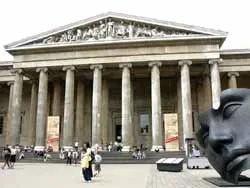
Foreign tourists bring British museums £350 million a year
Every year, museums in the UK contribute £1.5 billion (about $3 billion) to the country's economy. According to The Guardian, experts say that £350 million per year comes from foreign tourists alone. Additionally, 43% of Britons visited at least one museum in 2005. In recent years, attendance at museums outside London has grown significantly, experts note. For example, visitor numbers at Liverpool's museums have doubled over seven years. There are 1,848 museums in the UK, seven of which are among the top ten major attractions in the country.
France managed to deport 24,000 illegal migrants in a year
By the end of 2006, France had deported 24,000 illegal migrants. This figure was provided at a press conference by French Interior Minister Nicolas Sarkozy. According to him, thanks to the government's efforts to bring order to immigration, the number of deported illegal migrants doubled from 10,000 to 20,000 between 2002 and 2005.
"In 2006, the number of deportees will reach 24,000," said the interior minister, adding that this applies only to metropolitan France. As for its overseas departments and territories, by the end of this year the number of deported illegal migrants there should exceed 22,000.
Given the severity of the problem, Sarkozy spoke in favor of creating a minister for immigration affairs in the French government. He also proposed the idea of developing an international treaty on immigration and establishing a World Agency for Migration.
New system for obtaining residence permits launched in Italy
A new system for issuing residence permits to foreign citizens has come into effect in Italy. According to a note distributed by the Italian Interior Ministry, from now on those wishing to obtain a residence permit will no longer have to stand in lines for days at the entrance to the questura (police station responsible for issuing documents). Application forms will be available at post offices, which in large cities are in every district, and in the provinces in almost every village, whereas questure are very few in number.
As noted in the document, after submitting the completed forms at the post office, the applicant will receive a notification letter informing them of the appointment time at the police station. They will have to go there to provide a photo and fingerprints and palm prints of both hands (without which a residence permit cannot be obtained), and a second time to pick up the finished document, which will no longer be an A4 sheet of paper but a magnetic card containing all the necessary data. However, the cost of the process will increase fivefold: previously, a stamp duty of €14.62 was charged for issuing a residence permit; now the applicant will have to pay for postal operations (?30) and for issuing the electronic document (?27.50) — a total of €76.62.
Before introducing the new system, the Interior Ministry tested it in six cities with large foreign populations. Going forward, Interior Minister Giuliano Amato plans to extend the maximum validity period of a residence permit — currently, it is issued for no more than two years. The minister believes that residence permits should be issued for five years.
Croatia may become an EU member by the end of 2009
European Parliament President Josep Borrell said Croatia could join the European Union at the end of 2009. "It would be reasonable at the end of 2009," Borrell said at a press conference after a meeting in Brussels with participants of the EU summit being held there.
At the same time, the European Parliament president did not rule out that Croatia's accession to the EU could occur later than the date he mentioned. "No further EU enlargement should take place until the organization's institutional reform is completed," Borrell believes. In his opinion, the enlargement process cannot be accelerated while the integration process is stalled. Borrell considers it necessary to implement at least 20 different reforms so that the EU "can function effectively" with 27 member states. "It's not about saying 'no' to future EU enlargement. The European Parliament believes, in particular, that commitments regarding the Western Balkans must be fulfilled," Borrell said.
In his view, for the EU constitution to be ratified by all 25 countries of this regional organization, it must be partially revised. "The main thing is that the content of the document does not stray too far from the agreements it contains," the parliamentarian noted.
EU leaders declared a pause in the ratification process of the European constitution after a majority of participants in national referendums in France and the Netherlands refused to approve it. Speaking about the decision of EU foreign ministers to partially freeze accession negotiations with Turkey, Borrell called it a logical consequence of Turkey's failure to implement the protocol extending the EU-Turkey customs union to ten new members, including the Republic of Cyprus. At the same time, Borrell expressed hope that the German leadership, which will take over the EU presidency on January 1, 2007, "will be able to overcome this difficulty."
Europeans confused by the euro
Despite the fact that on January 1, 2007, it will be five years since the euro banknotes and coins entered circulation in 12 EU countries, not all EU residents have yet become accustomed to the new common European currency.
As shown by a Eurobarometer survey conducted in September of this year, 41% of citizens of the countries that first switched to the euro still experience 'some or significant' difficulties in using the euro. According to the study, the euro has 'taken root' best in Ireland and Luxembourg, where 81% and 77% of respondents said that using the euro causes them no difficulties. Residents of Italy and France have become less accustomed to the euro. There, only 45% and 51% respectively reported no difficulties. And about a third of Germans and Austrians still continue to confuse euro coins.
40% of Europeans habitually convert euros into their former national currency to assess the significance of a large purchase. Meanwhile, when making small purchases, Europeans have become quite accustomed to using the euro: only 22% of respondents admitted that they mentally convert euros into the old currency when making everyday purchases.
It is noteworthy that in the first years after the introduction of the euro, the population of European countries adapted quite quickly to the new currency: in 2003, 51% of respondents said they had no difficulties using it. Now, however, as experts note, the pace of adaptation has slowed significantly, and the share of the population for whom the euro remains a foreign currency remains virtually unchanged.
Latvia to ban smoking in public from 2008
The Latvian government has approved a bill banning smoking in all public places from 2008, the parliament's press service reported.
According to the bill, smoking will be banned on streets, in parks and squares, on staircases and in entrances of apartment buildings. Currently, Latvia already has a ban on smoking in educational institutions, in cafes and bars (except for specially designated areas), at public events, and near government institutions.
As noted in the press service, the Latvian Ministry of Health developed these bans as part of the European anti-smoking program. Similar bans have recently come into force in other European Union countries.
European Parliament approves unified driving licenses
The European Parliament has approved an EU directive providing for the issuance of standardized driving licenses in member states from 2013. According to the directive, EU countries must make necessary changes to national legislation by 2010, and by 2033 there should be no paper driving licenses left in EU countries.
Some EU member states, including Germany and Austria, opposed the transition schedule proposed by the European Commission for unified driving licenses. Berlin and Vienna agreed to approve the EU directive only after the exchange period for current licenses to new ones was extended to 15 years.
Pan-European driving licenses will be a plastic card with a microchip containing driver data. New licenses must be exchanged every ten years, but retaking the driving test and road rules exam will not be required.
Unified EU licenses are also being introduced for bus and truck drivers, but they will be valid for only five years. During the transition period, both new and current driving licenses will be in use. Currently, there are over one hundred types of driving licenses in the EU, which differ both in design and validity period.