
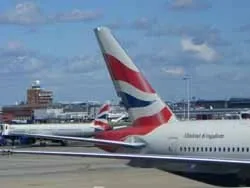
British Airways reduces flights to London
At the end of October, British Airways switched to a winter schedule, canceling its flights from Kyiv (Boryspil) to London (Gatwick), leaving only flights from Kyiv to London Heathrow Airport. This was announced by the airline's commercial director Nataliya Martynenko.
Flights from Kyiv to London (Heathrow) will continue to operate daily, but one hour earlier – at 14:15. Flights to Gatwick airport on Mondays, Wednesdays and Fridays have been suspended because 'a more profitable route was found that will bring the company more profit.' Nataliya Martynenko noted that the cancellation of flights to Gatwick freed up three flights. British Airways is considering using them for Odesa and Donetsk. The opening of these routes will be possible 'if the company feels that these flights can be fully booked.'
Recall that British Airways has been operating flights on the Kyiv-London route in Ukraine since 1996. Flights to Gatwick began in March 2006.
European Union and Ukraine to simplify visa regime
Ukraine and the European Union have initialed two agreements: on readmission and on simplifying the visa regime. After the Ukraine-EU summit in Helsinki, the agreements were signed by Ukrainian Foreign Minister Borys Tarasyuk and EU Commissioner for External Relations and European Neighborhood Policy Benita Ferrero-Waldner.
Earlier, the head of Ukraine's foreign policy department said that the entry into force of the readmission agreement would be delayed for two years. In addition, according to the Foreign Ministry, Ukraine and the EU have tentatively agreed that the readmission conditions will apply only to those citizens who clearly passed through Ukraine's territory. The EU also assumed official obligations to provide financial assistance for the establishment of temporary accommodation for such citizens and, possibly, for their transfer to the countries from which these citizens came to the EU.
Key provisions of the visa regime agreement include, in particular, simplifying the issuance of long-term single-entry visas to certain categories of Ukrainian citizens (journalists, students, businessmen), as well as improving the quality of services provided to Ukrainian citizens at foreign embassies.
Belgium to partially open labor market for Bulgaria and Romania
The Belgian government intends to partially open the national labor market to citizens of Bulgaria and Romania. According to local media, Belgian authorities intend to apply the same approach to representatives of these two states, which will become EU members in January 2007, as to those from other new countries: Slovenia, Czech Republic, Slovakia, Hungary, Poland, Estonia, Latvia and Lithuania, which joined the EU in May 2004.
Citizens of these states have been able to find work in Belgium since 2006, but only in areas where there is a shortage of skilled labor.
So far, only three of the 15 old EU member states (UK, Ireland, and Sweden) have fully opened their borders to labor migrants from ten Central and Eastern European countries, excluding Cyprus and Malta, which also joined the EU in 2004. Austria, Germany, Italy, Denmark, and the Netherlands keep their labor markets closed. The remaining 'veteran' EU states protect their jobs with various restrictions that will remain in place until 2011.
The European Commission regrets the intention of some old EU member states, primarily the UK, to close national labor markets to workers from Bulgaria and Romania. 'We regret such intentions. The Commission's position is to ensure free movement of labor within the EU,' said European Commission representative Katharina von Schnurbein in Brussels. According to her, the Commission expects official statements by the end of this year from 'veteran' EU states about their readiness to open access to workers from Bulgaria and Romania.
Turkish citizens do not want to join the European Union
A sharp decline in pro-European sentiment has been recorded in Turkey. If last year 57.4% of local citizens supported joining the European Union, now only 32.2% support the idea, according to the results of a sociological survey conducted in 32 of Turkey's 81 provinces.
The survey data was published by the newspaper Milliyet. 'The number of opponents of European integration has sharply increased in Turkey. The percentage of locals who say the country should under no circumstances join the EU rose to 25.6% in 2006. For comparison, in 2002, 17.9% were against Turkey's EU accession,' the publication notes.
The European Union, which Turkey is seeking to join as a full member, demands accelerated reforms, particularly concerning the democratization of domestic legislation, protection of human rights, freedom of speech, and resolution of the Cyprus issue. Official negotiations on Turkey's EU accession began on October 4, 2005.
Over the year, according to sociologists, the number of Euro-pessimists in Turkey has almost doubled. 'Currently, 33.3% of respondents say they don't care whether their country enters the EU or not. A year ago, 18.2% expressed the same opinion,' the survey data shows. The study also revealed that the majority of Turks do not trust the European Union – 78.1% of respondents. Meanwhile, 76.5% of respondents believe that the EU will toughen the conditions for Turkey's integration.
Another interesting result of the survey is that the majority of Turks do not believe in the friendship of neighboring countries. 'The survey showed that the Turkish people do not believe in the friendship of countries neighboring Turkey. Most of them are convinced that, above all, European countries are not friends of Turkey.'
A poll conducted in Turkey largely reflects Europeans' attitudes towards that country. According to the latest sociological surveys, a majority of residents of EU member states do not want Turkey to join the European Union. Currently, about 35% of respondents support it. According to Western experts, Turkey's EU integration process could take 15-20 years.
Tourists were not scared off by the riots in Hungary
The unrest in Budapest, which had subsided a month ago, flared up with renewed vigor last week - Hungarians 'marked' the 50th anniversary of the uprising with new riots. On the bridges over the Danube and on Kossuth Square, rioters built barricades, and several protesters even managed to hijack a Soviet tank that had been put on display for the anniversary. Between 40 and 70 people were injured in the unrest. Dozens of rioters were detained.
Despite recent events, experts are confident that the flow of tourists to the country will not decrease. At the peak of the unrest in the Hungarian capital, the number of tour cancellations was insignificant, and the total number of bookings even exceeded last year's autumn figures. Experts believe that there will be no more outbreaks of unrest.